Meta launches Muse Spark 1.1: competitive with GPT-5.5 and Opus 4.8 on multiple agent evaluations
- Meta Superintelligence Labs ships Muse Spark 1.1 for agentic work; Meta Model API enters public preview; Thinking mode lands in Meta AI / meta.ai.
- Feature spine: main agent + parallel subagents, 1M-token active context, desktop/browser/mobile computer use, coding, multimodal action.
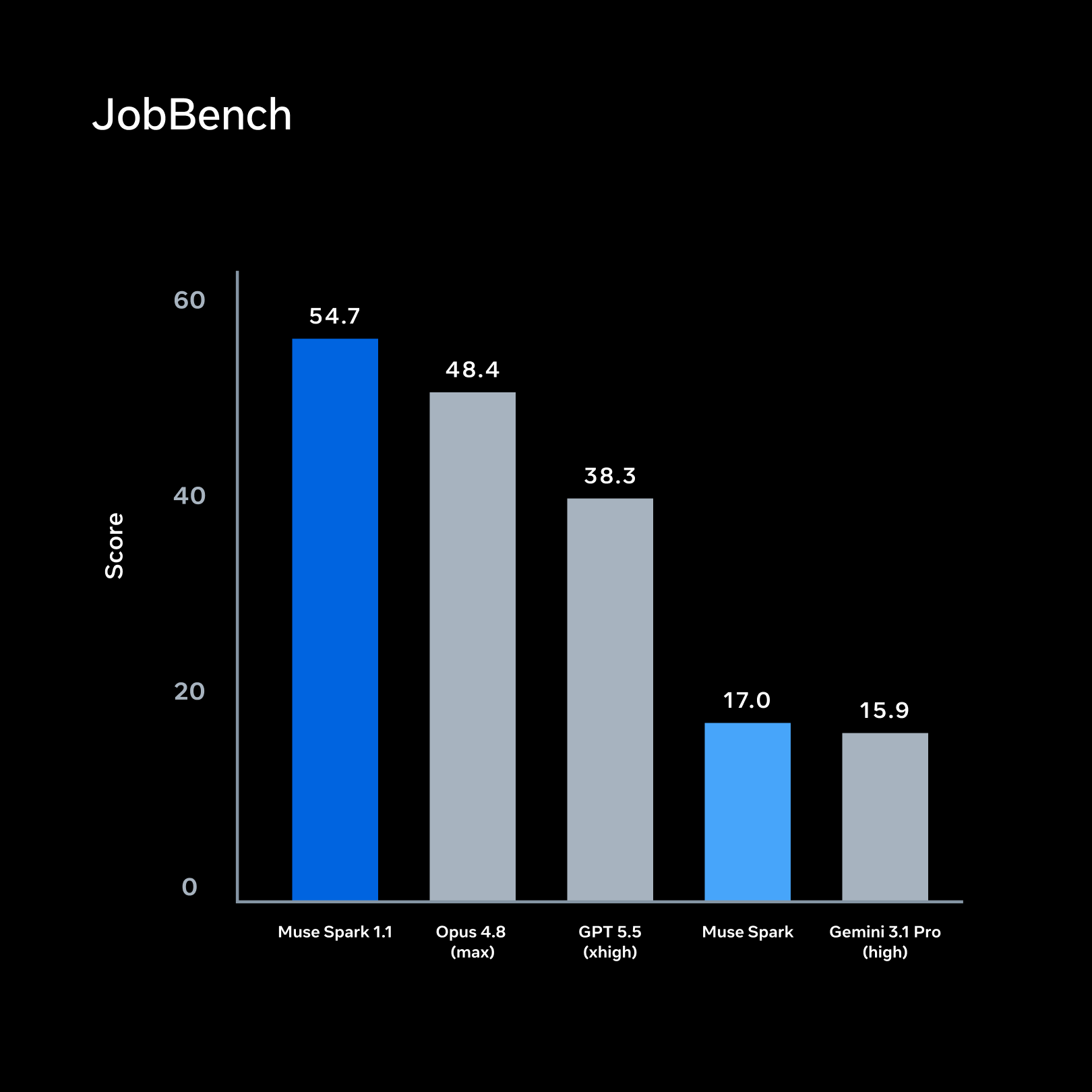
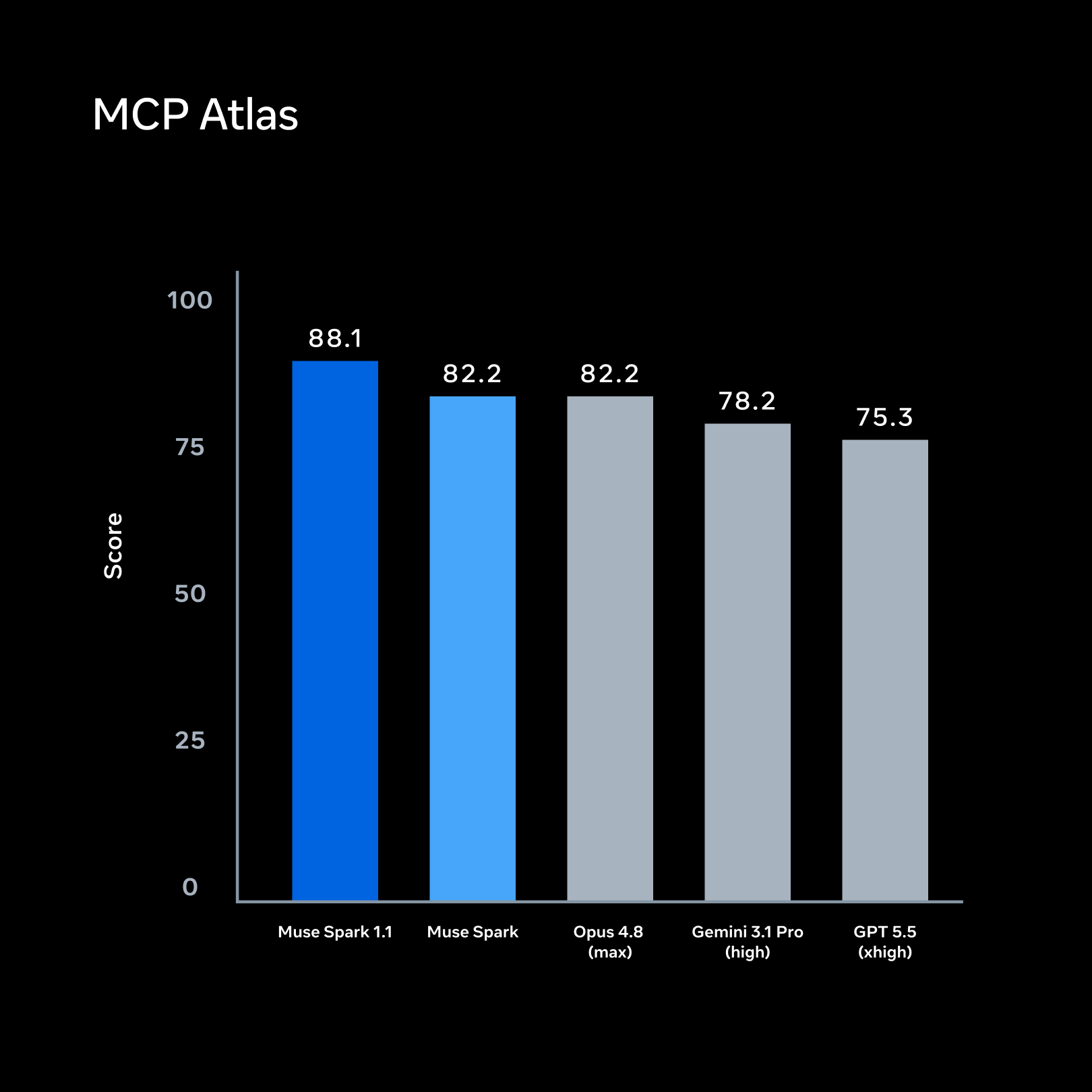
- Wang's scorecard: JobBench 54.7, MCP Atlas 88.1, HLE w/ tools 62.1 and more sit with or above GPT-5.5 / Opus 4.8 on several agent lines; coding is near the frontier, not a sweep.
- Pay-as-you-go: input $1.25, cached input $0.15, output $4.25 per 1M tokens; web search grounding $2.50 per 1,000 queries; no long-context premium.
- Compatible with OpenAI SDK, Anthropic SDK, OpenCode / Claude Code; three API shapes, one model, one price.
Say what happened first
On July 9, 2026, Meta Superintelligence Labs released Muse Spark 1.1 and, for the first time, put it on Meta Model API for external developers. The same day, Meta CAIO Alexandr Wang wrote:
muse spark 1.1 is an industry-competitive agentic and coding model. across many agentic evals it rivals gpt-5.5 and opus-4.8. available now through the new meta model api and in meta ai. - Alexandr Wang, @alexandr_wang, 2026-07-09
In plain terms: this is not a "chat feels slightly better" patch. It is aimed at agent work and coding. On many agent evals, Meta claims parity with GPT-5.5 and Opus 4.8. Below: features first, then each layer, then scores, then money.
What it can do: one map before the deep dive
Read this table once. Everything later only expands a cell.
One-line spine: learn to assign parallel work like a project manager, bind desktop/browser/mobile and coding into one agent pipeline, then ship it via a high-score, relatively low-cost API.
How agents work: main assigns, subs run in parallel
- Main agent plansGather context, make a plan, split work instead of clicking every UI step alone.
- Subagents execute in parallelStay on task, know available tools (native, MCP, custom skills), escalate when needed.
- Active context management1M tokens are managed: remember actions, retrieve early work, compact chatter while keeping decisions and open steps.
context + plan
code / tools
browser / desktop
search / verify
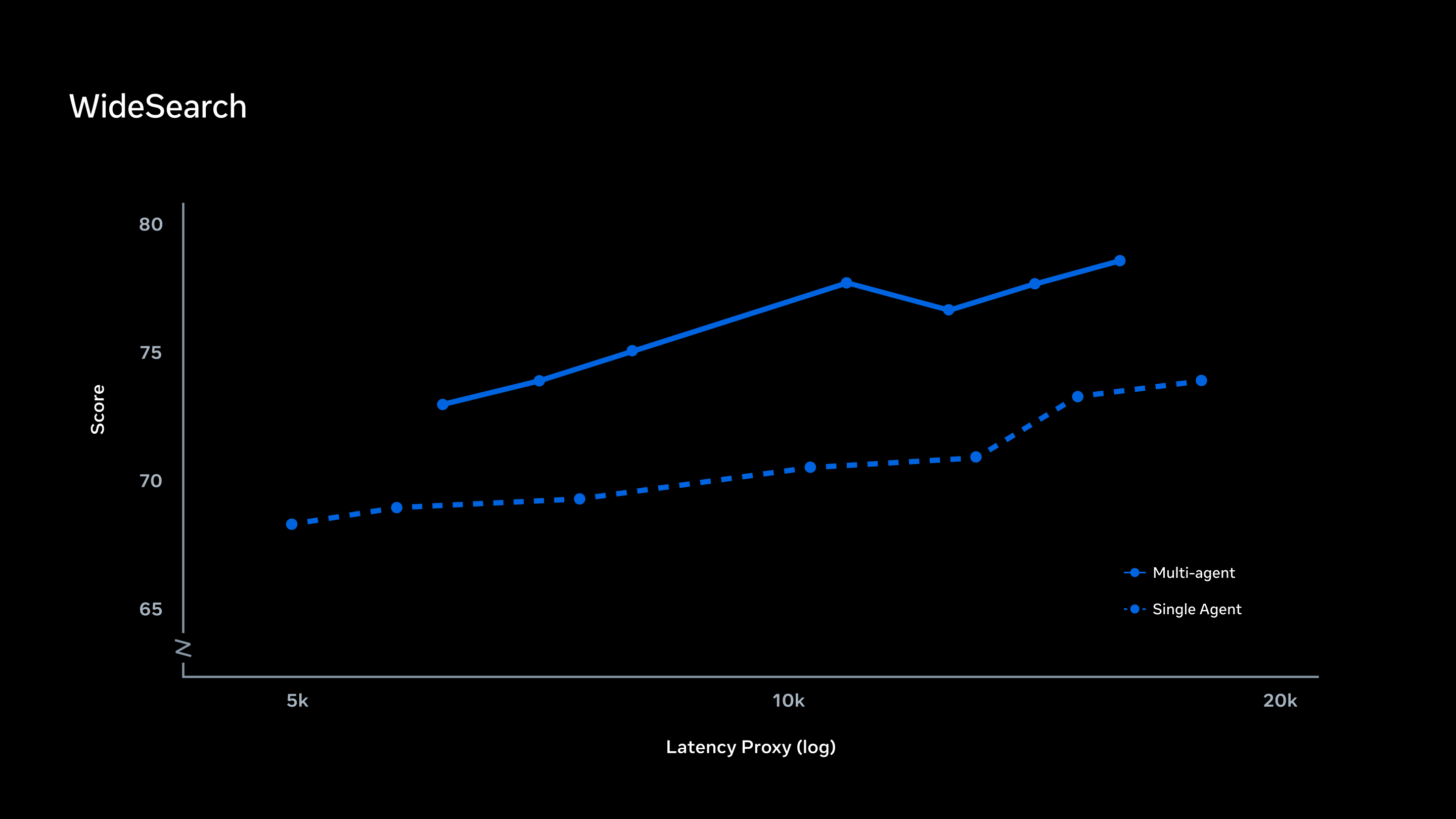
Zero-shot generalization to new tools/MCP/skills is claimed. WideSearch shows multi-agent above single-agent at the same latency proxy.
Computer use: desktop, browser, and mobile
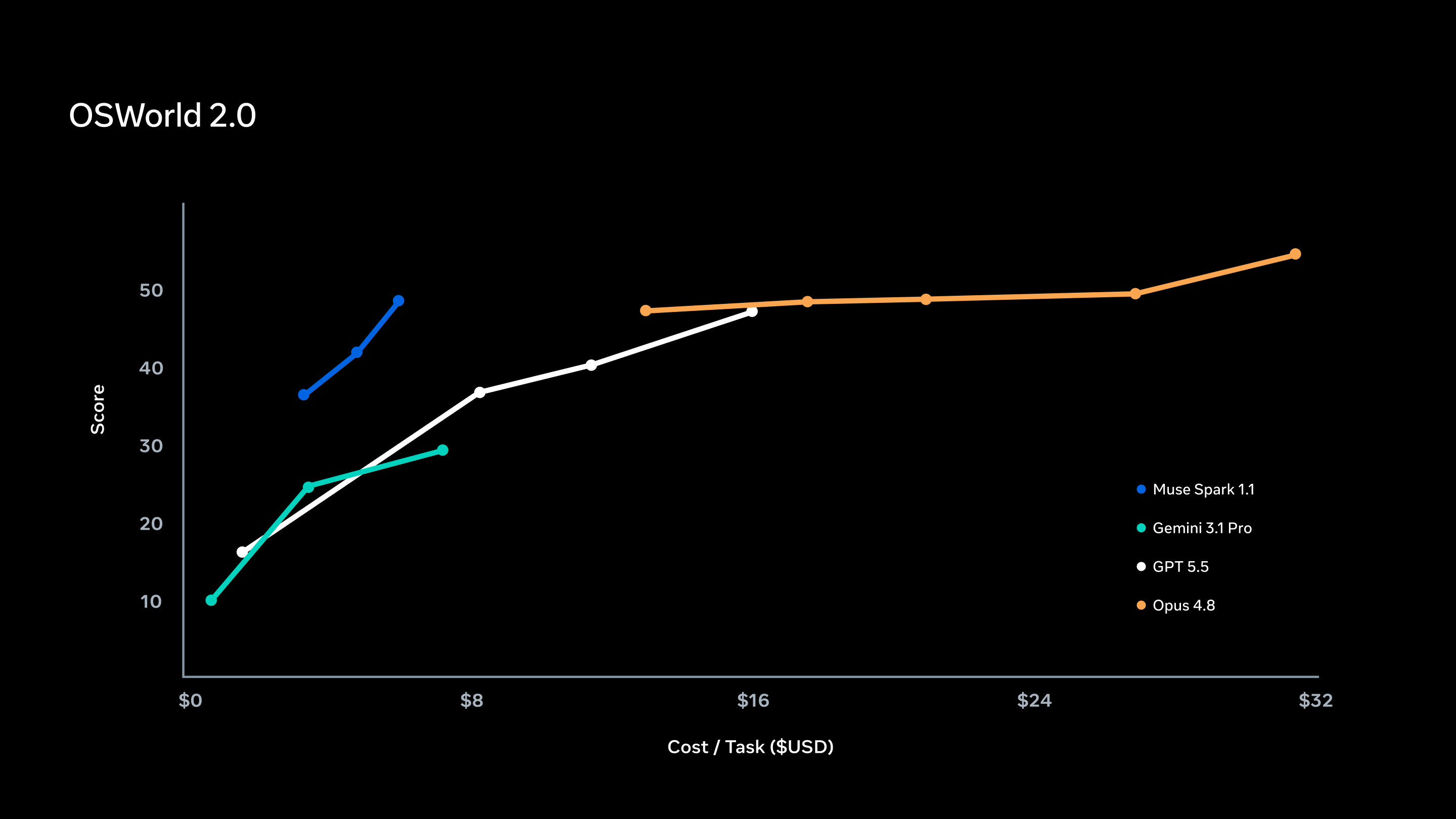
Wang is explicit: desktop, browser, and mobile. Training target:
- Write a script when automation is faster
- Click the UI when direct interaction is simpler
- Emit batches of actions per step, not one click at a time
Give an intern a remote device and only a goal. They choose whether to open an app and click a few times, or script bulk checks of menus and inventory.
Coding: large repos, multi-turn, screenshot self-check
Multimodal: see details, then act
Media generation line. Image mechanics live there; this piece covers Spark's agent / coding / API line.
Multiple agent evals: where it leads, where it only matches
Full table from Wang's thread (same numbers as Meta's Muse Spark product page). Everything visible—no tab switching.
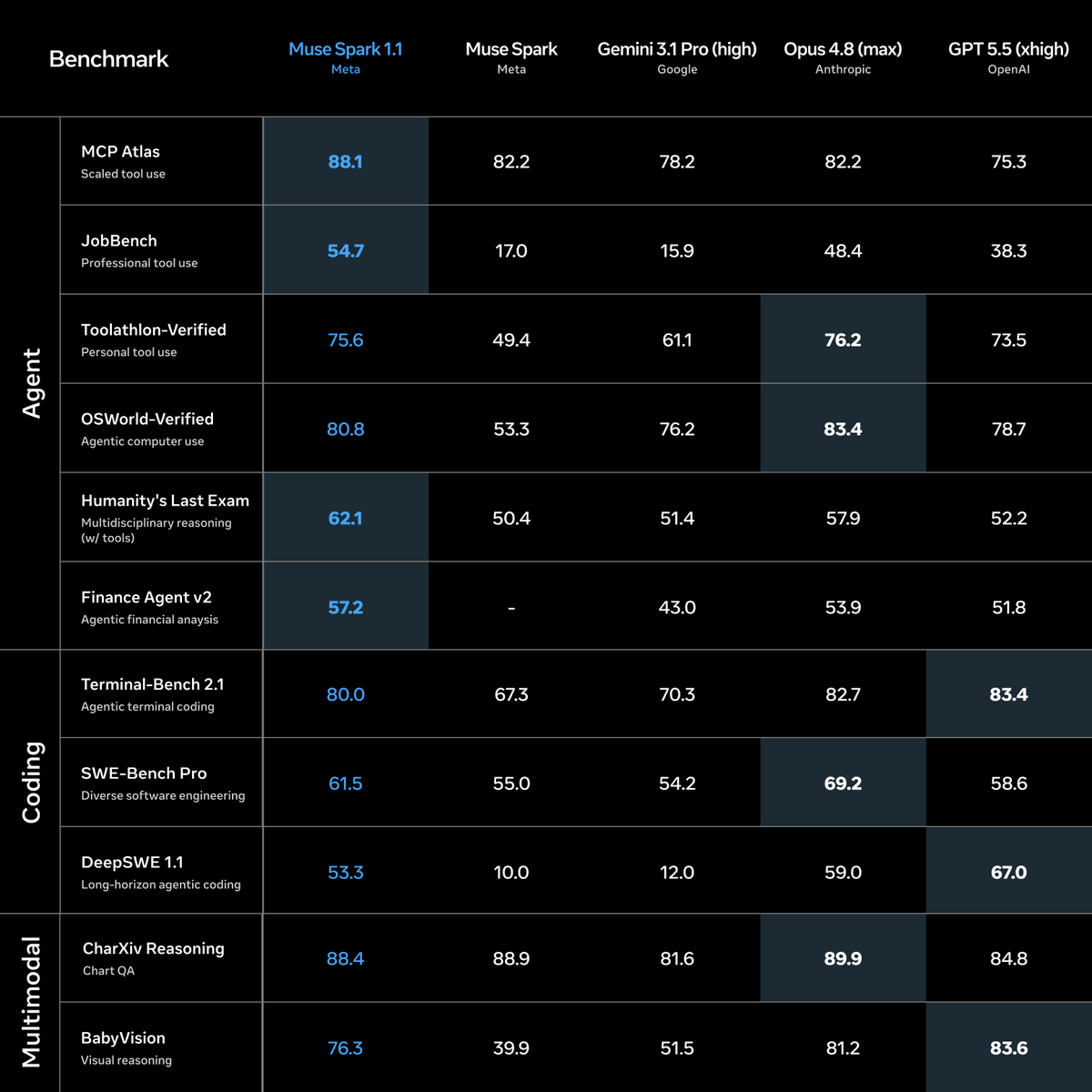
| Class | Benchmark | Spark 1.1 | Prior | Opus 4.8 | GPT-5.5 |
|---|---|---|---|---|---|
| Agent | MCP Atlas | 88.1 | 82.2 | 82.2 | 75.3 |
| Agent | JobBench | 54.7 | 17.0 | 48.4 | 38.3 |
| Agent | Toolathlon-Verified | 75.6 | 49.4 | 76.2 | 73.5 |
| Agent | OSWorld-Verified | 80.8 | 53.3 | 83.4 | 78.7 |
| Agent | HLE (w/ tools) | 62.1 | 50.4 | 57.9 | 52.2 |
| Agent | Finance Agent v2 | 57.2 | - | 53.9 | 51.8 |
| Coding | Terminal-Bench 2.1 | 80.0 | 67.3 | 82.7 | 83.4 |
| Coding | SWE-Bench Pro | 61.5 | 55.0 | 69.2 | 58.6 |
| Coding | DeepSWE 1.1 | 53.3 | 10.0 | 59.0 | 67.0 |
| Multimodal | CharXiv Reasoning | 88.4 | 88.9 | 89.9 | 84.8 |
| Multimodal | BabyVision | 76.3 | 39.9 | 81.2 | 83.6 |
Where Meta claims lead: MCP Atlas, JobBench, HLE w/ tools, Finance Agent v2 often top or near-top.
Neck-and-neck: Toolathlon and OSWorld sit next to Opus; Terminal-Bench slightly behind GPT-5.5 / Opus.
Still behind: DeepSWE 53.3 vs GPT-5.5 67.0; BabyVision 76.3 vs GPT-5.5 83.6. Not a clean sweep.
Vs prior Muse: JobBench 17.0→54.7, DeepSWE 10.0→53.3, OSWorld 53.3→80.8.
What it costs, how you connect
Wang's line is "premium performance at low cost." Official pay-as-you-go pricing (USD per 1M tokens, no minimum):
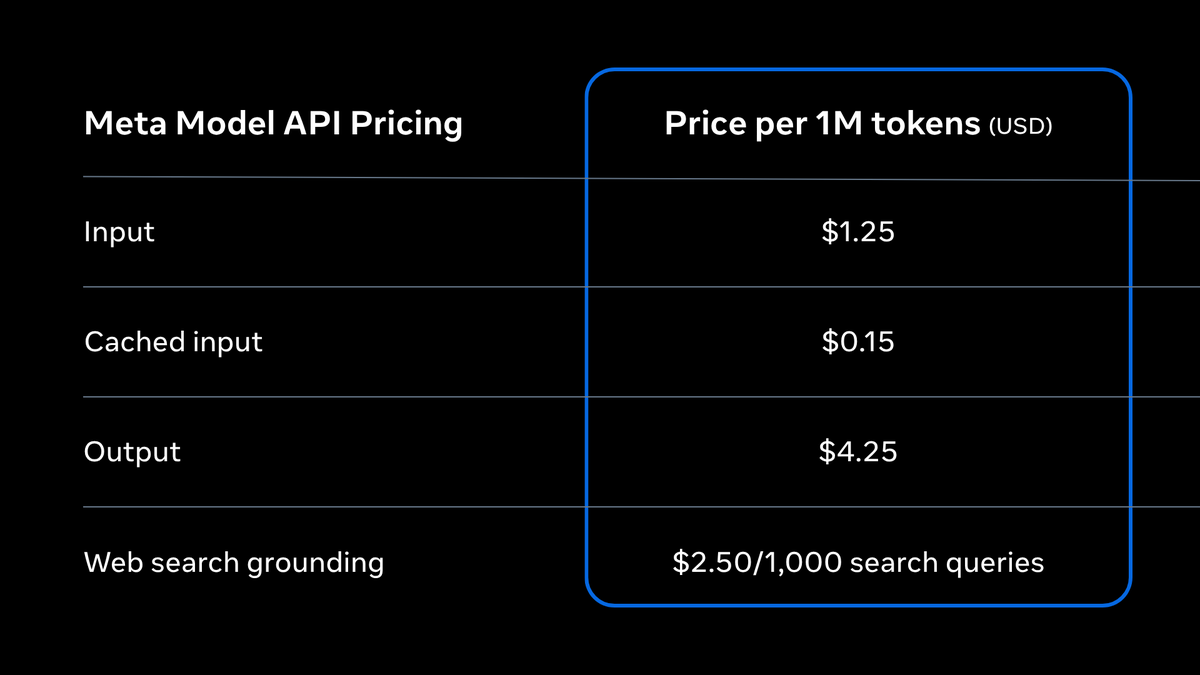
- No long-context premium: same rate empty or nearly full
- Prompt caching bills matched prefixes at cached-input rate
- Responses / Chat Completions / Messages: same model, same price; Responses is fullest for agents
- Rate limits per team: Free 60 RPM / 2M TPM; Paid 3,000 RPM / 4M TPM
- Small injected steering tokens are not billed
base_url = https://api.meta.ai/v1
model    = muse-spark-1.1
key      = MODEL_API_KEY (dev.meta.ai)
"What's most impressive about Muse Spark is how much it packs into one model: massive million-token context, full multimodal support, built-in search with citations, strong reasoning, top-tier coding abilities, structured output, and parallel tool calling - all in a clean OpenAI-compatible package." - Amjad Masad, Replit CEO
Stronger capability, tighter risk evals
The 112-page eval report: without mitigations, chem/bio and cybersecurity cannot be ruled out at Framework "high risk"; with deployment mitigations, residual risk is "moderate or lower." Loss of control stays moderate or lower. Cyber capability jumps (Cybench pass@1 65.4→92.9) while jailbreak / injection ASR falls (StrongREJECT 25.2→0.5; AgentDojo 11.9→0.7; Agentic Misalignment 47.7→1.1).
Who should try it
Parallel tools + 1M context + main/sub orchestration; OpenAI/Anthropic-compatible harnesses can retarget endpoints.
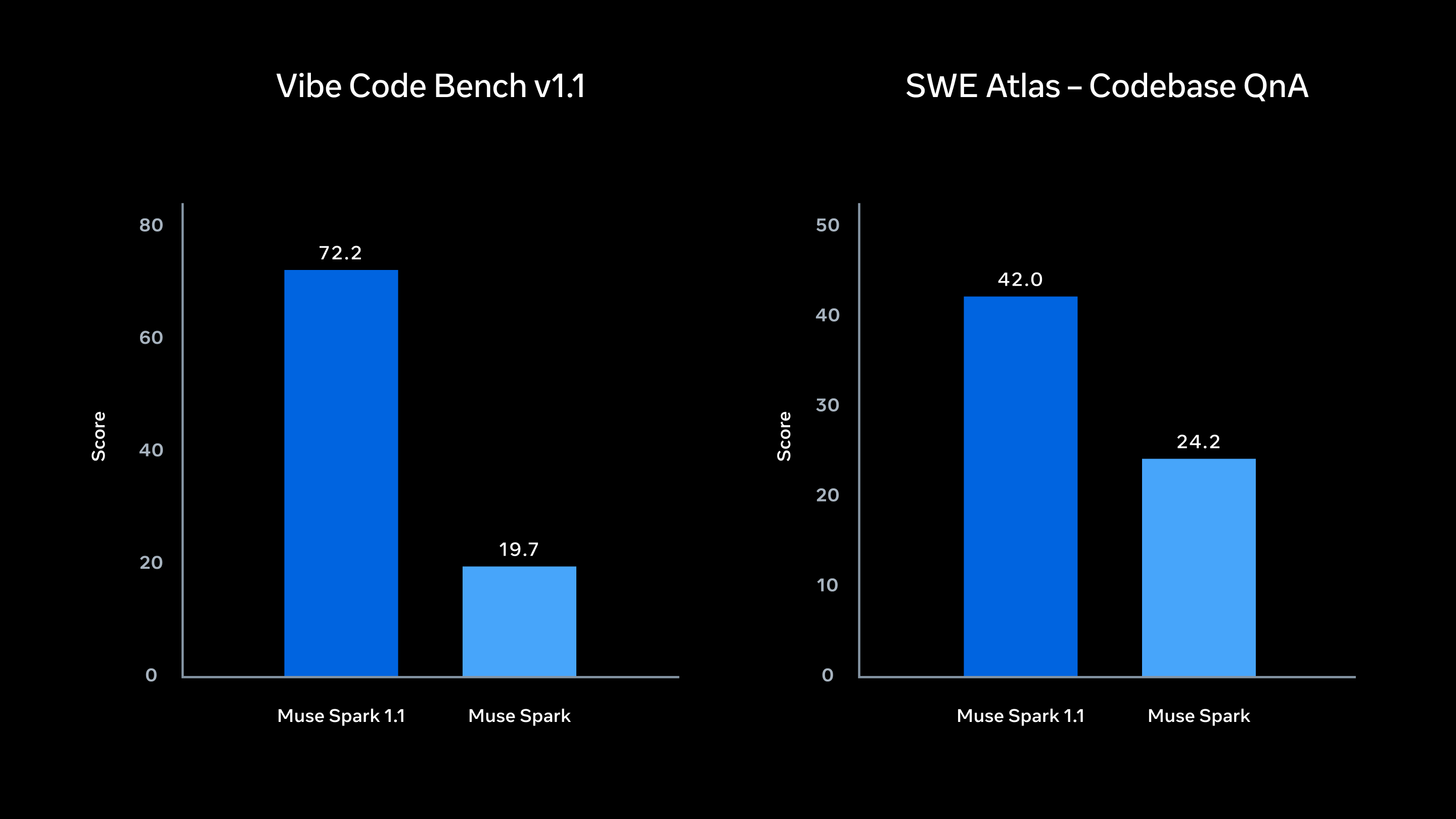
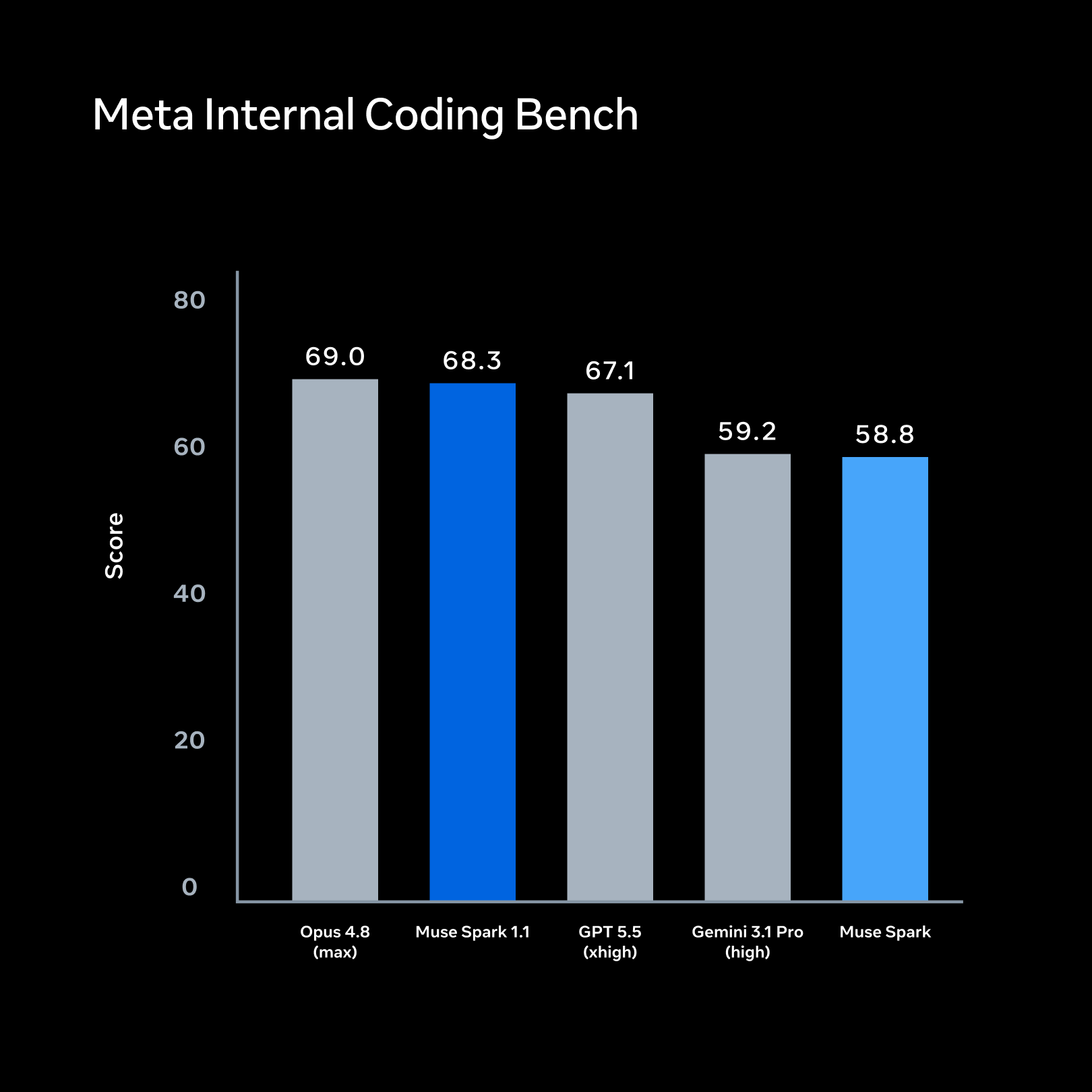
Large repos and screenshot UI checks; internal coding nearly ties Opus; cached input $0.15 helps long runs.
Desktop + browser + mobile computer use; mid-task goal changes are a featured demo pattern.
Video/screenshot in, then drive a browser to list, fill, submit.