1X Unveils NEO's New Robotic Hand: It Can Work and Feel What It's Holding at the Same Time
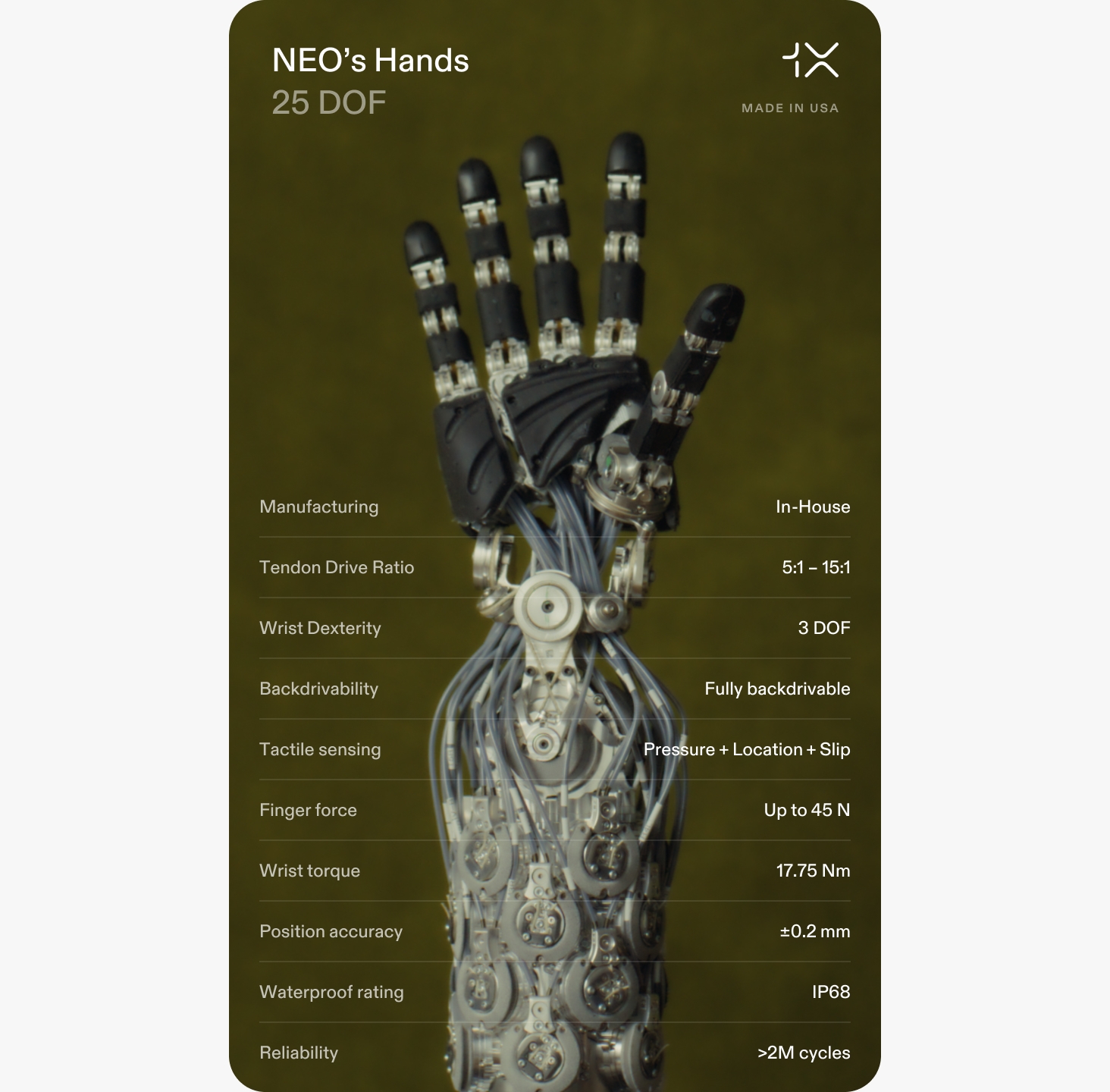
- 1X Technologies has unveiled a new-generation hand for its NEO humanoid robot, with 25 degrees of freedom: 22 in the fingers and palm, 3 in the wrist.
- It's tendon-driven, with a gear ratio as low as roughly 5:1 to 15:1. Every joint is force-controlled and back-drivable — it can sense externally applied force, not just execute position commands.
- The fingertips and palm are covered in high-resolution tactile skin that measures normal force, contact location, and shear force — detecting slip in real time and re-adjusting the grip.
- Peak torque: 3.5 Nm at the thumb carpometacarpal joint, 2.6 Nm at the finger metacarpophalangeal joint, up to 45 N of fingertip flexion force, 17.75 Nm of wrist torque, and ±0.2 mm positioning accuracy.
- Hundreds of hands are already off the line, with a dedicated production line planned to reach 10,000 units a year in 2026. The whole hand is IP68 waterproof, made of food-grade materials, and can be washed clean.
1X Gave NEO a New Pair of Hands
On July 9, 2026, 1X Technologies unveiled a new-generation hand for its NEO humanoid robot — a tendon-driven biomimetic hand with 25 degrees of freedom, every joint force-controlled and back-drivable.
First, What It Can Do
Before the how, let's look at what this hand can actually pull off. The official demos are all fine tasks that require the fingers to work together.
These aren't specially tuned demo modes. They're the natural result of putting "enough joints, each independently force-controlled" onto a human-hand scale.
The Ceiling of the Ordinary Robotic Gripper
To grasp what this launch means, first look at where today's humanoid robot hands stall. The common approach on the market is a position-controlled two-finger gripper: you give it a target position, and it opens or closes to that point.
For a developer, a hand like that exposes just three actions — pick, place, push. Every application built on such a hand is some combination of those three, done with its eyes closed. The ceiling isn't in the software; it's at the end of the arm.
The deeper problem is in the transmission. To amplify the motor's small torque into usable force, these hands often use gear ratios of 100:1 to 200:1. The price: external contact force gets eaten up in the gear friction before it ever reaches the motor. The hand has no sense of what it's touching or how hard it's pressing, so engineers can only rig up external cameras to guess what the fingers are doing.
This Hand Can Touch and Know What It's Touching
NEO's new approach is to let the hand read the outside world's reaction back, unaltered, at the same moment it acts.
NEO's hand is tendon-driven, paired with an ultra-low gear ratio of 5:1 to 15:1, and all 25 joints are natively force-controlled and back-drivable. Push one of its fingers and it yields, while precisely reporting how hard you pushed. Force flows out through the hand, and information flows back along the very same physical channel. 1X calls this "force transparency" — the act of pushing a finger is itself a measurement.
It's like a car in neutral: you can push it along, and feel from the resistance how heavy it is. Put it in Park and locked, and no matter how you push it won't budge — you feel no force at all. A traditional robot hand's high gear ratio is exactly that locked Park.
The key here is tendon drive: the motors aren't inside the joints but sit in the forearm, pulling the finger joints remotely through cords that work like tendons. It's a bit like a puppet show — the motors are the puppeteer's control bar off in the distance, tugging the puppet's fingers with fine strings, so the fingers themselves can be made very light.
- Write-only — commanded position, and there it goes
- High gear ratio, 100:1 to 200:1
- Contact force eaten up in gear friction
- Guesses what the hand's doing via external cameras
- Read and write — action is measurement
- Ultra-low gear ratio, 5:1 to 15:1
- All 25 joints force-controlled, back-drivable
- Force and info flow both ways on one tendon
There's another quiet reading always running in the background, called proprioception. Because every joint is closed-loop controlled, the hand knows without looking what pose it's bent into and how much force it's using at each point — the way you can touch the tips of both index fingers together with your eyes shut.
How to Split 25 Joints for Both Dexterity and Strength
A degree of freedom is a direction a joint can move independently in — one degree of freedom roughly corresponds to one point that can be controlled on its own. 25 degrees of freedom means this hand has 25 spots that can each swing independently. Beyond the count, how they're allocated matters more.
With enough force-controlled degrees of freedom, at human-hand scale, the result is both dexterous and strong. Here are this hand's hard numbers.
Strength like this handles full-hand grasping, using tools, carrying things, opening doors, pushing a loaded cart, and precise pinching under load — all while keeping full dexterity. The ±0.2 mm positioning accuracy lets it work at the "small object" scale where most human labor actually happens.
The Last Half-Millimeter at the Fingertip
Force control alone isn't enough — that last half-millimeter of information at the fingertip has to come from the skin. NEO's fingertips and surfaces are covered in high-resolution tactile skin that continuously measures three things.
The most direct use of this skin is catching slip in real time. The instant an object starts to slide, the shear-force channel reads it, and the force-controlled joints immediately tighten or adjust their grip, steadying the object before the slide completes.
senses slip beginning
adjust grip in real time
Vision alone can't do this — especially with objects that are transparent, fragile, deformable, or blocked from view. The official demos show contact-force normal maps, a pressure heatmap during a handshake, and picking up a fragile paper crane without crushing it. This skin, the sensors inside it, and the tendons behind it are all designed together — it's a functional material.
What Happens When It's Hit by a Hammer or Caught in a Drawer
A hand that learns by touch has to withstand being touched over and over, and it has to be safe enough around people.
This hand's safety comes from its compliance. The very low gear ratio, plus tendon drive and very low fingertip inertia, let external impacts safely push the fingers back and get absorbed. In the official slow-motion clips, the fingers yield gracefully in each of the situations below.
Reliability is engineered into every subsystem: tendon routing, bearings, finger structure, cable routing, tactile integration, electronics, assembly process. Individual parts and whole finger assemblies have gone through millions of test cycles, drive units are tested at extreme temperatures, and the wrist joint is validated to over 2 million cycles under high load. The whole hand is sealed to IP68 with food-grade materials, and can be washed at the sink when it gets dirty.
Being Able to Build It Is the Real Moat
The last number, and the strategic point 1X stresses: production capacity.
First, how the hardware carries all this force. The motors sit in the forearm — where most of a human hand's grip strength originates — and transmit force through in-house tendons past the wrist to pull the fingers. So the hand can be made very light yet output a lot of force, and run continuously for long stretches without the temperature running away.
The whole hand is deeply integrated as part of the complete NEO: in-house motors, custom electronics, embedded sensing, a proprietary tendon system, compact transmission, hand-specific firmware. From the tendon materials to the outermost soft polymers, skin, and tactile sensing stack, every hand is built end-to-end on 1X's own line.
Hundreds of hands are already off the line, with the dedicated production line planned to reach 10,000 units a year in 2026. Why capacity is the real point of this launch: a hand you can't build at scale can't run experiments at scale; without real grasping data at scale, you can't train a manipulation model that actually works. How many hands you can build directly determines how fast the manipulation model can learn.
Our goal was never a hand that looks good on paper. These hands are the product of dense engineering, aimed at making humanoid robots genuinely useful. We want them to match or exceed human capability on every dimension that matters. With these hands, NEO crosses a key threshold: robots can now do the things people do with their hands every day. This is what the industry has been waiting for. Bernt Børnich, Founder and CEO, 1X