Mira Murati’s First Open Model Activates Just 41 Billion Parameters per token
Thinking Machines Lab, founded by former OpenAI CTO Mira Murati, has released Inkling, its first large model trained in-house. It can read text, interpret images, listen to audio, write code, and use tools. Its full weights are available to download, and developers can continue training it on Tinker.
The One-Minute Overview
- Thinking Machines Lab, founded by former OpenAI CTO Mira Murati, has released Inkling, its first general-purpose large model trained from scratch.
- The full model weights are available for developers to download, deploy, and continue training. These models are often called “open-source models,” but “open-weight models” is more precise.
- It can process text, images, and audio; write code; use tools; operate websites; and complete complex tasks that run for dozens of rounds. It outputs text only and does not generate images or speech directly.
- It has 975 billion total parameters, but activates only about 41 billion for each token. Think of it as a company with many specialists that assigns only the best-suited teams to each job.
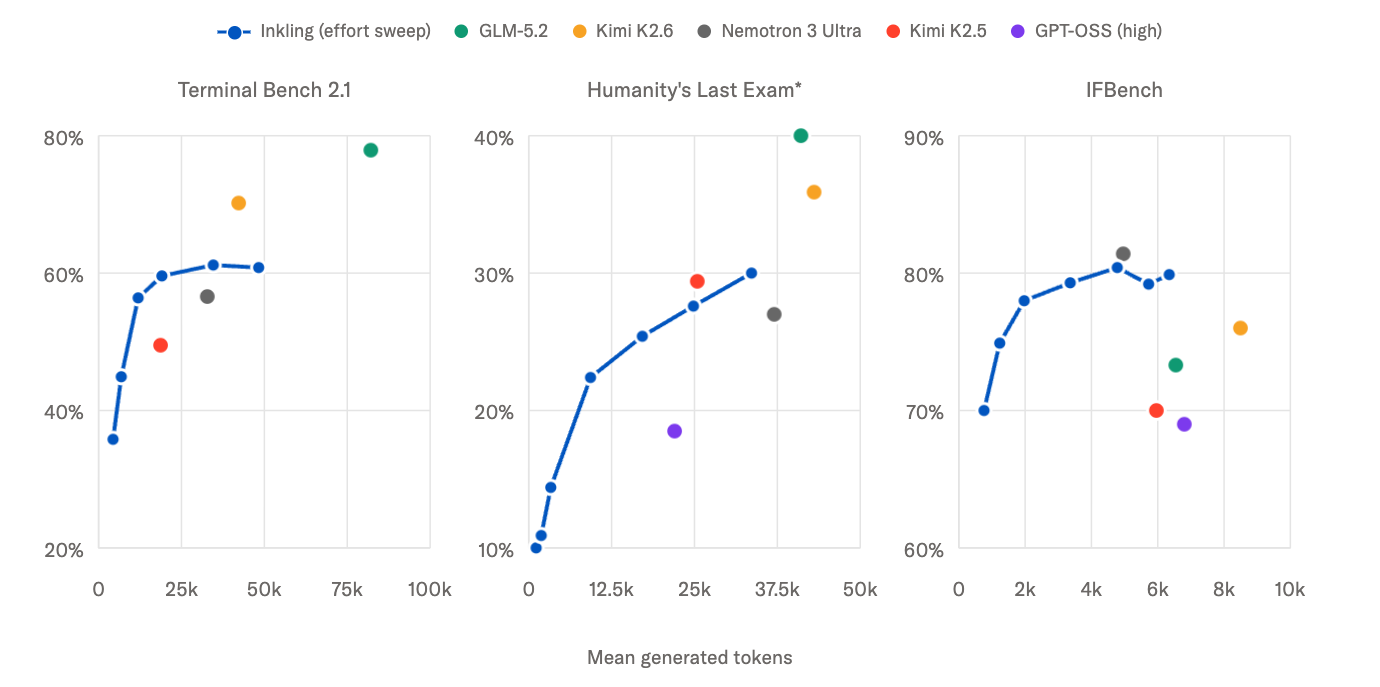
- Developers can control how long it thinks: less for simple tasks and more for complex ones, trading output length for speed, cost, and accuracy.
- Thinking Machines Lab also offers Tinker fine-tuning, a Playground, a Cookbook, and third-party deployment services, covering evaluation, continued training, and deployment.
- It does not beat leading models across every capability, and running it yourself still requires at least about 600GB of GPU memory. Most users are better off using an online service.

A Year After Leaving OpenAI, Its Former CTO Unveils Her First In-House Model
Mira Murati served as OpenAI’s CTO before leaving in September 2024 and founding Thinking Machines Lab in 2025. The company recruited several researchers from OpenAI and focused on making models easier for businesses and developers to understand, modify, and train.
Thinking Machines Lab’s first product was Tinker, a model fine-tuning platform. Developers provide their data and scoring methods, and Tinker fine-tunes open-weight models. At the time, Thinking Machines Lab did not yet have a foundation model of its own.
On July 15, 2026, the company released Inkling, its first publicly available general-purpose large model trained from scratch. The full weights are on Hugging Face under the Apache 2.0 license, with direct Tinker integration. The company now has both its own model and its own training platform.
So What Exactly Is Inkling?
In short, Inkling is a multimodal foundation model that can be downloaded, deployed, and trained further. It accepts text, images, and audio, and can write code, use tools, and operate websites. It is not a standalone chat app for consumers. It is more like a general-purpose engine that developers can build into coding assistants, customer service systems, research tools, web agents, or internal enterprise software.
When a large model finishes training, it leaves behind a vast set of numbers that determine how it responds. These are the model weights. Inkling’s full weights are on Hugging Face under the Apache 2.0 license, so developers can download, deploy, and modify them. But the team has not released all of the training data, training code, or training process. People may casually call it an “open-source model,” but “open-weight model” is the more accurate technical term.
How Is It Different from a Typical Open Model?
Many open-weight releases focus on the weight files. Inkling was integrated with Tinker from day one. Developers can test the model in the Playground, send their own data, scoring rules, and training jobs to Tinker, produce a version better suited to their business, and then download it or deploy it through a third-party service.
Downloading the Weights Alone
You still need to prepare training code, data formats, evaluations, GPU clusters, and deployment tools. The engineering barrier remains high.
Inkling Plus Tinker
Testing, data preparation, continued training, evaluation, and deployment can follow one connected workflow, with far less infrastructure to build.
What Can Inkling Actually Do?
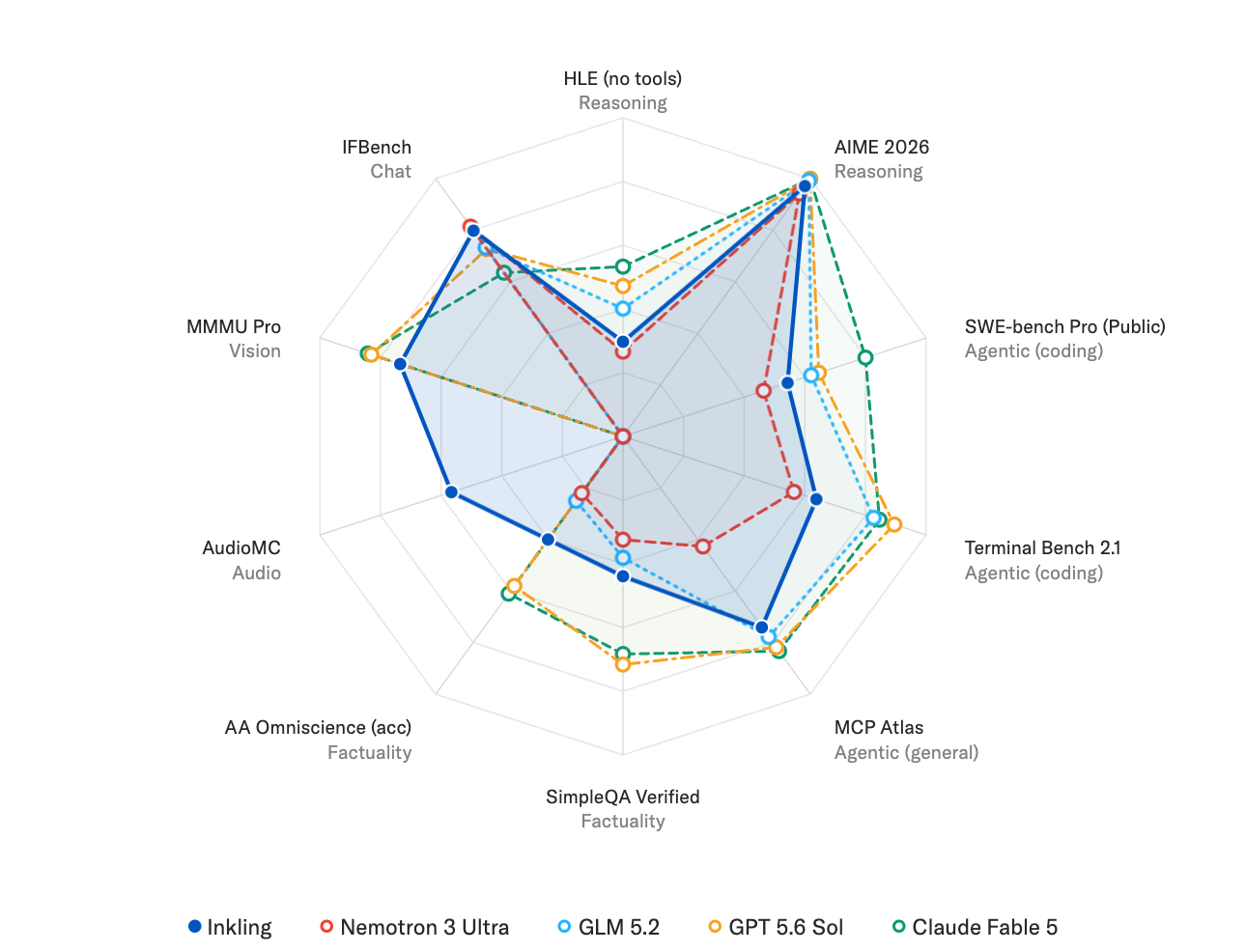
Start with the overall picture. The official release compares Inkling with four representative models across ten evaluations. The thick blue line is Inkling: it does not dominate every rival on any single axis, but it has no obvious gaps across coding, tool use, vision, audio, factuality, and instruction following. That is exactly the profile of a general-purpose foundation that developers can continue training.
1. Scale: 975 Billion Parameters, Plus a Faster Small Version
Original Inkling has 975 billion total parameters and uses a mixture-of-experts architecture. It activates only about 41 billion parameters for each token and supports up to 1 million tokens of context. These are tokens, not characters; Tinker currently offers practical context tiers of 64K and 256K.
Inkling-Small preview has 276 billion total parameters and activates about 12 billion per token. With upgraded pretraining data and training methods, it approaches or even surpasses the original on many tests while running faster and costing less. It is not equally strong on every test, however, and the full Small weights have not been released.
Inkling
41 billion parameters active per token
Maximum context: 1 million tokens
Inkling-Small
12 billion parameters active per token
Designed for lower latency and cost
2. Controllable Reasoning: Developers Choose the Depth
Many reasoning models decide for themselves how long to think. Even simple tasks can produce lengthy internal reasoning, increasing wait times and cost. Inkling gives developers that choice. The release page shows reasoning effort from 0.2 to 0.99: lower values produce faster answers and use fewer tokens, while higher values give the model more time for math, code, and multistep tasks.
3. Native Multimodality: Vision and Audio from the Start
Inkling’s vision and audio components were trained from scratch. Audio is converted into spectrograms the model can read, while images are split into 40×40-pixel patches. After lightweight conversion, they enter the same model alongside text; there is no need to transcribe everything into text first.
or tool call
Audio: It can transcribe speech, follow spoken instructions, answer questions about recordings, and analyze longer audio.
Vision: It can interpret charts, formulas, and mathematical diagrams. When details matter, it can also use Python to zoom in or crop an image.
4. Getting Work Done: Less Guessing, More Follow-Through
Less guessing when uncertain: The training team designed a reward that allows the model to abstain. On short-answer questions it scores only for correct answers; when uncertain, saying “I don’t know” or qualifying its judgment is more rewarding. A separate grader searches the web to check facts in its answers. This can reduce confident fabrication, but it cannot guarantee the model will never make mistakes.
Practical skills: It was trained to write code, run programs, read and write files, and operate websites. The team uses complete tasks to demonstrate whether it can keep working through to completion.
Build a Job-Application Page, Then Fill In the Form
Inkling first generates a job-application webpage from a single request, including the role description, contact details, and reasons for applying. An embedded automation then reads the user’s saved profile and completes the form. The demo combines coding, interface generation, and browser operation.
Revise a Multiplayer Game Through 40 Rounds of Review
Another task was to build a multiplayer Snake game. The requirements covered server-authoritative game state, human and bot players together, collision rules, a leaderboard, tests, and startup instructions. Inkling built an initial version, then revised it through 40 rounds of GPT Codex review. The example demonstrates long-horizon task performance: the model can preserve context, take criticism, rerun tests, and keep correcting its work.
Create a 9-Page Travel Magazine
The model searches for breakfast information and images from six cities, then assembles a consistently styled PDF with a cover, city features, a comparison spread, and references.
Use Tinker to Complete a Fine-Tuning Run
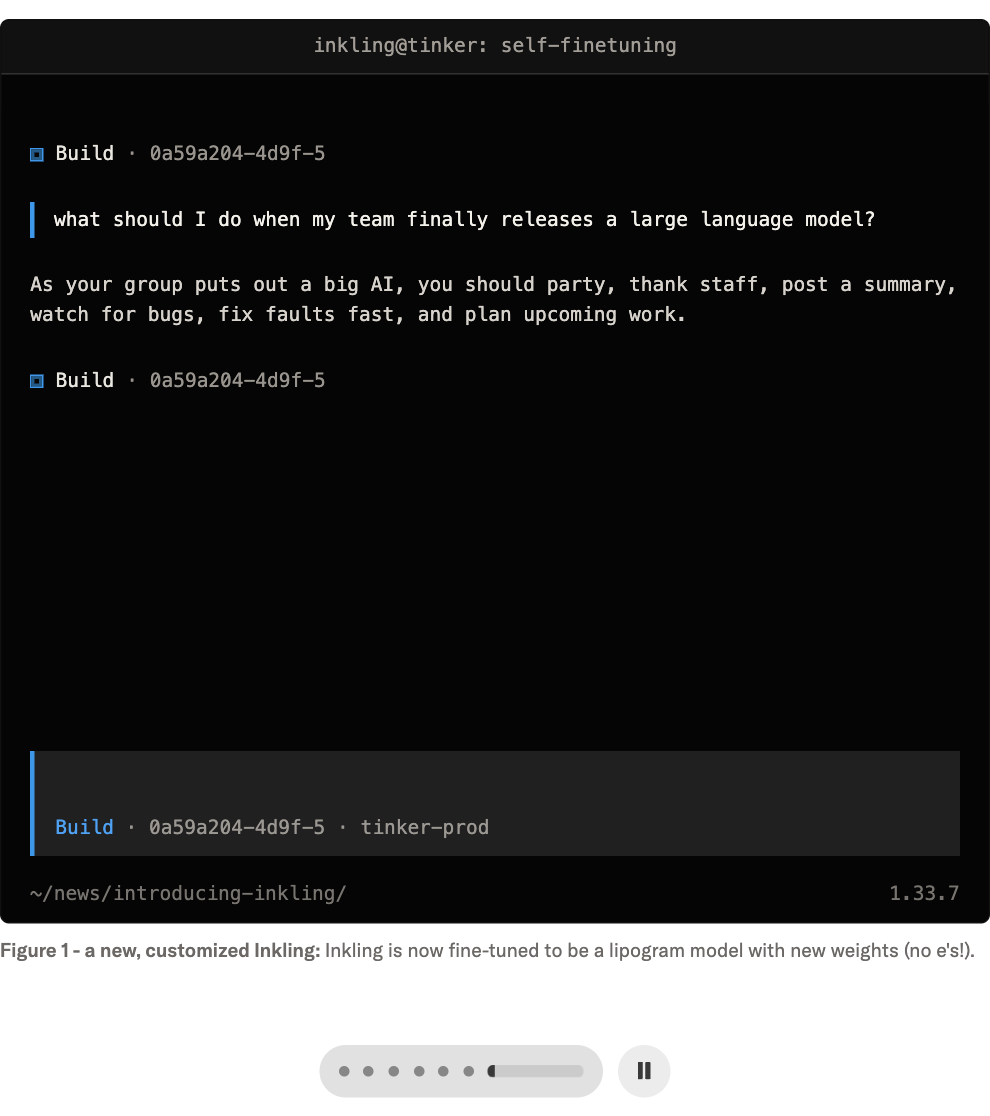
The model writes training code, prepares data, defines scoring rules, calls Tinker for training, and then has the outer program switch to the new model weights.

The fine-tuning demo has a specific goal: make all future English answers avoid the letter e. The model first writes a scoring function that gives 0 points if e appears and 10 points if it does not. It then generates training data and configuration, and uses Tinker to complete 32 batches over 3 epochs, for 96 training steps in total.
Technical Choices and Surprising Findings
Learning to Say Less: Internal Reasoning Turns Telegraphic
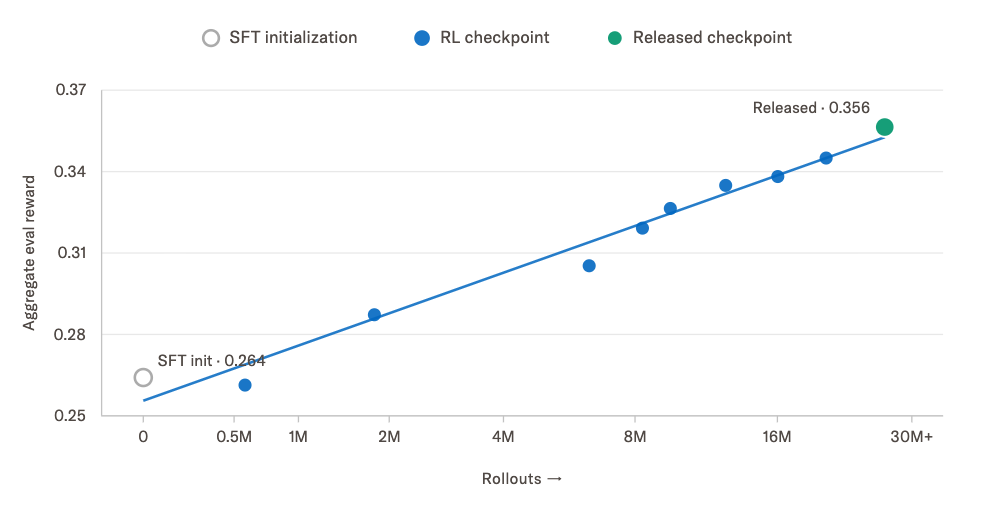
Inkling’s pretraining data contains text, images, audio, and video, totaling 45 trillion tokens. Post-training included more than 30 million reinforcement-learning task attempts. One attempt means the model completes a task, receives a score, and improves based on the result.
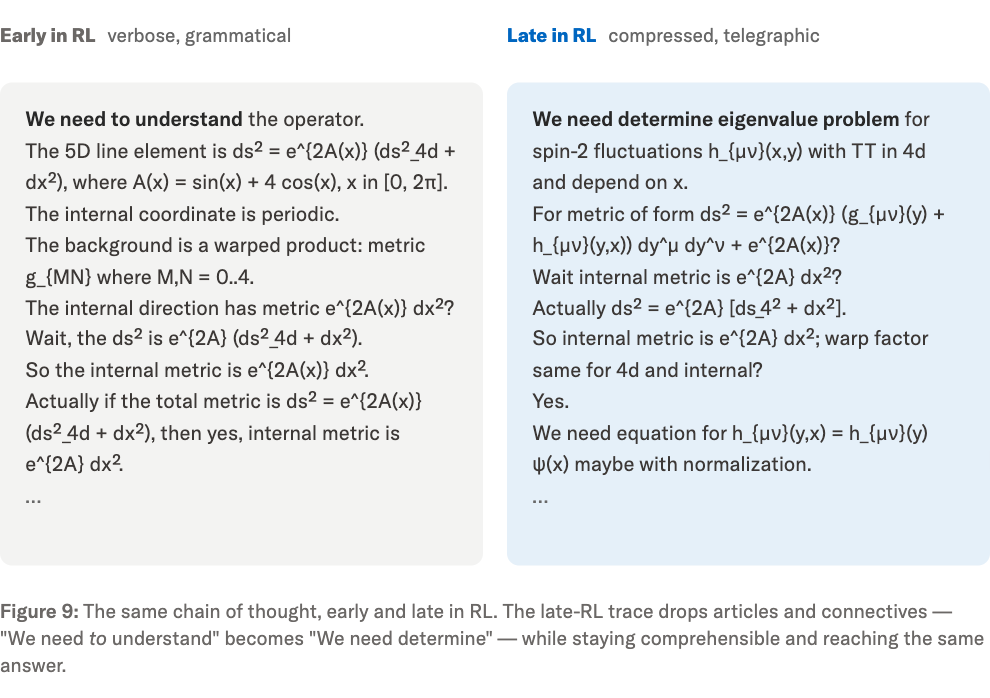
The training team found that the model’s internal reasoning automatically grew shorter as reinforcement learning continued. Early on, sentences were complete and used many connecting words. Later, the model dropped articles, prepositions, and some grammar, producing telegraphic fragments while reaching the same final answer. This behavior was not written into the reward objective; the model learned it under pressure to reduce token cost.
Early Reinforcement Learning
“We need to understand this operator. This five-dimensional line element is…”
Complete sentences, but longer internal reasoning.
Late Reinforcement Learning
“Need determine eigenvalue problem… internal metric is…”
Drops connecting words but keeps the reasoning skeleton.
Replacing Mainstream RoPE with Relative Position Encoding
Many large models use RoPE, or rotary position encoding, to help remember where content appears in a long document. Inkling instead uses relative position encoding, focusing more on the distance between two pieces of content. Its attention layers also alternate at a 5∶1 ratio: five consecutive layers look at nearby information, then the next considers the full context.
Common Approach: Record Content Positions
The model adds positional information to each segment. When text runs far beyond the training range, changes in position may affect stability.
Inkling: Record the Distance Between Content
The model focuses more on how far apart two segments are. In the release team’s tests, it was more stable on long sequences beyond the training length.
How Can You Use It?
To try it now: Open the Inkling Playground on Tinker, currently free for a limited time.
To fine-tune or build on it: The full weights are on Hugging Face, along with an NVFP4 quantized version for NVIDIA Blackwell GPUs. To continue training with your own data, use Tinker and the official Cookbook.
Downloadable Does Not Mean It Runs on an Ordinary Computer
The full weights on Hugging Face occupy about 1.9TB. The BF16 version requires at least about 2TB of aggregate GPU memory, while the NVFP4 quantized version still needs at least about 600GB. Most developers are better served by the Playground, a third-party API, or Tinker. Self-hosting is a data-center-scale job.
Expand: Main Benchmark Scores and Testing Methods
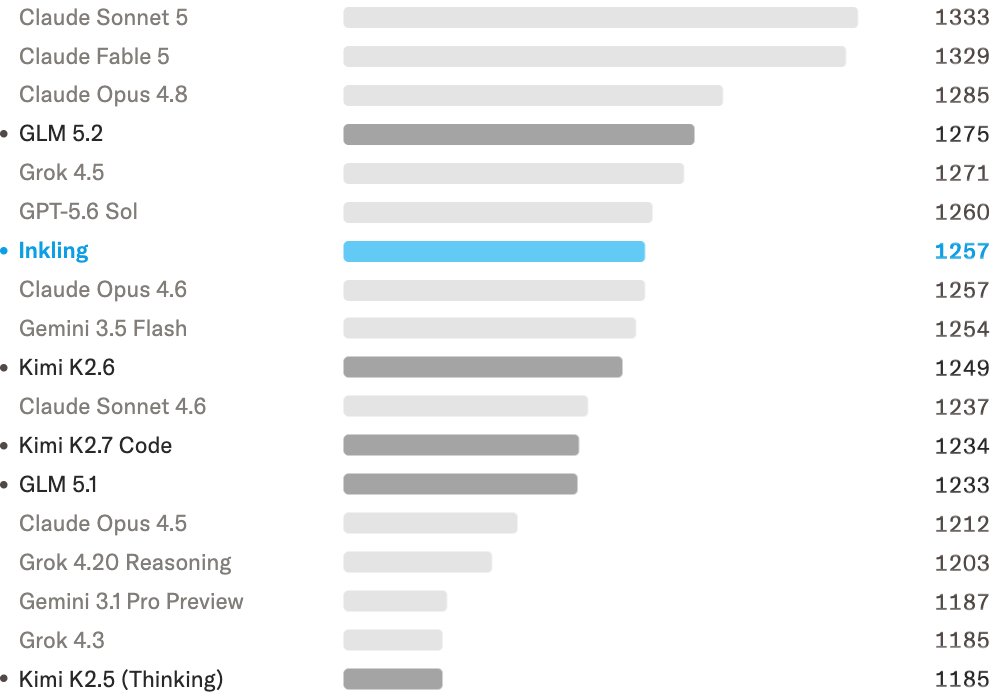
Inkling posts results across coding, tool use, vision, audio, knowledge Q&A, and safety tests. Its capabilities are broad, but it does not comprehensively outperform the leading open or closed models.
These tests measure different abilities, so their scores do not indicate comparable difficulty. Results are reported at the maximum reasoning effort of 0.99, and tool environments also affect coding tests. Forecasting, audio, and some vision results use the team’s internal testing and still need independent replication.
The model card also lists a safety gap: harmful requests framed through role-play or indirect wording can occasionally bypass refusal behavior. Public deployments still need content filtering, rate limits, and monitoring.
Inkling Connects the Model, Training, and Deployment
Thinking Machines Lab’s first in-house open-weight model reads text, images, and audio—and gives developers a direct path to keep training it.
↓ One page · Includes an animated diagram
Inkling is a multimodal foundation model you can download, deploy, and train further. It is not a standalone chat app, but a general-purpose engine for coding assistants, customer service, research tools, and web agents.
✘ Weights alone still leave you to build training code, data formats, evaluations, GPU clusters, and deployment tools
That was the old bottleneck: the model files were open, but further training and production deployment remained separate, heavy engineering projects.
Inkling integrated with Tinker on day one. Developers can try it, continue training with their own data and scoring rules, then download the new version or deploy it through a third-party service.
Build training and evaluation
Set up GPU clusters
Add deployment tools
Continue training in Tinker
Follow the Cookbook
Download weights or use third-party deployment
The full weights use the Apache 2.0 license. “Open-weight” is the more accurate term because the training data, training code, and full training process were not released.
Inkling has 975B total parameters. It does not run all of them for every token; only about 41B parameters are active.
Inkling is not merely large. It puts control over how long to think and what inputs to process into one model.
0.99: think more on math, complex code, and multistep tasks
Trade output length for speed, cost, and accuracy
Images become 40×40-pixel patches
Audio becomes spectrograms; all three inputs are reasoned over together
Inkling is downloadable, but that does not make it suitable for self-hosting on a personal computer. Its full weights are about 1.9TB, and minimum GPU-memory requirements remain data-center scale.
✘ Self-hosting is a data-center-scale job, and the model does not beat the leaders across the board
Public deployments still need content filtering, rate limits, and monitoring because the model card says some disguised harmful requests may bypass refusals.
- × Further training is heavy
- × Production deployment is heavy