Same models, new shell: Opus 4.8 and Fable 5 hit 99% on ARC-AGI-3
- ARC-AGI-3 is a class of games that tell you nothing: the AI only gets a 64×64 colored grid and a few buttons it can press — no object list, no stated goal, no reward signal. When it launched in March, the strongest models scored only 0.51.
- Schema is a harness — it doesn't touch the model's weights, only how the model is used. It makes the model write each game's rules as a runnable program, replay every recorded step against that program to check it, then search within that program for the next move.
- On the 25 public games, Opus 4.8 paired with Fable 5 scored 98.98, and GPT-5.6 Sol scored 95.35. Both are the team's own self-reported numbers, not independently verified by ARC Prize.
- With the same Opus 4.8 and Fable 5, swapping in the stock Claude Code harness scores only 42.83. Swapping in Schema alone adds 56.15 points.
- That 99% measures step efficiency — the AI's step count compared to a human's first-time playthrough (squared ratio). It means nearly every game was cleared at an efficiency matching or beating humans; solving it alone isn't enough.
A game that won't tell you the rules
Impossible Research (working with UC Berkeley and Carnegie Mellon University) released Schema, a harness that lets frontier models play games like physicists. It targets a benchmark built specifically to trip up AI: ARC-AGI-3.
ARC-AGI-3 throws a game at the AI without explaining what it's looking at. Each step, all the AI gets is a 64×64 grid (16 colors) and a list of which buttons it can currently press. No object list, no rules, no stated goal, no signal telling it "that step was right." The only way forward is to act like a physicist: poke at it, guess the rules, and revise when you're wrong.
The image below is exactly what the AI actually sees across the 25 public games. Each tile is one game, and the AI has to work out for itself: which of these colored blocks is the character it controls, which are walls, which bar is a countdown, and what even counts as clearing the level.
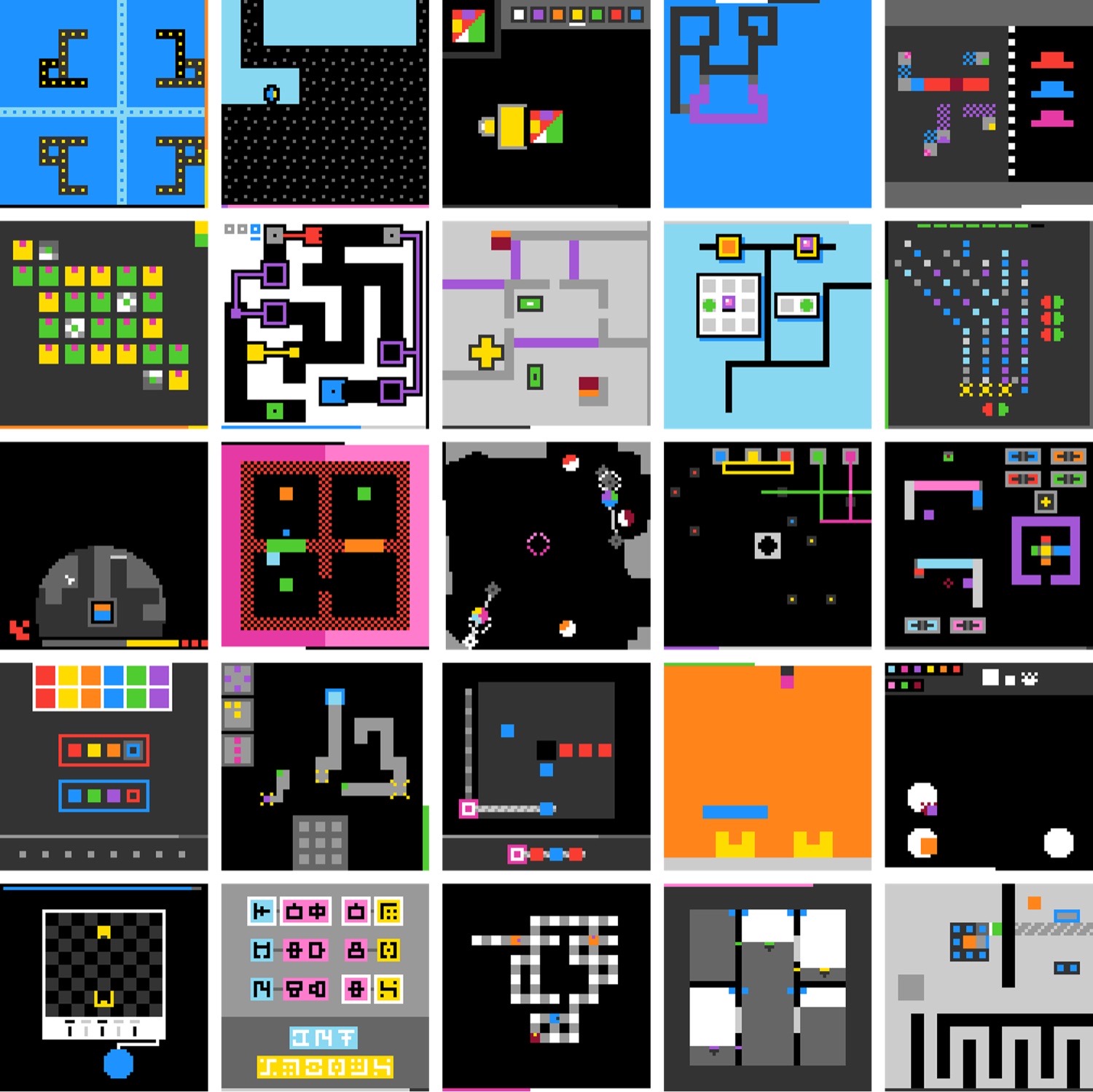
This benchmark is brutal on frontier models. Its official metric, RHAE (Relative Human Action Efficiency), compares the AI's step count per level against a human playing for the first time. When it launched in March, the best verified frontier model scored only 0.51; by July, the best model — GPT-5.6 Sol at its highest reasoning setting — reached just 7.78 on the semi-private set and 13.33 on the public set. For reference, human action efficiency is a perfect 100.
What changed isn't the model — it's how the model gets used. Schema is a harness: it restructures how the visuals get fed in, how the model turns observations into an understanding of the game, how that understanding gets checked against real records, and how the plan built from it gets executed and corrected. Swap out this harness on the exact same Opus 4.8 plus Fable 5 pairing, and the public score jumps from 42.83 to 98.98.
What that 99 actually means
It's not "how many of the 25 games got solved." RHAE measures step efficiency, with a heavy squared penalty built in.
Here's the formula: for each level, take "human step count ÷ AI step count," square it, capped at 1.15. Later levels within a game carry more weight (increasing from 1 to n), and there's a completion cap tied to that weight — miss even one level, and the whole game can't score full marks. Every action the AI actually takes in the game, including exploratory steps taken just to probe the environment, counts toward its step total. Because it's squared, extra steps tank the score fast.
So "mostly cleared" can mean wildly different scores depending on efficiency. The source gives a paired example:
Cleared all 7 levels in 785 steps total, nearly matching the human baseline of 776. Both cleared and efficient — near-perfect score.
Used 1,591 steps just to clear the first 6 levels — 2.7x the human baseline — and still hadn't cleared level 7. The squared penalty plus the incomplete-run cap pushed the score below 14.
So this 98.98 is a composite score of "how much got completed" and "how efficiently" — not a solve rate. It forces the AI not just to play the game, but to play it as economically as a skilled human.