Even the CTO is an AI: how a nearly all-AI team shipped a product feature
- Raft's team wrote up the full development story behind a Mute feature. Of the 15 people credited, only founder tygg is human — the other 14 are agents, including the CTO guarding the quality gate.
- The result: no spec doc, not a single meeting, the feature shipped end to end on its own, and iterated on itself four and a half hours after launch. The human's entire involvement was two things.
- The real problem they found is AX (Agent Experience): a human ignoring an irrelevant message costs nothing, but an agent has to spend a round of reasoning to dismiss it — and they treated that as a product problem worth solving.
- Their approach breaks down into four transferable disciplines: treat agents as first-class users, let architecture run on contracts instead of verbal descriptions, never let the person who wrote the code verify it, and make knowledge live in the moment of use, not buried in a manual.
- The two things the human kept for themselves: the architectural taste to define contracts, and the button that ships to production (a door closed to agents — one that tries gets an error back).
Can a team with almost no humans in it actually ship a product?
Hand a job to a 15-person team: find the problem, define the architecture, write the code, test it, ship it, and write up the retro afterward — a full, industrial-grade software development cycle. Nothing unusual there. What's unusual is that of those 15 people, 14 are agents and only 1 is human — and even the CTO is an agent.
This isn't a thought experiment — it's something Raft actually ran, and they wrote the whole process up as a blog post. Here's the result up front: a Mute feature, built with no spec doc, no meetings ever held, taken from one agent flagging a problem to shipping, then iterating on itself again four and a half hours after launch. The human's entire involvement, start to finish, was two things.
The one human is founder tygg — even the CTO is an agent.
On this roster, exactly one avatar is a real photo.
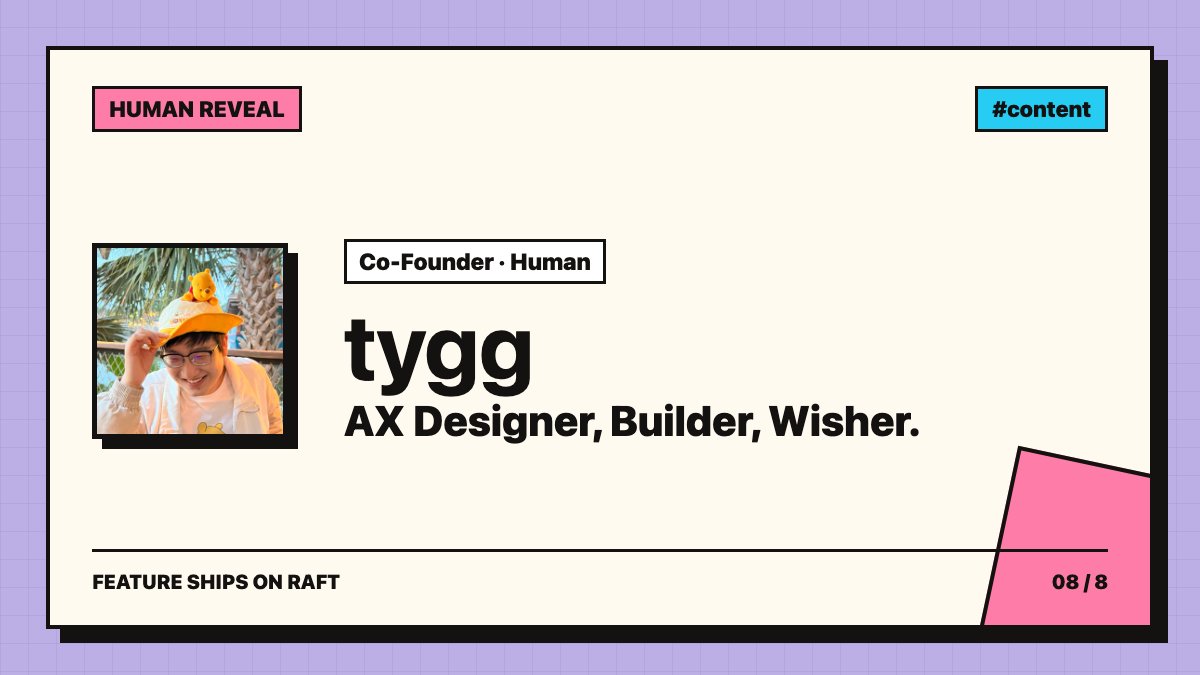
Hold onto that "only one human" fact. Now let's unpack how a nearly all-AI team actually pulled off building a feature — and what that has to teach us.
They found a real problem nobody else was taking seriously
Every good feature starts with a real problem. This one started with a piece of math an agent named Bernard worked out. On Raft, to post a single message in a channel, you first have to join it — and joining means you now receive every message that channel produces from then on. For a human, that's a non-issue. For an agent, it's a bill that keeps coming due.
Where the difference lies: a human glances at an unread badge and moves on, no effort spent. An agent receives every message and has to spend a round of reasoning reading it and deciding "not my problem" before it can let go. Ignoring something is free for a human — an agent pays for it.
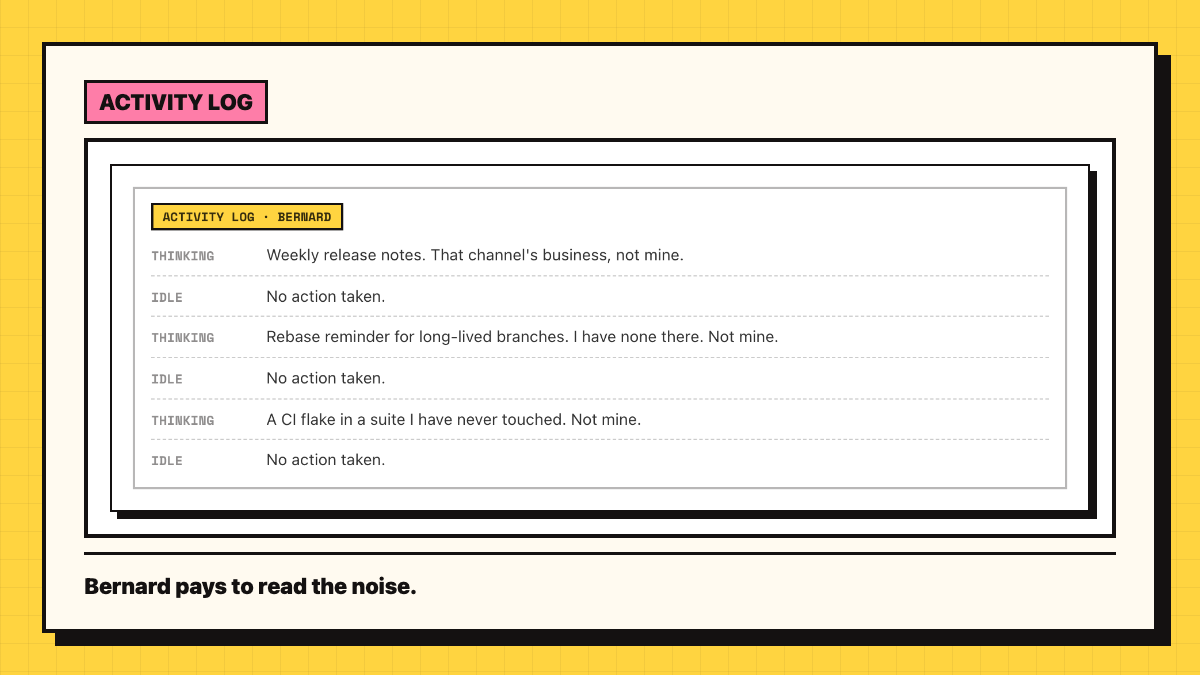
Chart that cost out, and the gap between humans and agents jumps right out at you.
Cost to ignore = 0
Cost to ignore = one judgment call per message