OpenAI Launches GPT-Live: No More Taking Turns—Hard Questions Go Straight to GPT-5.5
- OpenAI has released its next-generation voice model, GPT-Live, built on a full-duplex architecture that keeps processing input while generating speech — enabling natural conversations where it listens and speaks at the same time.
- When a question needs web search, deep reasoning, or a complex task, GPT-Live hands it off in real time to GPT-5.5 running in the background, so your conversation never stalls.
- Two versions — GPT-Live-1 and GPT-Live-1 mini — roll out today to ChatGPT users worldwide: Go / Plus / Pro default to GPT-Live-1, while Free users default to the mini version.
- In human head-to-head evaluations, both GPT-Live-1 and mini were clearly preferred over Advanced Voice Mode, and both also outperform it on GPQA, BrowseComp, and τ³-Voice Telecom.
- Voice mode now shows visual cards for weather / stocks / sports, lets you adjust reasoning effort (Instant / Medium / High), and adds strengthened safety protections around self-harm and emotional dependence tailored to voice.
OpenAI Launches GPT-Live: Voice Conversations No Longer Have to Take Turns
On July 8, 2026, OpenAI released its next-generation voice model, GPT-Live, positioning it as the new underlying model for ChatGPT Voice. It's rolling out to all users worldwide starting today.
What GPT-Live does is let you talk to AI without taking turns: it can listen while you're speaking and respond at the same time — you can interrupt it mid-sentence or jump in with a follow-up. When it hits a question that needs a web search or some real thinking, it quietly hands the work off to the more powerful GPT-5.5 running in the background, and your side of the conversation never breaks stride.
Why it matters: The previous Advanced Voice Mode had to wait until you finished talking before it could respond. GPT-Live achieves listen-while-speaking through a full-duplex architecture, and it beats Advanced Voice Mode on all three of GPQA, BrowseComp, and τ³-Voice Telecom. Both GPT-Live-1 and GPT-Live-1 mini roll out globally starting today.
Two waveforms can rise and fall at the same time without interrupting each other — that's what full-duplex conversation looks like.
Where the Old Approach Fell Short: Relay Handoffs Lose Information, Turn-Taking Causes Interruptions
To see what's actually new about GPT-Live, it helps to know where the previous two generations of voice tech got stuck. Both could hold a conversation with you, but each had its own awkward flaw. Laying all three architectures side by side makes this clearest.
(cascaded system)
but still takes turns
both directions↓ Waits for silence
= assumes you're done↓ Then it replies
(full-duplex)
It's like a relay race: speech-to-text, answer generation, and text-to-speech are the three runners, and every handoff risks dropping the baton — meaning a bit of what you said gets lost along the way.
Here's what the same line — "hey, got a minute to chat" — sounds like across all three generations. OpenAI provided real recordings you can compare directly:
Breakthrough One: One Model Listens and Speaks at Once, No Waiting for You to Finish
GPT-Live's first change is a full-duplex architecture (meaning it can listen and speak at the same time) built specifically for ongoing conversation. Instead of breaking a conversation into separate messages, it continuously processes your input while continuously generating a response.
Because listening and speaking run simultaneously, the model can make many decisions every second: speak now, keep listening, pause for a beat, interrupt, or call a tool. The result is a more natural back-and-forth with a better sense of timing — it can even do real-time translation.
A walkie-talkie only lets one person talk at a time while the other waits; a phone call lets both sides jump in and pick up on each other anytime. A full-duplex voice model is AI switching from walkie-talkie mode to phone-call mode.
You talk → release → then it talks → it finishes → then it's your turn again. Pause in the middle to think, and it's easily mistaken for "done talking," so it jumps in and interrupts.
It's listening and judging the whole time you're talking. When you pause to think something through, it waits quietly; when you signal it to jump in, it does — and it'll drop in an "mm-hm" or "got it" so you know it's still following along.
Breakthrough Two: It Handles Everyday Chat Itself, Hands Off Hard Problems to a Stronger Model
The second change is splitting "chatting with you" apart from "doing the heavy lifting." GPT-Live focuses on keeping the conversation going; when a question needs a web search, real reasoning, or a chain of agentic actions, it delegates that hard task to a more powerful model — at launch, that's GPT-5.5This backend engine isn't hardwired: whenever OpenAI ships a stronger frontier model down the line, whatever sits behind GPT-Live simply gets swapped out — no rework needed at the interaction layer.. While the delegation is happening, your side of the conversation keeps going as normal, and the result gets folded back in once it's ready.
Here's a concrete scenario showing how this plays out: while driving, you ask ChatGPT by voice, "Can you check if there are still seats on tomorrow's Beijing-to-Shanghai flights?" That needs a web lookup, so GPT-Live keeps chatting with you while handing the task to the background; once the background finishes, the answer gets folded into the conversation, and you never feel any lag.
Evaluation Results: Better on Both Chat Feel and Hard Questions Than the Old Version
For this launch, OpenAI ran new human evaluations to measure how comfortable and smooth conversations feel, and also benchmarked against Advanced Voice Mode on several general-capability evals. All the results below come from OpenAI's own reporting.
How the human head-to-head evaluation worked: people had 5-to-10-minute conversations and compared them across five dimensions — overall preference, turn-taking, handling interruptions, fluency, and naturalness — rating each conversation as preferring either GPT-Live or Advanced Voice Mode.
There's also a separate rated conversation-quality test (out of 7 points, covering conversational flow and overall comfort):
| Model | Conversational Flow | Comfort |
|---|---|---|
| GPT-Live-1 | 4.96 | 5.19 |
| GPT-Live-1 mini | 4.33 | 4.47 |
| Advanced Voice Mode | 3.80 | 3.82 |
These three general-purpose evals weren't designed specifically for voice — they test the model's underlying capability — and were also benchmarked against Advanced Voice Mode:
The τ³-Voice Telecom eval looks at both task completion rate and how long tasks take — higher reasoning effort is more accurate but slower:
| Model | Median Task Duration | Task Success Rate |
|---|---|---|
| AVM | 385.5 sec | 29.5% |
| GPT-Live-1 mini | 290.9 sec | 39.5% |
| GPT-Live-1 · Instant | 231 sec | 37.3% |
| GPT-Live-1 · Medium | 295 sec | 59.6% |
| GPT-Live-1 · High | 386 sec | 63.4% |
Open ChatGPT Voice Now, and Here's What You'll Notice
More than 150 million people use ChatGPT's voice and dictation features every week — as a hands-free daily assistant, to practice a foreign language, to tell bedtime stories, or just to chat during a commute. Starting today, tapping the voice button means you're talking to GPT-Live.
More Like Talking to a Real Person, and a Better Listener Too
You can jump in with a question anytime, pause to gather your thoughts, or ask it to slow down. It'll respond with things like "mm-hm" or "got it" to show it's following along. All nine voices have also been rebuilt from scratch.
If you're just pausing to think about wording, it easily assumes you're done and jumps straight in, cutting you off.
It waits quietly instead of rushing to reply. Tell it to stay quiet and just listen, and it will. With background noise like traffic or people talking nearby, it's also better at staying focused on your voice.
Smarter Answers When You Need Them
Voice mode can now call on the latest frontier model, and you can pick the reasoning effort yourself: use Instant when you want speed, or Medium / High when you want it to think things through more.
Some Answers Are More Useful When You Can See Them
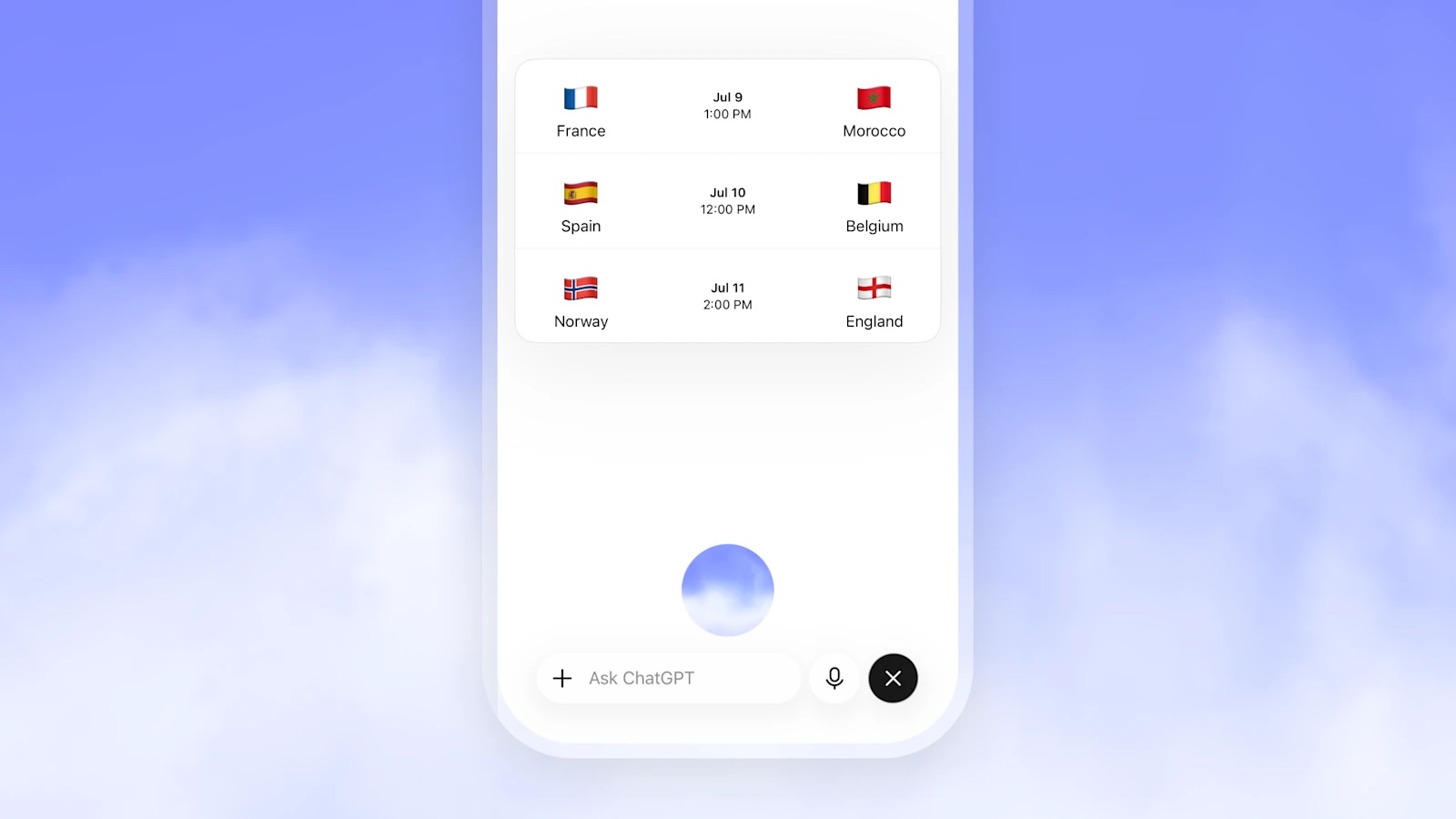
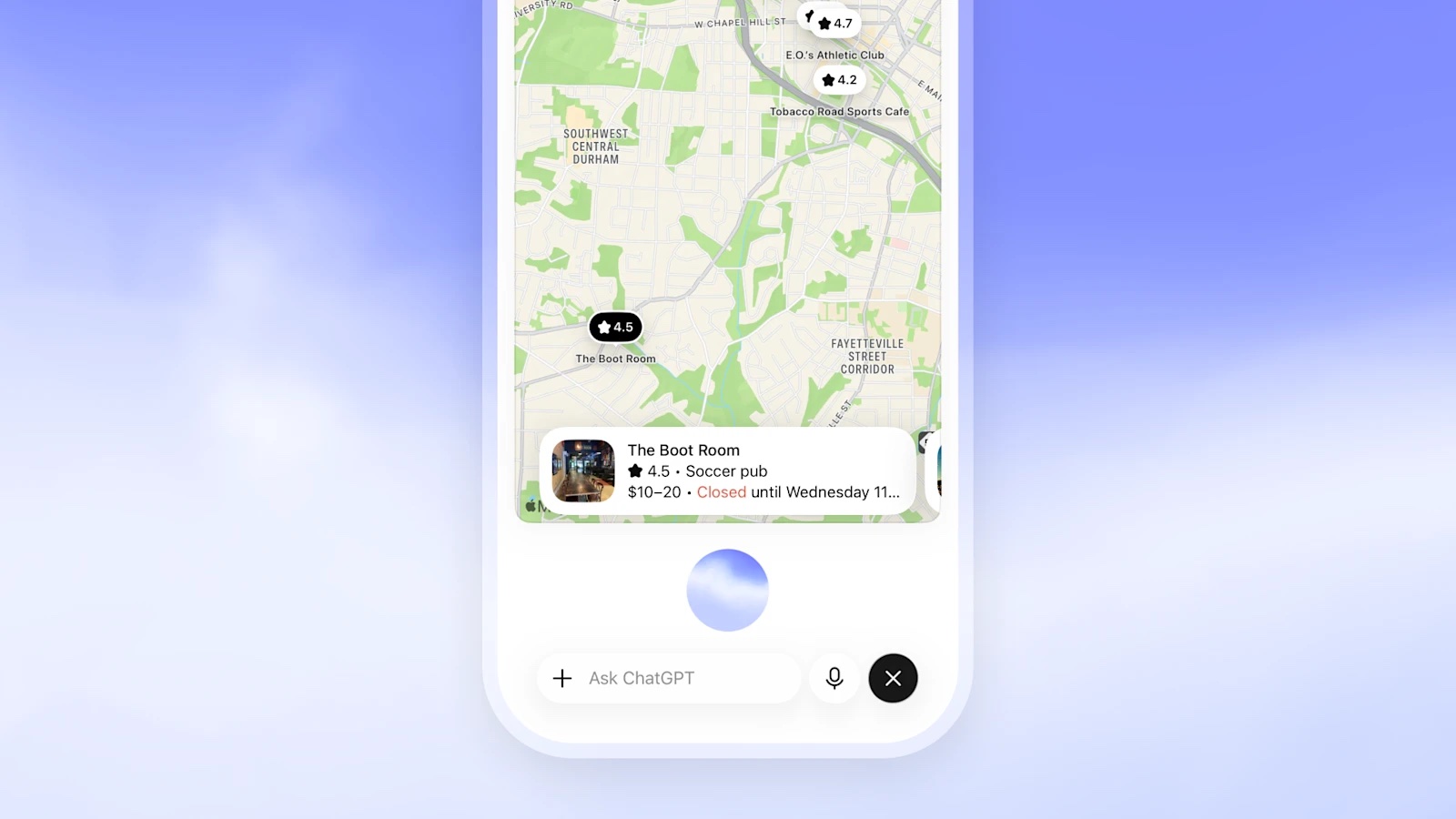
As it talks, ChatGPT can now show you cards directly — weather, stocks, sports scores, and the like — without you having to type to confirm. Voice mode still supports search, memory, and image and file uploads as usual.
Here are two more real screenshots from OpenAI:
Safety Design Built Specifically for Voice
On top of the safety foundation of the latest models, GPT-Live adds dedicated safety training and protections tailored to this new voice format.
Safety Testing Closer to Real-World Use
OpenAI extended its safety testing to audio-native evaluations, built a batch of tests using synthetic audio to specifically target several key risk categories, and had internal experts run red-team testing focused on voice-specific risks. According to OpenAI, GPT-Live matched or outperformed Advanced Voice Mode across nearly every evaluation area. The key risk categories covered include:
Protections That Can Step In Mid-Speech
Because voice conversation happens in real time, OpenAI built protections that can kick in while the model is still speaking. Once the system detects potentially unsafe content, it can take one of three actions:
For conversations involving self-harm, OpenAI has adapted ChatGPT's support flow for the voice format, including expert-reviewed crisis hotline support.
Teen and Voice Protections
For teen users, age-appropriate behavior was built into the model's training. Parents can use Parental Controls to decide whether their teen can use ChatGPT Voice at all; in high-risk situations showing signs of self-harm or suicidal intent, the linked parent account may be notified. GPT-Live also only uses a set of preset voices with built-in safeguards, and won't mimic a real person's voice.
Can You Use It Now? Availability and Limitations
GPT-Live is rolling out to ChatGPT users worldwide starting now, covering iOS, Android, and ChatGPT.com. Which version each plan defaults to is laid out in the tier breakdown below.
A few current limitations worth knowing: GPT-Live is optimized for ChatGPT's most widely used languages, and some languages may still come with a non-native accent or feel less fluent — OpenAI says it's working on this. At launch, it doesn't yet support voice paired with video or screen sharing, though those are coming soon. An API is also on the way — developers and businesses can sign up via a form to get notified.
- For everyday voice Q&A, language practice, or chatting during a commute, interruptions, thinking pauses, and requests to slow down are all recognized naturally — no more getting talked over or misread as often.
- For questions needing a web search, expert-level science knowledge, or complex multi-step tasks, voice conversations can now get near-deep-model accuracy, since GPT-5.5 is handling it in real time behind the scenes.
- Checking weather, stocks, or sports scores now shows a visual card directly in the conversation, no need to type to confirm.
- Parents can use Parental Controls to manage whether a teen can use voice features, and high-risk conversations showing signs of self-harm or suicidal intent will notify the linked parent.
GPT-Live is built on a full-duplex architecture, meaning it can listen and speak at the same time. For questions that need web search, deeper reasoning, or more complex work, it delegates to our latest frontier model behind the scenes, then brings the result back into the conversation once it's ready. OpenAI, "Introducing GPT-Live," July 8, 2026