MIT Builds a Robotic Bird That Swims and Flies Without Paddling Feet
A 250-gram robot crosses water and air with the same flexible wings, taking off from a lake at a 70° pitch after 8–10 wingbeats
An MIT and EPFL team placed a roughly 250-gram flapping-wing robot in Lake Geneva. It swam upward, broke the surface, kept beating the same pair of wings, and flew away—without switching propulsion systems or using feet to paddle across the surface.
- Water is about 1,000 times denser than air, forcing the same wings to handle radically different loads.
- The flexible membrane wings bend passively underwater, reducing wingtip amplitude by 60–90%, then regain enough motion and lift after leaving the water.
- Every test at a 70° exit angle succeeded; the robot cleared the water in roughly 8–10 wingbeats.
- The paper demonstrates cross-medium locomotion, but waves, turning, autonomous sampling, and long-duration ocean missions remain untested.
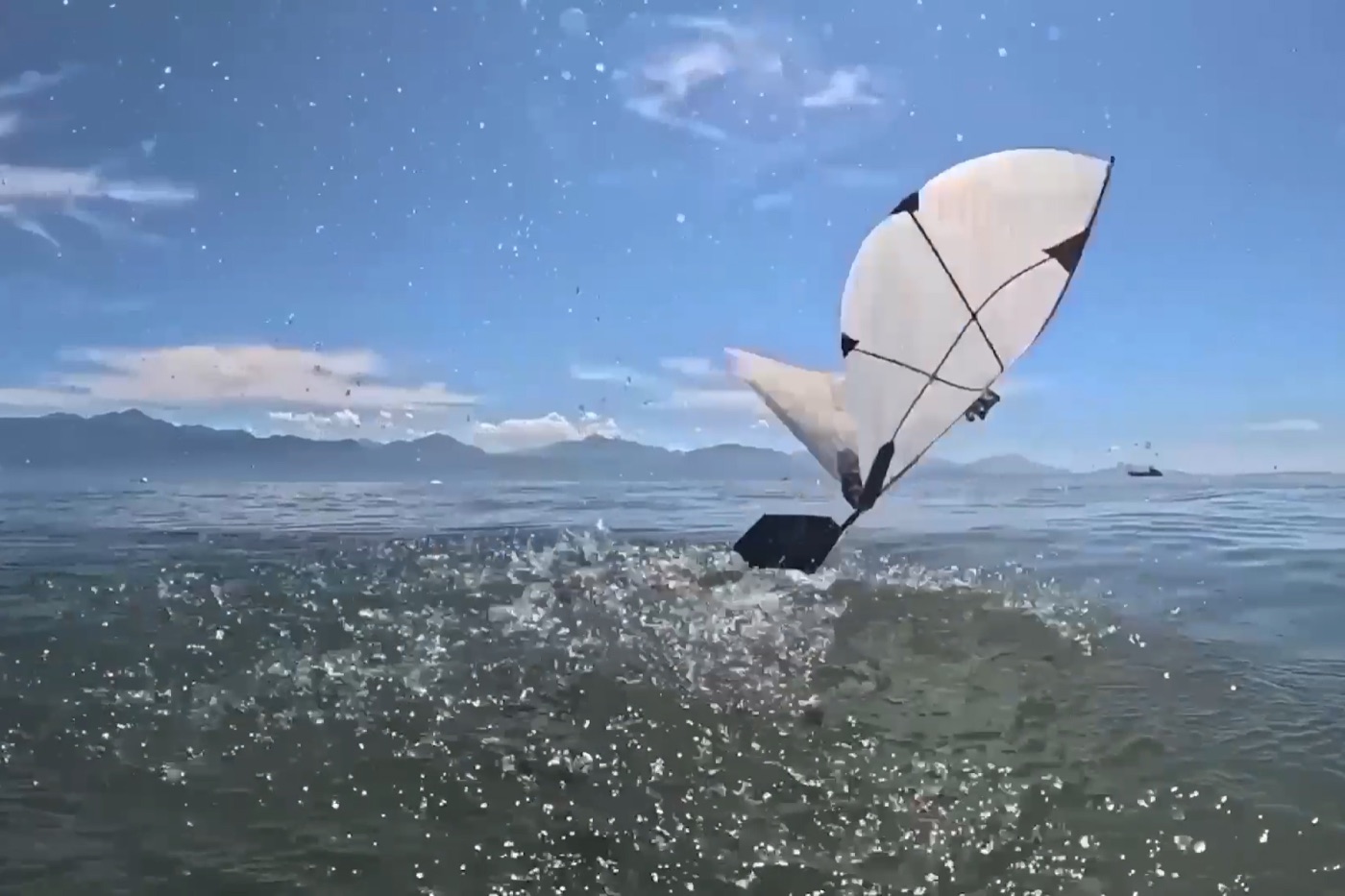
A robotic bird flaps straight out of a lake
The robot has a fuselage, two membrane wings, and an adjustable tail. A waterproof motor drives a crankshaft that pumps the wings up and down, while the tail controls pitch and diving. Hydrophobic nanoparticles coat the wings so they shed water faster during takeoff.
It can also reverse the transition: entering the water at about 5 m/s, rapidly slowing to roughly 0.5 m/s, and continuing to swim with its wings. The paper calls the system FAAV, short for flapping-wing aerial–aquatic vehicle.
The hard part is making the same wings work in water and air
Flying robots are common, and swimming robots are hardly rare. Combining both abilities in one machine creates a conflict the moment its wings touch water.
Air is thin, so the wings must sweep quickly through a larger volume to produce enough lift. Wings that are too small or soft cannot keep the robot aloft.
Water is about 1,000 times denser than air. Beating at aerial amplitude causes drag to soar and can push the motor to its torque limit.
Fluid-scaling estimates suggest that flapping frequency should change about twelvefold between water and air to preserve similar propulsive efficiency. Yet diving birds such as puffins and petrels typically change it by only two to four times. They reduce underwater stroke amplitude and wing area, keeping their muscles within a narrower operating range.
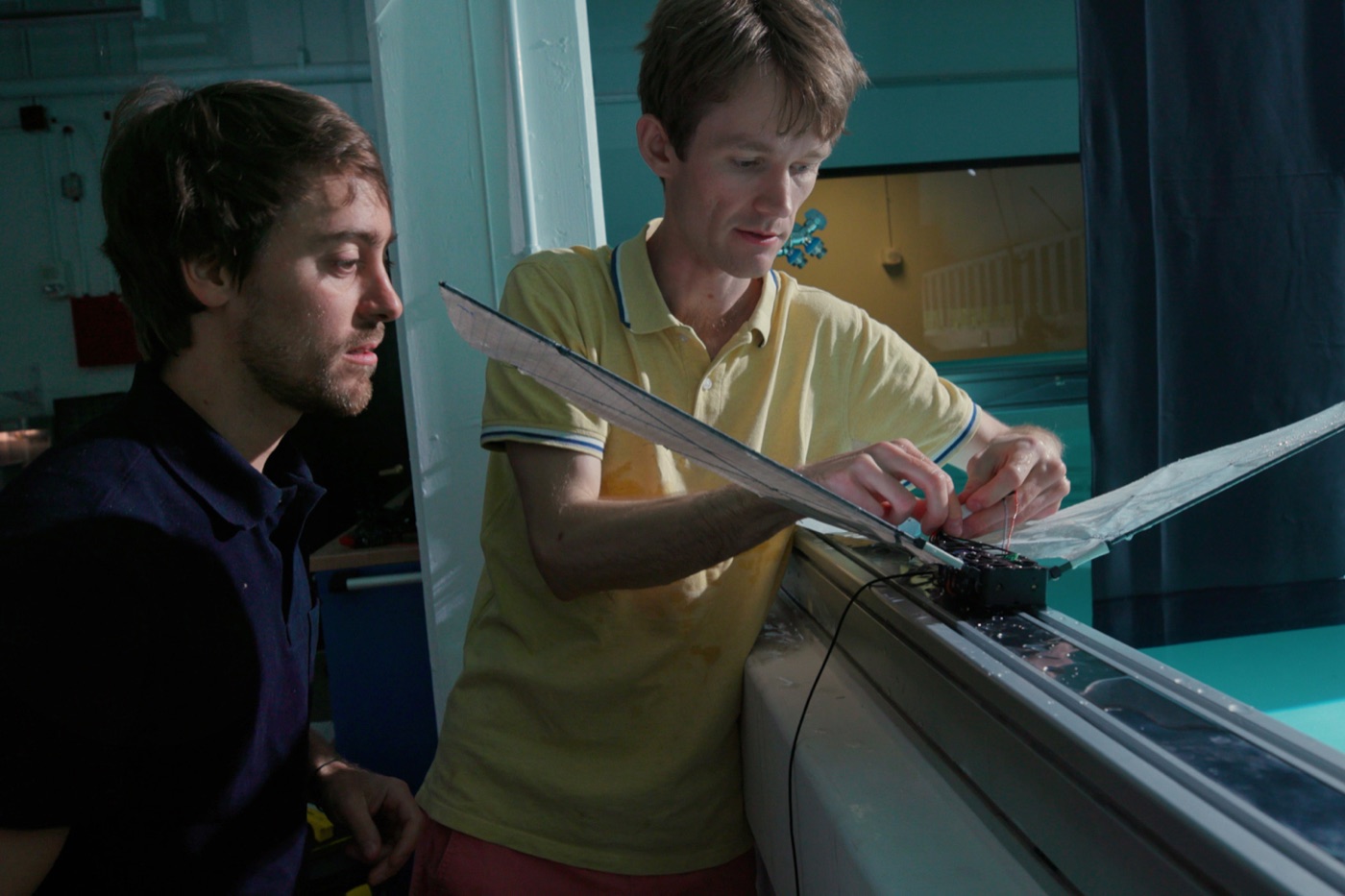
The team used the robot as a repeatable, tunable “mechanical bird,” swapping three wing sizes and five stiffness levels while varying flapping frequency and tail angle. Animals cannot reliably repeat the same maneuver on command; robots can.
| Previous approach | How it crosses media | Trade-off |
|---|---|---|
| Two propulsion systems | Rotors in air, propellers underwater | More weight, drag, and structural complexity |
| Extra exit mechanism | Buoyancy, combustion, or launchers supply exit energy | Hard to repeat continuously; limited value as a biological model |
| Complex folding wings | Actively fold underwater and unfold after exit | More joints, seals, and control steps |
No folding mechanism: the wings deform under load
The design relies on a passive compromise. The wings need no command telling them to fold underwater; the load imposed by the water bends them automatically.
In experiments, the small wings were fastest underwater at 5 Hz, reaching about 0.95 m/s, but could not produce enough thrust for low-speed takeoff. Large wings helped in flight but reduced underwater speed to about 0.64 m/s. Medium-sized, medium-stiffness wings became the compromise: roughly 0.79 m/s underwater and 6.3 m/s on average in air.
A 70° pitch turns water exit into three stages
Flexibility alone is not enough. The approach angle must give the wings room to work. Too shallow and the wingtips keep striking the water; too steep and the body can tip backward into the lake.
The tail pitches the body to about 70° while the wings keep pushing upward underwater.
The first four strokes rely mainly on hydrodynamic thrust; on the fifth, the wings skim the surface and shed attached water.
After roughly six to seven strokes, frequency reaches 10 Hz; two more strokes bring the tail fully out of the water.
In lake tests, the robot typically took off in 8–10 wingbeats. Every reported trial at 70° succeeded, and the paper states that free flight was achieved within one second. Unlike puffins and ducks, it did not paddle with its feet.
Not using feet does not make the exit easy. Power per unit mass during water exit is about 2.6 times aerial cruising and more than ten times underwater cruising, making it the most demanding phase of the sequence.
It proves cross-medium motion, not readiness for ocean work
The study matters on two levels. In engineering, it delivers a lightweight flapping platform that can repeatedly cross between water and air. In biology, it lets researchers systematically vary wingspan, stiffness, frequency, and exit angle to test why diving birds use similar movement strategies.
What the paper measured
- Multiple wind-tunnel, pool, tank, indoor-flight, and natural-lake tests
- Three wing sizes, five stiffness levels, and multiple flapping frequencies
- 11 lake exits plus 15 tank trials across approach angles
- Hardware demonstrations of flight, swimming, water exit, and plunge diving
What remains unshown
- Reliable exit in waves, turbulence, and severe weather
- Active wing steering and full autonomous navigation
- Endurance and reliability with sampling payloads
- Long-duration ocean patrols and high-frequency repeat missions
Based on the current battery, power, and speed, the paper estimates about 6 km of flight or 2 km of low-frequency horizontal swimming per charge. These figures come from a power model, not completed end-to-end range tests.
The team envisions launching it from shore or a boat to fly near icebergs, port facilities, or whale pods, dive to measure or sample, then return with data. Reaching that point still requires steerable wings, wave stability, autonomous control, communications, and sensor payloads.
In one sentence:The advance is not an added underwater propulsion system. It is using fluid load to make the same flexible wings switch states automatically, moving continuously from hydrodynamic thrust to aerodynamic flight.
Primary sources:MIT News; Zufferey et al., “Leaping out of the water: aerial-aquatic locomotion with flapping wings,” Science 393, 207–211 (2026); MIT open-access paper and supplementary materials.
Images and video remain the property of their creators and MIT. Speed, power, frequency, exit angle, and trial counts come from the paper and its supplementary materials.