Breaking Down Dan Koe's Essay: 3 Tensions and 5 Levers of Human Persuasion — Steal These for Your Copy
- Dan Koe posted a long essay on X arguing that "understanding human nature" is the one meta-skill the AI era can't make obsolete — it amplifies whatever other skill you learn.
- He splits the human psyche into three tensions: survival tension, identity tension, and growth tension — mapping to Maslow's hierarchy from bottom to top.
- The essay gives 5 psychological levers you can apply directly: name the threat, mirror identity, exclude the outsider, paint the transformation, and give the first step.
- He cites Eugene Schwartz's "five stages of awareness" as a diagnostic tool for figuring out where your reader stands and what to say to them.
- The original post links to the author's own paid writing bootcamp twice, saying it starts in 5 days.
Nobody Knows What Skill to Learn — Except This One
What should you learn? AI? Coding? Marketing? Everyone else is already vibe-coding apps with AI — is going back to school a waste of time? Should you do YouTube or write a newsletter? Get a job, or go solo?
That string of questions opens the long essay creator-economy heavyweight Dan Koe posted on X on July 4. He says there are more opportunities than ever, but more options just leaves people paralyzed — whatever you learn, you're afraid it'll be obsolete in two years. Then he drops the hook: there's one skill that never goes obsolete, a "meta-skill." What is it?
He says he's not here to teach you how to write a novel — he's teaching the underlying mechanics of "creating value": once you get it, you'll write better, speak better, build better products, and attract more clients and friends.
Machines Solve for Efficiency; Humans Are Only Hooked by Story
Why does understanding human nature generalize so well? Start with a contrast. Machines are best at handling "efficiency," but nobody actually cares about efficiency — what grabs people is suspense and novelty wrapped in a story.
- Waiting hours at the DMV just to renew your license photo
- A fast-food order gets messed up — nobody's happier for it
- Sitting in a stranger's back seat for a rideshare, getting small-talked with "how's your day going"
- Your team is about to lose in the final quarter and your chest tightens
- People will fly halfway around the world for one five-star meal
- A story loaded with stakes and novelty — humans are wired to want to know what happens next
Hand efficiency off to the machines, and people have the bandwidth left over to chase meaning, purpose, and story. Dan Koe's take: mastering human nature is really mastering the underlying mechanics of storytelling.
The mind is a story engine — that's exactly what humans can't help but pay attention to.Dan Koe, original post
The Three Switches in the Human Mind: Fear of Dying, Fear of Being Excluded, Fear of Standing Still
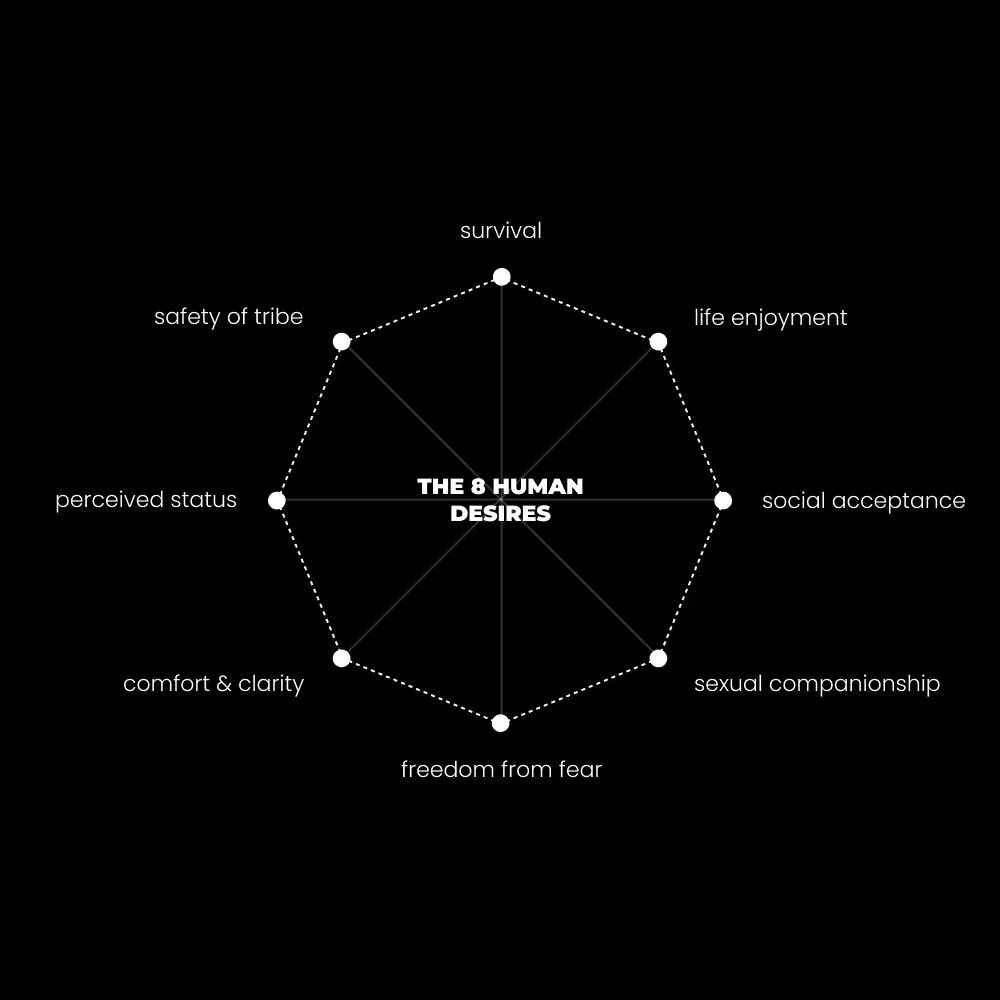
There are three pressure points in the human mind. Flip any one of them and attention becomes almost involuntary; flip all three at once and reasoning alone won't get you free of it. These three pressure points map exactly onto Maslow's hierarchy of needs, bottom to top.
The three tensions: survival, identity, growth. They're a "persuasive-writing translation" of Maslow's hierarchy, explaining why these switches work on almost everyone. Until someone's lower-level needs are met, their attention stays narrow — they can't spare bandwidth for anything higher up.
- You wake up at 30 and realize you've been living on autopilot — the gap between who you are now and who you want to become feels so wide that even change seems impossible.
- You spend ten years helping someone else chase their dream, only to find out they never cared about you at all.
- Some people who are dumber than you make 10x more money — simply because they don't get hung up on risk.
- When your team is about to lose, you feel personally insulted — someone jokes about it and you might actually want to fight them.
- You pick a side — "anti-AI" or "pro-AI" — then spend all day arguing about it, repeating lines like "AI is rotting our brains."
- Humans are wired to want a tribe, status, belonging — because without them, your odds of survival drop.
- People need safety and comfort first, then belonging and status, and only then do they crave deeper meaning, direction, and transformation.
- When the environment isn't safe, or you're under chronic stress, the mind narrows and can't think about anything beyond the problem in front of it.
- Once the lower-tier needs are roughly met, people start craving clarity, direction, purpose, and transformation.