Working with Claude Fable 5, the real skill is finding your own "unknowns" first
- Anthropic employee Thariq wrote a long-form post distilling a practical set of techniques for locating "unknowns" when working with Claude Fable 5.
- The core framework splits unknowns into four types: known knowns, known unknowns, unknown knowns, and unknown unknowns.
- 8 concrete techniques are spread across three stages — pre-implementation, during implementation, post-implementation — covering blindspot passes, reverse interviews, source-code references, implementation notes, quizzes, and more.
- Every technique comes with an English prompt you can copy verbatim.
- The case study section shows how this method applies to editing a Fable launch video — a domain the author himself wasn't familiar with.
What actually gets you stuck when working with Claude
Thariq (a member of Anthropic's Claude Code / Claude Design team) published a long-form post on X on July 3, 2026, distilling a set of practical techniques for locating "unknowns" when collaborating with Claude Fable 5.
Working with Claude Fable 5, the author found that the quality of the work kept getting stuck in the same place: whether he could articulate the "unknowns" he hadn't yet thought through. This piece breaks "finding unknowns" down into 8 actionable techniques, each with a prompt you can copy directly.
Why it's worth reading: the author is a member of Anthropic's Claude Code / Claude Design team, and the 8 techniques are distilled directly from real projects like editing the Fable launch video — grounded in hands-on practice. Each technique comes with the original English prompt, ready to copy and use.
An old saying the author kept coming back to is: the map is not the territory. The map — a simplified description of the work to be done — is the prompts, skills, and context you give Claude. The territory is where the work actually happens: the codebase, the real world, its actual constraints. The gap between the two is what he calls the "unknown." When Claude hits an unknown, it can only make its best guess at what you want and decide from there. The more work there is to do, the more unknowns it's likely to run into.
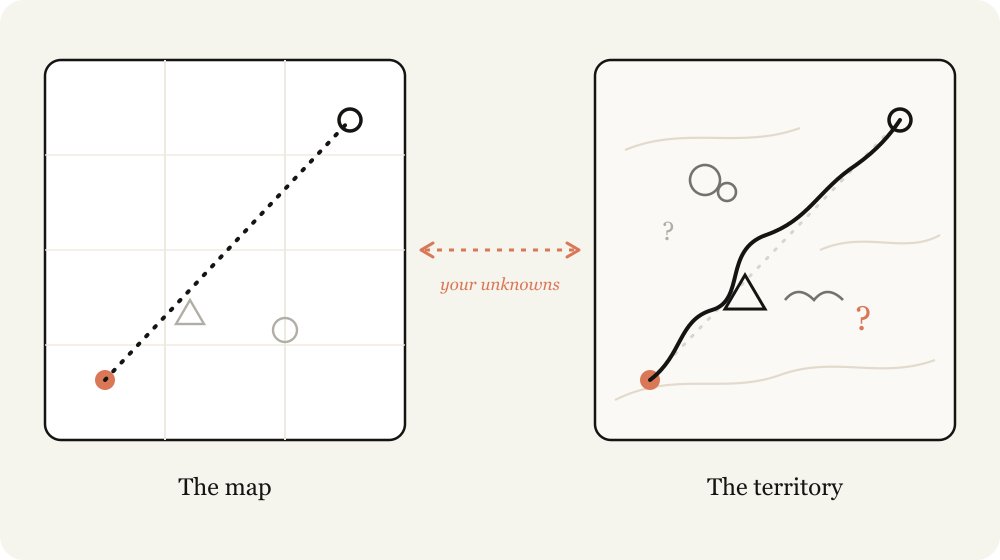
The author says Fable is the first model that made him feel "the quality of the work is bottlenecked by my own ability to articulate unknowns." And planning ahead of time isn't always enough on its own: unknowns can surface deep inside implementation, and can also flip the script — telling you the problem should really be solved a completely different way. So working with Fable is a continuous process of discovering your own unknowns before, during, and after implementation.
Which kind of "not knowing" are you actually missing
When the author brings a problem to Claude, he's in the habit of first sorting his unknowns into four boxes. The bigger the job, the more likely you are to fall into the last two: the things you're not even aware of, or things so taken for granted you'd never think to write them down.
What's written into the prompt — what you explicitly told Claude you want.
Example "I want a login button in the top-right corner."
Things you know you haven't fully figured out, but you're aware there's a gap there.
Example "I haven't decided whether this list needs pagination."
Common sense so obvious you'd never write it down, but you recognize it the instant you see it.
Example "That color scheme is too jarring — I know it's wrong at a glance."
Blind spots you never even considered — you don't even know how good "good" could be.
Example "I had no idea video editing could automatically cut out pauses via code."
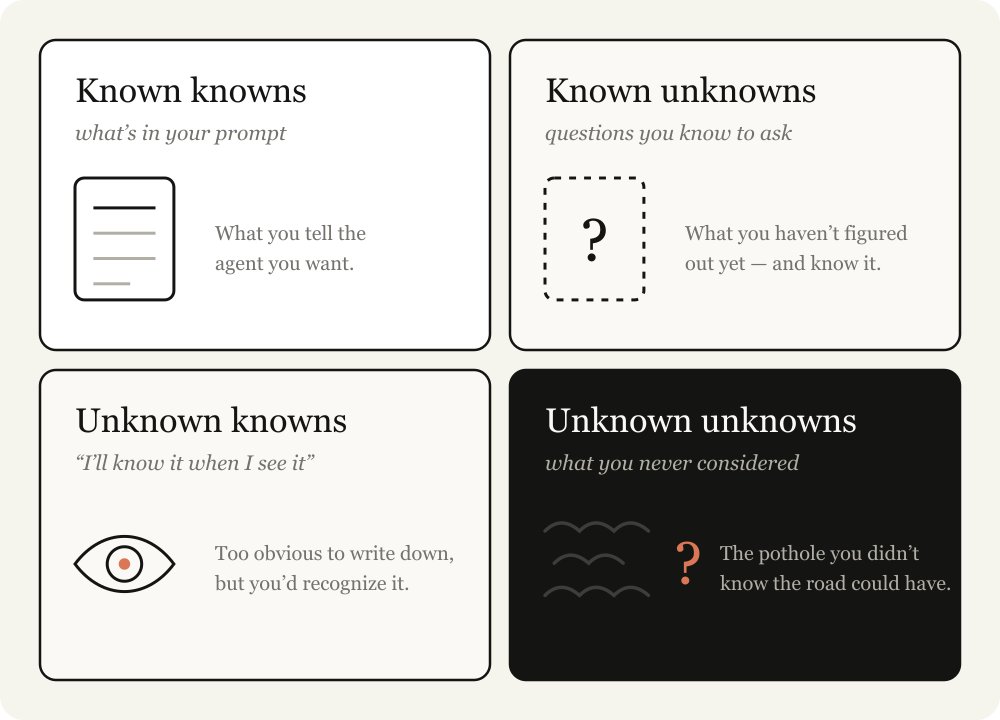
It's a bit like moving into a new home: known knowns are the shopping list you've already made; known unknowns are knowing the living room is missing some piece of furniture but not having decided what to buy; unknown knowns are things you'd never write down but instantly recognize — "that outlet is in the wrong place"; unknown unknowns are not even knowing that underfloor heating was an option.
The author observes that the strongest collaborators — people like Boris Cherny or Jarred Sumner — have relatively few unknowns: watching them write prompts, it's clear they know exactly what they want and are closely in sync with both the codebase and the model's behavior. But they still leave room for unknowns. Reducing your unknowns and planning ahead for them is, in a sense, the core skill of working with Claude — and it's a skill you can practice by working with Claude itself.
Why both being too specific and too vague with Claude backfires
Directing Claude is like walking a tightrope. Be too specific, and it will mechanically follow every step you wrote, even when it should change course midway; be too vague, and it will guess based on generic industry best practices, which may not fit your situation. When you haven't sorted out your own unknowns, you fail on both ends: you don't know which stretches of the path have pitfalls, and you don't know which stretches are actually clear — yet you still want it to turn when a turn is needed.