xAI Launches Grok 4.5: Rivals Opus 4.8, ~2x Faster, Quarter the Price
- xAI launches Grok 4.5: official and Musk's own framing put it near "Opus-class," but the pitch is speed and cost; co-trained with Cursor, positioned for coding, agentic work, and knowledge tasks.
- DeepSWE 1.0 score of 62.0% ranks third; SWE Marathon 29% ranks first; third-party Artificial Analysis puts it 4th overall (score 54), with a Coding Agent Index of 76 tying GPT-5.5.
- Output speed ~80 TPS, roughly 2× faster than Opus 4.8; output pricing $6/million tokens, about a quarter of Opus 4.8's $25; AA measures per-task cost at ~$0.31, though hallucination rate rose to 54%.
- Priced at $2/million input tokens and $6/million output tokens; already the default model in Grok Build, rolled out across all Cursor plans, plus official add-ins for Word, PowerPoint, and Excel.
- Trained on tens of thousands of NVIDIA GB300 GPUs, with reinforcement learning spanning hundreds of thousands of tasks centered on software engineering; not yet available in the EU, expected mid-July.
xAI Launches a New Flagship: Grok 4.5
On July 8, 2026, xAI launched Grok 4.5, positioning it as their strongest model yet, built for coding, agentic tasks, and knowledge work — trained in partnership with the code editor Cursor.
One Sentence, One Spinning Solar System
Before the benchmarks, look at what it can actually build. In one official example, a single prompt was enough for Grok 4.5 to generate an end-to-end, fully working three.js solar system simulator — adjustable speed, realistic orbits, a starfield, and a styled HUD. Officials emphasize that even with a bare-bones prompt, the output is a complete, ready-to-use application.
One natural-language instruction, all the way to a complete, interactive, real-time-running front-end app. Beyond demos like this, officials also note it can handle challenging Rust and C / C++ tasks — end to end, from prompt to finished product.
Same challenge: one prompt + one reference image to rebuild a 3D globe dashboard
Developer @hqmank ran the same challenge he previously used on Fable 5: one prompt plus one reference image, task = rebuild a Three.js 3D globe dashboard.
His take: lighting, glass panels, depth, and spacing all matched; the Three.js scene rendered correctly on the first try; frontend quality was better than expected. On this task he ranks Grok 4.5 above Opus 4.8, with only Fable 5 still ahead.
Where It Actually Lands on Coding Tests
Here's the DeepSWE 1.0 score officials released. DeepSWE 1.0 is a benchmark for how well an AI handles real-world software engineering tasks, scored on pass@1 — solving the task correctly in a single attempt (like an exam with no do-overs). On this leaderboard, Grok 4.5 scores 62.0%, ranking third.
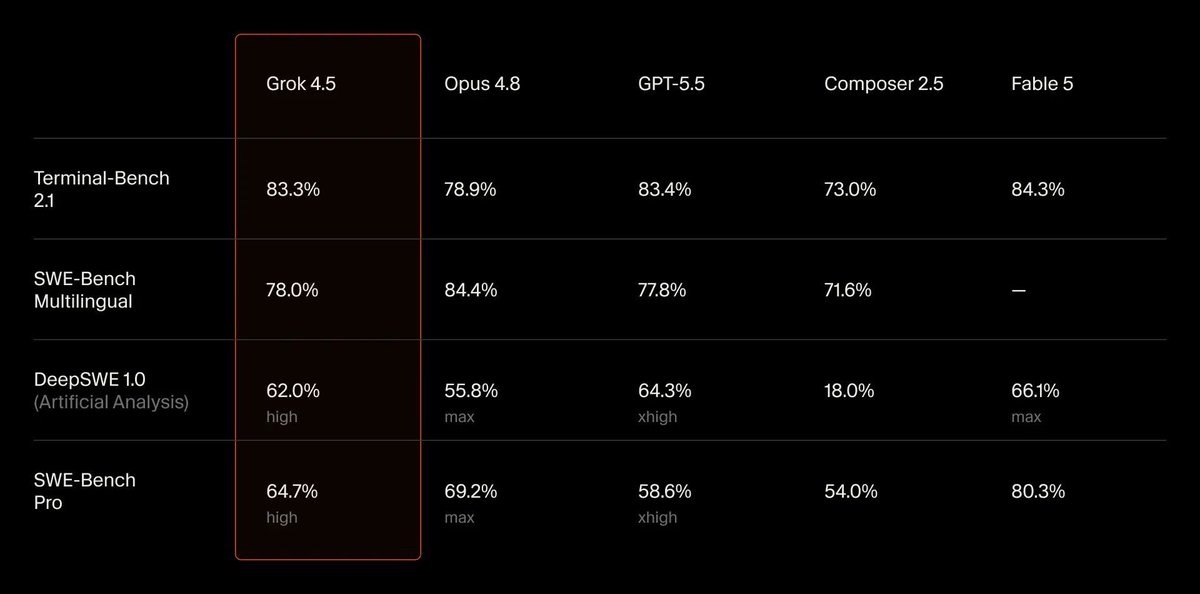
The same launch page lists several other coding-related benchmarks. Different scope, different rankings — some first place, some further down:
Independent evaluator Artificial Analysis published composite scores right after launch (not from xAI's own charts):
- Intelligence Index score of 54, 4th overall — behind only Fable 5, GPT-5.5, and Opus 4.8; up 16 points from the previous-generation Grok 4.3.
- Coding Agent Index (run in Grok Build) score of 76, tying GPT-5.5 in Codex, slightly behind Fable 5 in Claude Code.
- Per-task cost: roughly $0.31/task for the Intelligence Index; roughly $2.49–2.59/task for the Coding Agent Index (versus ~$11.80 for Fable 5 / Claude Code, ~$5.07 for GPT-5.5 / Codex).
- Average total tokens per Coding Agent task is about 1.9M, significantly less than Fable 5 (7.2M) and GPT-5.5 (6.2M).
- The weak spot is noted too: AA-Omniscience accuracy rose from 35% to 52%, but its hallucination rate rose from 25% to 54% — it knows more, and is more confident when it's wrong.
Third-party and surrounding coverage add some more context: Cursor says it co-trained Grok 4.5 with xAI, calling it their "first model that isn't only for software engineering." Some reports, citing Artificial Analysis and Musk-related disclosures, put Grok 4.5's parameter count at roughly 1.5 trillion — about 3× Grok 4.3 (the official launch page itself doesn't state a parameter count). Musk's public framing is "Opus-class, but faster, leaner, and cheaper." SpaceX's roughly $60 billion stock acquisition of Cursor back in June has been widely cited by outlets as the industry backdrop for this joint training effort.
Why It's Both Fast and Cheap
Grok 4.5's differentiation is concentrated on speed and cost. It didn't top the benchmarks, but it puts "flagship-level brains" together with "fast-model speed and low price."
It outputs at 80 TPS, reaching what the industry calls "fast model" territory; officials claim that on comparable tasks, its token efficiency is roughly double that of the latest flagship models — solving the same problem in under half the steps and tokens.
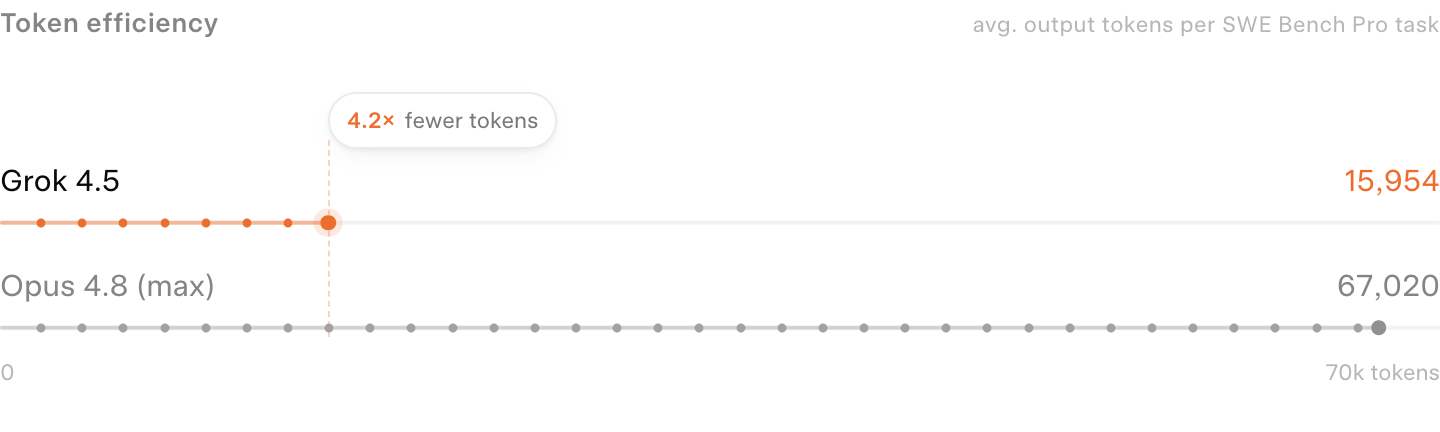
SWE-Bench Pro
For agentic use cases, this means sustaining longer autonomous runs and more back-and-forth within the same token budget and time.
What the Training Actually Involved
How was this capability built? Grok 4.5 was trained on tens of thousands of NVIDIA GB300s (NVIDIA's latest-generation high-performance GPU chip for large-scale AI training). Beyond just piling on compute, xAI says a big chunk of the effort went into curating and cleaning data: deduplication, quality scoring, and domain-based selection, so the training data is both broad in coverage and dense in signal.
The reinforcement learning stage covers hundreds of thousands of tasks, centered on multi-step software engineering, judged with a mix of automated scoring and model scoring. Their training architecture is highly asynchronous: a single agent can run autonomously for hours at a stretch, while tens of thousands of GPUs keep training in parallel.
Domain Filtering
Pretraining
RL (Async Rollout)
From Writing Code to Writing Excel, PPT, and Word
Grok 4.5's abilities aren't limited to coding. It's now the default model in Grok Build (xAI's command-line coding tool), and that same skill set now extends into the Excel, PowerPoint, and Word trio.
Each of the three has its own specific approach: Excel can research online while building multi-sheet models, and leaves notes for later reference; PowerPoint uses native shapes to draw complex diagrams and lay out clear slide content; Word writes well-organized, formal copy.
Excel
- Researches online, then builds models
- Uses formulas across multiple sheets
- Leaves notes / comments for later reference
PowerPoint
- Draws complex diagrams with native shapes
- Designs clear, intuitive slide content
- Builds out a full structure from a prompt
Word
- Writes clearly organized, formal copy
- Handles official/formal written expression
Outline a 5-slide quarterly business review
Word, PowerPoint, and Excel all now have official add-ins available for install through the Microsoft Marketplace.
What It Costs, and Where to Use It Now
Pricing and access: Grok 4.5 charges $2/million input tokens and $6/million output tokens. Layered on top of the token efficiency mentioned above, the actual bill for comparable coding tasks comes down even further.
Here's how it compares to peer flagships' public pricing (per million tokens):
| Model | Input | Output |
|---|---|---|
| Grok 4.5 | $2 | $6 |
| Opus 4.8 | $5 | $25 |
| GPT-5.5 / 5.6 | $5 | $30 |
| Fable 5 | $10 | $50 |
On specs, Artificial Analysis recorded a current context window of 500K tokens (down a tier from Grok 4.3's 1 million); Musk later said on X that it would "probably be back to 1 million next week or so." Modality is text + image input, text output.
Where you can use it now: Grok Build, all Cursor plans, and the xAI console (console.x.ai) are all live — grab an API key and you're wired up in a few lines of code. OpenRouter, Hermes Agent, and others also integrated it on launch day.
curl -s https://api.x.ai/v1/responses \
  -H "Authorization: Bearer $XAI_API_KEY" \
  -H "Content-Type: application/json" \
  -d '{
    "model": "grok-4.5",
    "input": "Find and fix the bug, then explain it: function median(a){a.sort();return a[a.length/2]}"
  }'
Artificial Analysis also noted a few more specs: cache hits run about $0.5/million tokens (roughly a 75% discount off list price); pricing doubles once input exceeds about 200K tokens; the current context window is 500K tokens (down a tier from Grok 4.3's 1 million, with Musk saying it'll probably be back to 1 million next week or so); vision input and configurable reasoning are retained. Cursor says usage doubled in the first week, and stresses that Grok 4.5 and its own Composer line are models at different scales — Composer 2.5 is staying.
⚠️ It's currently unavailable in the EU across any of xAI's products or APIs; officials expect a mid-July rollout there. Separately, Grok 4.5 is free to use in Grok Build and Cursor for a limited time.
What This Update Actually Delivers
Breaking this down by who benefits, here's roughly what's on the table right now.
-
Independent Developers
A single-sentence prompt produces a complete, working app directly — the path from idea to demoable prototype gets faster, and you can switch to it directly inside Grok Build or Cursor while coding.
-
Office Knowledge Workers
One more agent that can automatically build models, draw diagrams, and write copy: Word / PowerPoint / Excel add-ins are live, capable of multi-sheet Excel modeling that needs online research, PowerPoint diagramming, and formal document writing.
-
API Developers
Pricing of $2/$6 per million tokens, combined with roughly 2× token efficiency, means running more — and longer — autonomous agentic tasks on the same budget.
Overall, Grok 4.5 delivers the highest intelligence per unit of time and cost. From xAI's official "Introducing Grok 4.5"