VerifiedSourceDoorDash Engineering Blog07-14 · 14 min read⚑ Vendor content · take with context
🎧 Listen to the podcast0:00 / --:--
↓ Article body below · each piece has its own look
Deep Dive · XiaoHu Explains
How DoorDash Built a Great AI Shopping Assistant: It's Not Just the Model — It's Tools and Memory That Make It Work
After the memory system launched, grocery checkout conversion rose roughly 24%, and automated evals scaled daily eval volume from 1 human review to 2,000+ runs.
TL;DR
DoorDash launched Ask DoorDash, an AI assistant that searches restaurants, plans meals, and builds shopping carts through natural-language conversation, now in gradual rollout on iOS in parts of the US.
The architecture splits into four layers — an orchestrator agent, specialized domain agents, a shared tool layer, and managed services — with business logic living in the shared tool layer instead of being stuffed into prompts.
A three-tier memory system (long-term memory via offline batch processing, in-session memory updated in real time, and conversational memory with explicit extraction) powers personalization: 7 days of production data showed memory-backed grocery checkout conversion up roughly 24%, basket size up 17%, conversation turns down 7%, and restaurant recommendation conversion up 15%.
A homegrown eval framework uses AI to simulate users running against recorded tool data, running 2,000+ automated evals a day, lifting agent quality scores by 8 points and shrinking regression testing from 6 hours to 20 minutes — enabling a model backbone migration that cut latency by 35% without hurting quality.
⚑ Stance notice: This piece draws on DoorDash's official engineering blog trilogy and public remarks from co-founder Andy Fang. The conversion rate, basket size, and eval-scale figures cited are DoorDash's own self-reported results from a 7-day production window, not independently audited.
1Launch Update
What DoorDash Just Shipped
Starting in June 2026, DoorDash published three consecutive engineering blog posts detailing a newly launched AI shopping assistant, Ask DoorDash: its runtime architecture, its memory system, and the eval framework that made the launch possible.
Describe what you want to eat or buy in a single sentence, and the AI searches restaurants, plans meals, and builds your cart — now in gradual rollout on iOS in parts of the US.
◆
The hard numbers: the eval team scaled daily quality evaluation from roughly 1 piece of employee human feedback to 2,000+ automated evals a day; a full regression test went from 6 hours of manual work down to 20 minutes.
Right now only two scenarios are live: restaurant search and grocery shopping — Android and web aren't there yet. Early data shows roughly 70% of messages are discovery-type requests, like "ramen nearby," "what should I eat tonight," or "how do I shop for vegetarian dinners this week." Most users go back and forth several times within the same conversation, tweaking as they go, rather than asking once and leaving. DoorDash also notes that the most common production failure mode right now is "facts not matching up" — recommending a restaurant that's actually closed, quoting a price that doesn't match the shelf, or saying something got added to the cart when it actually didn't. The fix follows the same idea in every case: every factual statement the AI makes must come from an actual tool call to the real system data, not a guess based on context.
2Runtime Trace
What Actually Happens Behind One Order
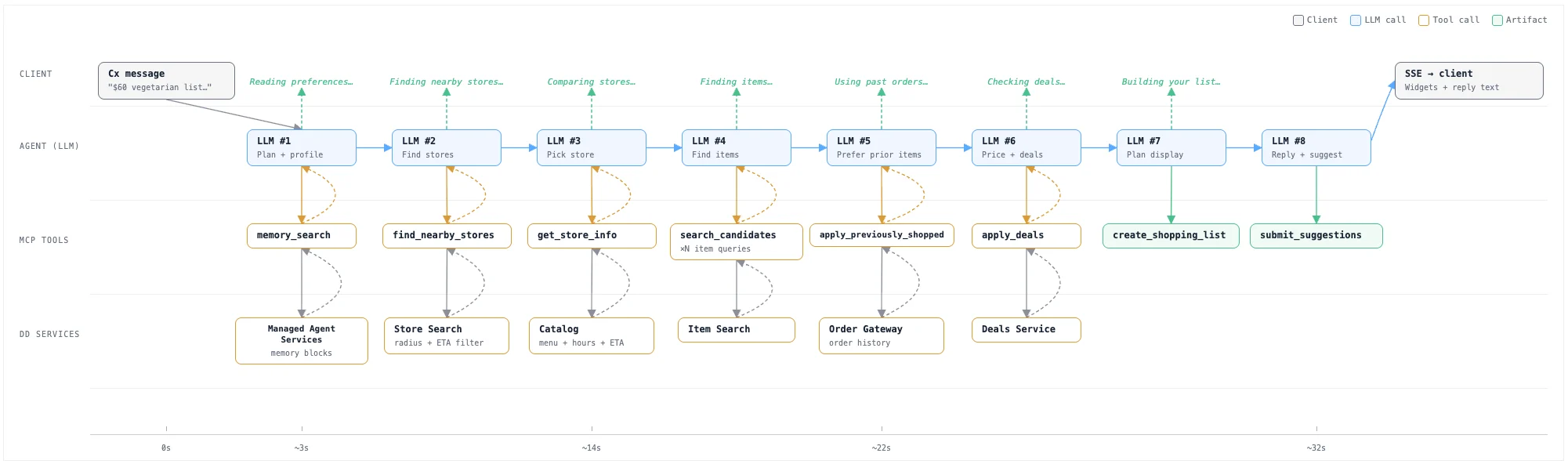
"Build me a $60 vegetarian grocery list for two" looks like one sentence, but a lot happens behind it. DoorDash walked through a real three-turn conversation example that shows which steps actually need the AI, and which don't need it at all.
Turn 1"Build me a $60 vegetarian grocery list for two"
Check user memory (diet preferences/brands/order history)Search nearby open grocery storesCheck single-store inventoryVerify prices/promotionsPlan the display widgetGenerate reply copy
Turn 2User directly swaps the pasta brand on the cart widget, removes a yogurt already at home, changes quantities
Directly edits the cart objectSubtotal recalculates in real time against latest inventory prices
Turn 3"Add some salad ingredients too"
Reads the user-edited cartChecks inventory at the same storeAdds ingredients within remaining budgetRenders the updated list
Goes through the AI modelNo AI, edits data directly
Turn 2 is the key design choice here: when the user taps around and edits the cart widget, those edits change the cart object directly, without another AI model judgment call — the AI sits idle. That means the most time-consuming step, "call the AI," gets cut out of most of the interaction entirely.
6-8x
AI calls triggered by Turn 1 alone, plus multiple tool calls
20-30 sec
End-to-end latency for Turn 1
The original trace diagram from DoorDash's engineering blog: the chain of AI calls and tool calls behind a single grocery shopping request. · Source: DoorDash Engineering Blog
3System Layers
How the Four-Layer Architecture Divides Labor
Ask DoorDash isn't a brand-new system built from scratch — it's a layer added on top of DoorDash's existing platform. The whole architecture splits into four layers, and business logic lives in exactly one of them, not in the prompts.