Anthropic analyzed 300,000 conversations and found: ask Claude in a different language, and it shows different values
- Anthropic analyzed 309,815 real conversations on Claude.ai, covering three models — Sonnet 4.6, Opus 4.6, Opus 4.7 — and the 20 most-used languages.
- The study compressed the 3,307 value expressions identified earlier into 339 high-level values, then used Hellinger PCA to distill 4 stable value axes: compliance↔caution, warmth↔rigor, depth↔brevity, candor↔execution.
- A real-correlation test shows only compliance↔caution (r=-0.448) and warmth↔rigor (r=-0.465) are genuine behavioral trade-offs; depth↔brevity (r=0.004) and candor↔execution (r=0.007) are barely opposed in real conversations.
- The three models have distinct profiles: Sonnet 4.6 leans compliant, warm, brief; Opus 4.6 leans rigorous, compliant, brief; Opus 4.7 leans cautious and in-depth, more often challenging faulty assumptions and flagging risks unprompted.
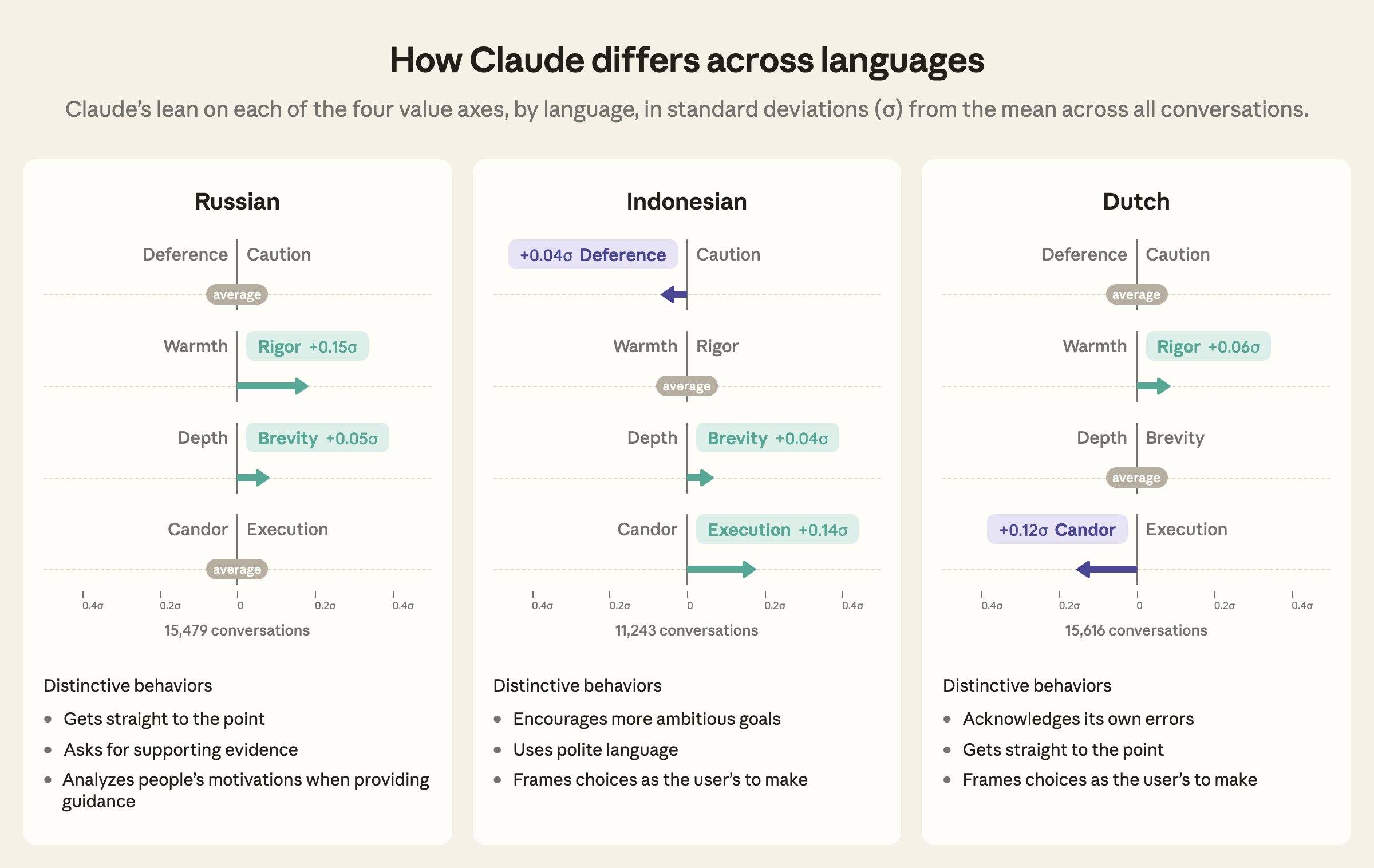
- Languages also show structured differences: English is the most cautious and in-depth, Russian the most rigorous, Hindi the warmest, Arabic the most compliant and brief, Dutch the most candid, Indonesian the most execution-oriented; the Chinese sample (15,365 conversations) sits close to the cross-language average.
How should Claude answer questions with no right answer
Anthropic published this research on July 13, 2026, systematically comparing how three models — Claude Sonnet 4.6, Opus 4.6, Opus 4.7 — and 20 languages differ in the values their answers express. It is a sequel to the earlier study Values in the Wild, which identified 3,307 value expressions from roughly 700,000 real conversations.
Every day users ask Claude questions with no right answer: should I change jobs, how to handle friction with a coworker, whether this business plan is actually viable. Answering these means trading off among several reasonable goals. Claude's constitution (a high-level code of conduct) can only give broad principles — it can't enumerate every real-world situation.
How to dig a few comparable lines out of 3,307 values
3,307 values are too fragmented to compare side by side. The study first gathered them into a few main axes, then looked at where each model and language falls on the axes. The whole process is like dimensionality reduction over a massive pile of conversations: out of hundreds of value dimensions, find the few that best distinguish the conversations.
This round labeled 309,815 conversations in total, keeping only tasks that require Claude to make a subjective judgment — 53.2% of all conversations (pure lookups and fixed-step execution were all excluded). On average each conversation was tagged with 68 Claude values; near-universal values that appear in over 80% of conversations (like helpfulness, clarity) were dropped, because they can't distinguish conversations.
Hellinger PCA takes the proportion of each value appearing in a conversation and square-roots it, so that conversations with "similar recipes" genuinely sit next to each other mathematically, then uses principal component analysis to squeeze out the few main axes that best explain the differences. It's like plotting every cup of milk tea on one map by its ratio of sweetness, tea strength, and milk — cups with close recipes naturally cluster together, and then you find the few axes on that map that best distinguish the flavors.
Open for a few method details
Why the regression comes first. Users in different languages already tend to ask different kinds of questions. Comparing languages directly would tangle "different question types" together with "the effect of the language itself." The study first regresses on task, topic, and user value to subtract the part of the variance those can explain, so the remaining residual more cleanly reflects the language or model itself.
varimax rotation. The main axes PCA squeezes out start off at awkward angles, hard to sum up in one phrase. varimax just rotates the axes toward directions whose meaning is easier to state, without changing the structure of the data itself.
The 4 axes explain only ~15%. The first ten principal components together come to only about 26%. That means value expression is scattered across many dimensions — there's no one or two core axes that explain everything. The study also cross-validated with another method (a logistic factor model), which roughly reproduced the same structure.
What each of the four value axes is pulling between
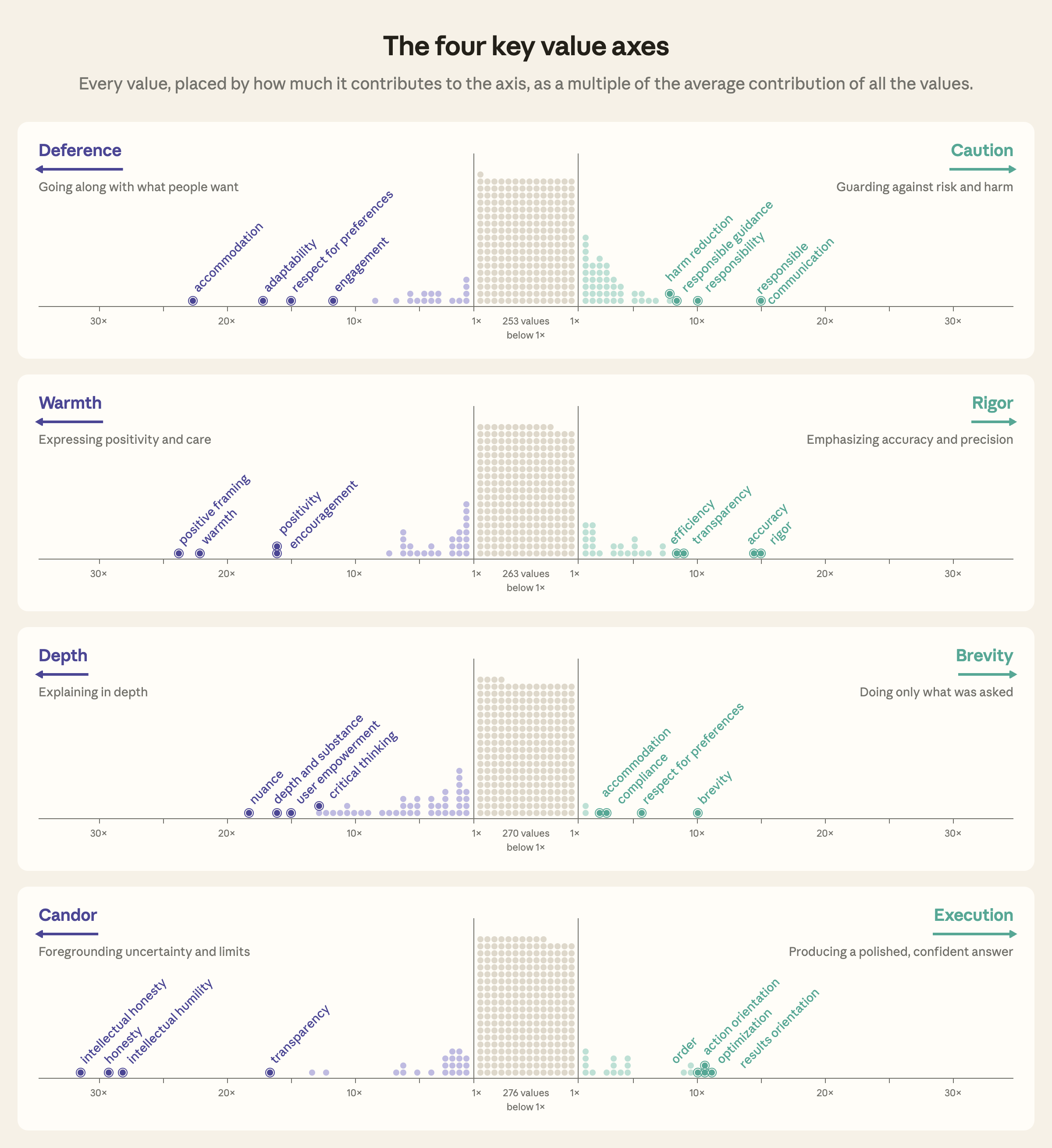
The 4 squeezed-out axes each place frequently co-occurring values at the two ends, to make it easy to compare models and languages. The two ends aren't necessarily a genuine behavioral conflict — that still has to be verified axis by axis with real correlations later.
- accommodation
- adaptability
- respect for preferences
- engagement
- responsible communication
- responsibility
- responsible guidance
- harm reduction
- positive framing
- warmth
- positivity
- encouragement
- rigor
- accuracy
- transparency
- efficiency
- nuance
- depth and substance
- user empowerment
- critical thinking
- brevity
- respect for preferences
- compliance
- accommodation
- intellectual honesty
- honesty
- intellectual humility
- transparency
- results orientation
- optimization
- action orientation
- order
Of these four oppositions, which are real trade-offs and which are just bookkeeping
Seeing "two opposing ends," it's easy to assume Claude picks one of two values every time. But there's a mechanical reason axes look opposed by nature: in each conversation the various values are converted into proportions that add up to exactly 1. When one kind of value takes a bigger share, the rest are naturally pushed down.
So just looking at an axis's shape, you can't tell which are real trade-offs. The study went and checked, for the five most important values at each end of each axis, whether they actually rise and fall against each other in real conversations. It used the Spearman correlation coefficient: the more negative, the more genuinely they're mutually exclusive; the closer to 0, the more unrelated they are.
Three Claudes, three personalities
The differences among models are actually small compared with the differences between single conversations, but the structure is stable and measurable. The three models each shift along the four axes, in units of σ (standard deviation) — the larger the number, the bigger the lean.
- Affirms your ideas and work
- Mirrors your tone and formality
- Uses humor and jokes
- Offers comfort without judgment
- Adds creative touches to the output
- Gets straight to the point
- Stays within the scope you asked for
- Emphasizes getting the job done, not widening the problem
- Challenges faulty assumptions
- Flags risks unprompted
- Gives candid critiques of your work
- Explains the basis for its conclusions
- Admits errors and limits
- Suggests next steps
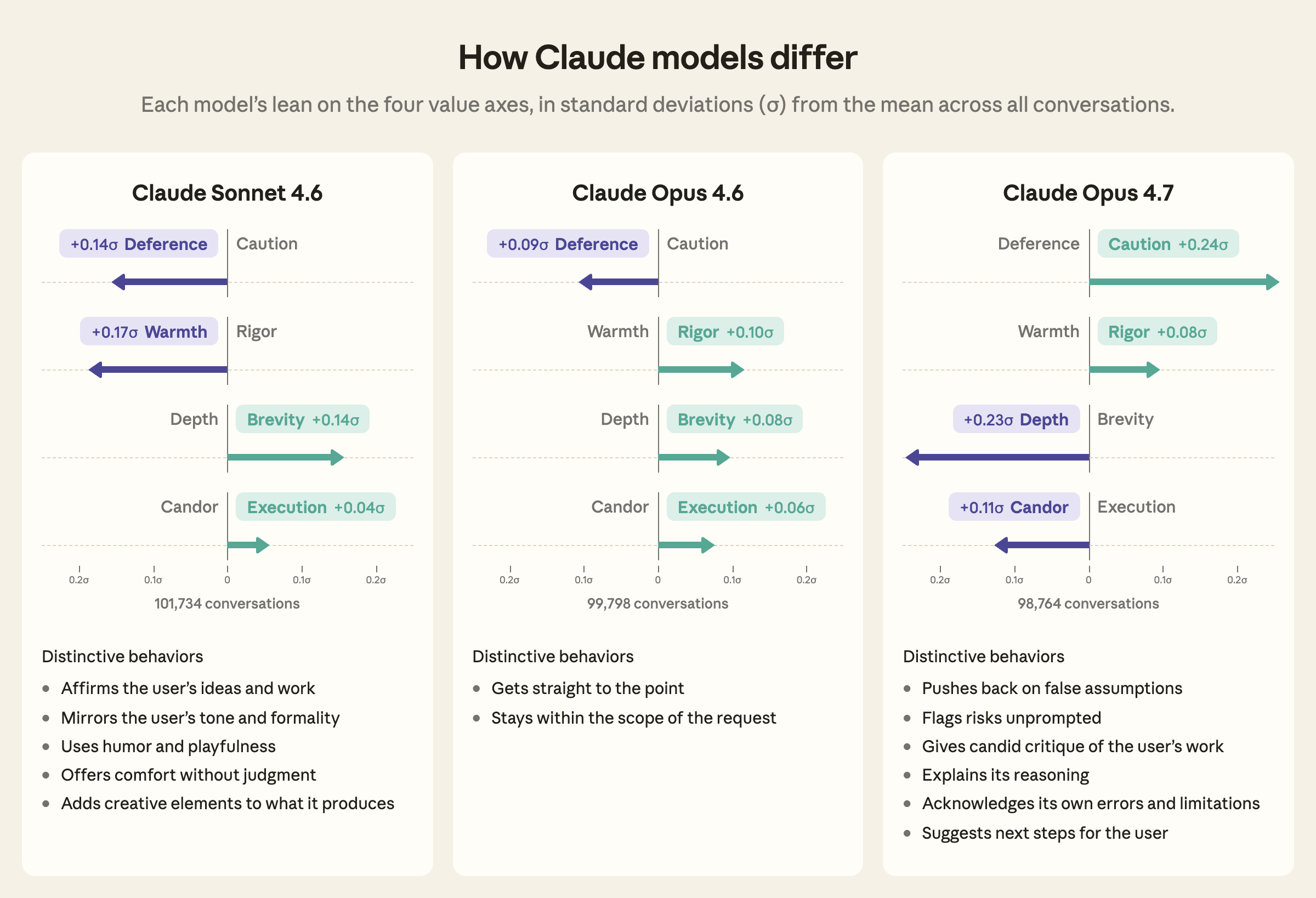
Anthropic says these results line up with employees' and users' subjective sense of the models' "personalities," but it hasn't proven which training step causes them; it only says character training and other fine-tuning decisions may have played a part in shaping these differences.
Ask in a different language, and Claude's sense of proportion shifts with it
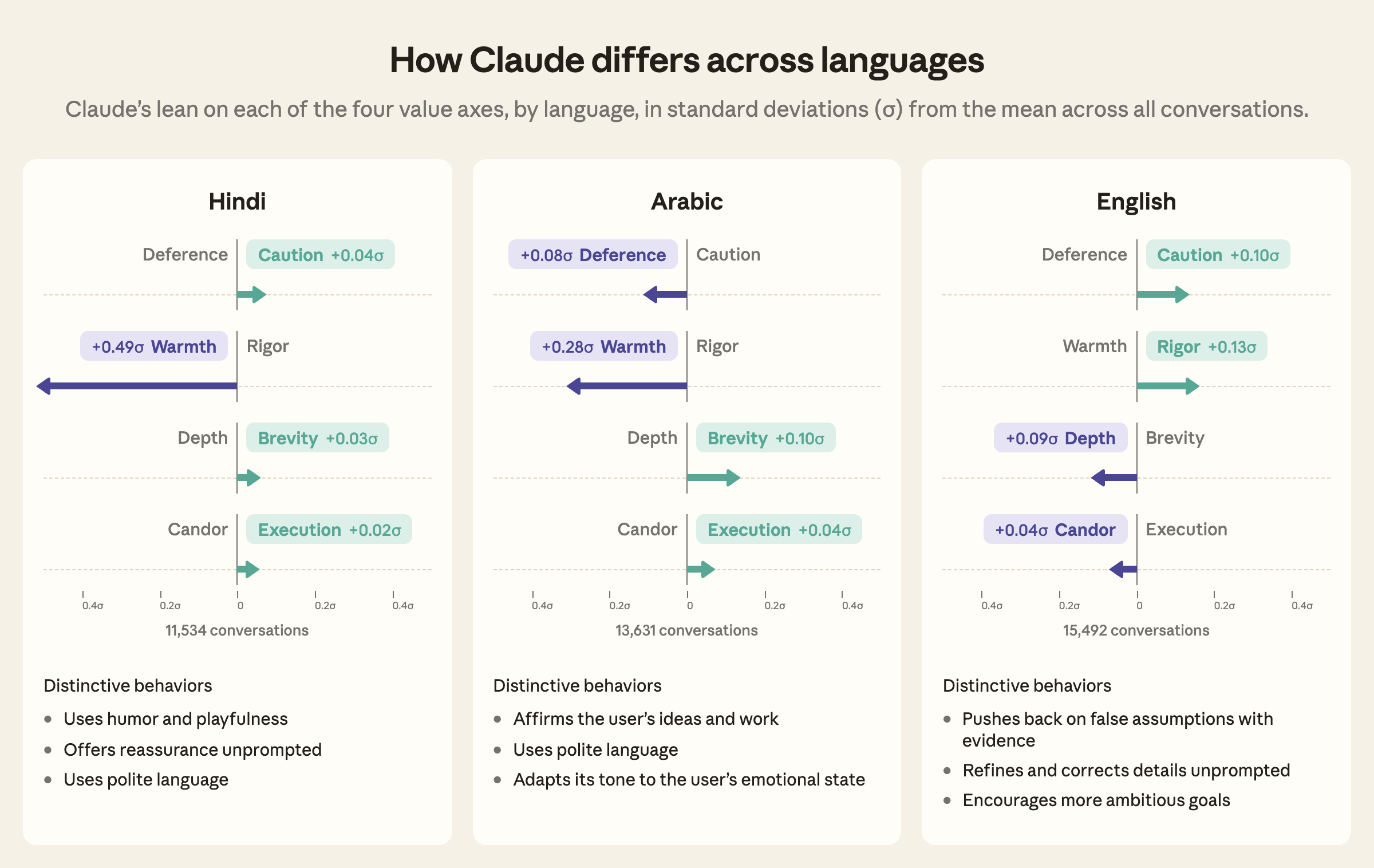
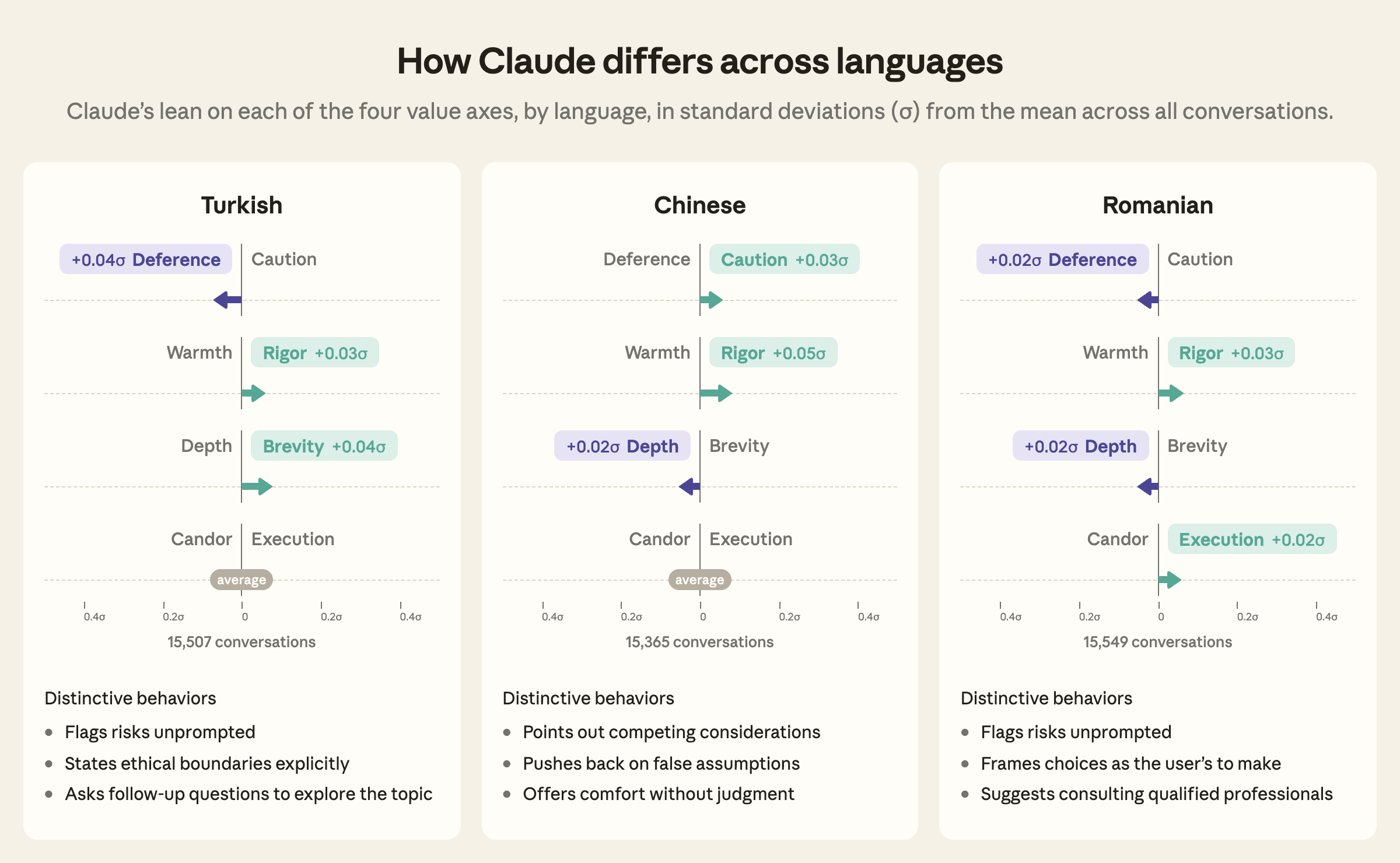
Languages likewise show structured differences, with the variation concentrated mainly on the "warmth↔rigor" and "candor↔execution" axes; the "compliance↔caution" and "depth↔brevity" axes are relatively more stable.
Ask the same kind of question in a different language, and the feedback framing you get back may differ. Anthropic illustrates with a hypothetical scenario: two people bring the same business plan to Claude for feedback — one asks in Hindi, one asks in Russian.
What Claude looks like to Chinese-language users
The Chinese sample has 15,365 conversations. Relative to the average across all conversations, Chinese's shifts are all small, sitting right on the cross-language average line — hardly a strong, fixed "Chinese personality."
In Chinese conversations, the three most distinctive behaviors:
- Points out competing considerations that need weighing points out competing considerations
- Pushes back on false assumptions pushes back on false assumptions
- Offers comfort without judgment offers comfort without judgment
Why language changes Claude's expression — no answer yet
Why does switching language change Claude's expression? Anthropic only offers hypotheses, no causal conclusion.
- Uneven training-data volume. Some languages have far more data than others.
- Different data composition. One language may skew toward professional writing, another toward casual chat.
- Languages carry their own communication norms. Claude may be adapting to each language's conventions around politeness, directness, and emotional expression.
- Uneven alignment and character training. It may be more thorough in data-rich languages, with different behavior in data-poor ones.
To confirm these labels aren't the analysis tool making things up, the study ran three kinds of checks: human review of conversations that could be read directly; lightly tweaking the analysis prompt and the sampling temperature to see whether the labels stay stable; and translating 800 conversations into 8 languages to re-label them. The result: of the 339 values, only 11 are affected by the "language used for analysis," and after correction the main conclusions hold. The 4 axes themselves also passed a random permutation test, plus 50 bootstrap resamplings (repeatedly random-sampling and recomputing to see whether the conclusion is stable), coming out about the same each time.
What this study still doesn't settle, and where it goes next
The study lists seven limitations of its own. A look at the key ones:
- Claude analyzing Claude. The analysis tool is itself Claude Sonnet 4.6, which may share the same language preferences and understanding of values as the subject. Human checks found it more likely to tag an answer as "warm" when it contains emoji or kinship terms.
- Values have no precise definition. Something like rigor is understood by the analysis model itself, so the labels carry the model's own linguistic and cultural frame.
- It only measures presence, not intensity. Salience 3 through 5 are all flattened into "present," without distinguishing whether a value appeared once or ran through the whole thing.
- Real usage isn't a controlled experiment. Users in different languages inherently ask different questions and phrase things differently; controlling for variables can reduce but not eliminate this confounding.
- The 4 axes explain only ~15%. More detail lives off the axes — don't treat the four axes as Claude's complete personality.
- Correlation isn't causation. No specific training data, fine-tuning stage, or system prompt was traced, and there's no measure of whether these differences affect users' trust, well-being, or decision quality.
There's also a technical bias. How a user expresses values may itself already be shaped by the model and language used. Treating user value as a control variable may instead amplify the surface link between "model language" and "Claude's output."
What Anthropic says it will study next
- Trace the differences to specific training data, training stages, or contextual factors.
- Measure how these value profiles relate to user trust, well-being, decision quality, and task outcomes.
- Ask different language communities which shared values they want Claude to hold onto, and where cultural difference should be allowed.
- See whether demographic signals like age, occupation, and region also change value expression.
- Test whether character training or a system prompt can reliably shift a value profile.
- Use value profiles in pre- and post-release evaluation and in live monitoring, to catch unexpected "personality" drift in time.
Claude can perfectly well be both in-depth and brief, and both candid and able to get the job done. Anthropic, "Claude's values across models and languages"
Think AI has just one set of values? Ask Claude in a different version or a different language, and its sense of proportion shifts
Anthropic combed through 300,000 real conversations: three Claudes, three personalities; 20 languages, each with its own measure. One page to see how they measured it — and which conclusions not to take on faith.
↓ read in one page · one figure animates
Every day users ask Claude questions with no right answer: should I change jobs, what to do after a fallout with a coworker, whether this business plan is actually viable. Such questions have no single solution — Claude can only find its measure among several reasonable goals.
✘ But it can't enumerate every specific real-world situation
So when it comes down to each concrete answer, the measure has to be judged on the spot. Anthropic wanted to figure out two things: answer with a different Claude version, or ask in a different language — does that "judgment" change?
The most vivid example: the same business plan, brought to Claude for feedback in different languages, comes out with a different flavor:
The two people read different signals, and may form entirely opposite impressions of the same plan. But "values" are intangible — on what grounds does Anthropic claim it can measure them accurately?
Anthropic compressed the values Claude showed across 300,000 conversations into 4 "value axes." Each axis is a spectrum with a pair of tendencies at its ends. Plot the three models and the various languages onto it, and one figure shows who leans which way.
Same question, different models and languages land in different spots: Opus 4.7 leans most cautious and in-depth, Sonnet 4.6 more compliant and brief; among languages Hindi is warmest, Russian most exacting; and the Chinese points sit almost right on that middle mean line.
All four axes look like "one of two," but there's a mechanical reason they're opposed by nature: each conversation's values are converted into proportions that add up to exactly 1, so when one kind goes up another naturally goes down. So Anthropic went and checked: in real conversations, do these oppositions actually rise and fall against each other?
These figures all come from Anthropic's internal analysis of its own Claude.ai conversations — even the labeling and analysis tool is Claude Sonnet 4.6, with no independent third-party replication; and it only measures "whether a value appeared," not its intensity, and as for why it varies by language, Anthropic offers only hypotheses, no causal conclusion.
Ask Claude.
has no right answer.
the broad line:
honesty, caution, care.
But it can't enumerate
every situation,
so the measure is judged on the spot.
ask again?
go for it!
more encouragement.
The assumption fails.
chasing after flaws.
one-of-two?
the other 2 you can have both.
trade off (r≈−0.45, one end strong,
the other weak); depth and candor
are nearly uncorrelated — deep yet brief.
switch the version, switch the language,
and the measure shifts.
15,365 conversations,
every shift tiny,
the global mean line.