Deep Dive · Databricks
How much did this order really make? Retail finance turns to AI
Customers buy online, pick up in store, and return across locations—one purchase, many ledgers. Databricks Genie is framed as a finance sidekick: first see true profit, then free trapped cash, and avoid needless markdowns.
Source Databricks Blog · 2026-07-14 · Sarah Duffy
Case Unilever × Genie
Product Databricks Genie
Based on the Databricks blog and Unilever’s public case study. Figures, user counts, and industry forecasts follow the source wording. Profit-waterfall numbers are teaching examples, not a real store P&L.
01 PainOmni-channel + agents outrun finance
02 FixGenie: a data-smart finance coworker
03 Three QsTrue profit → cash → full price
04 ResultUnilever: days → minutes
Pain: shoppers love convenience; finance hates the mess
Forget the product name for a moment. The real story is simpler: buying paths got messy, so profit leaks mid-journey. By the time reports land, the business has already moved on.
A familiar example:
You order a jacket in the app for “ship from nearby store tonight.” Three days later it doesn’t fit, so you return it to another store. For you, that’s buy-and-return. For the books, it’s at least three headaches:
1) Where did it ship from?Store fulfillment is often costlier than a warehouse (staff time, inventory tied up). Same jacket, different ship path, different money left for the company.
2) Who owns the return?Cash came through the app; the return hit another store. Revenue sits on e-comm, return cost lands on the store—reports don’t line up, and finance feels the pain.
3) Who changed the price?Promotions may be auto-set by systems/AI, not a human click. The plan said “don’t discount hard,” but the engine already did. By the weekly report, the damage is done. One industry forecast: by 2028, about 15% of day-to-day decisions may involve this kind of automated decisioning (Gartner, projected). Monthly closes only fall further behind.
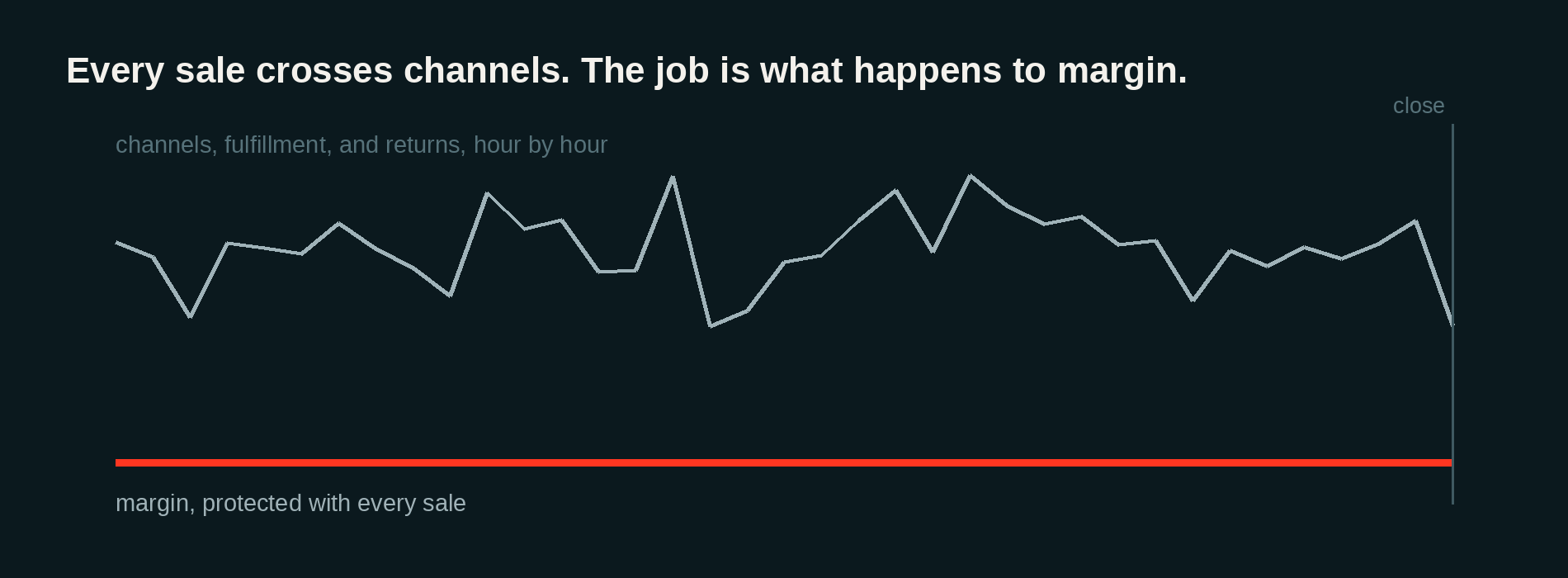
Gray line: orders, fulfillment, returns jump hour by hour. Red line: what finance must protect—how much this sale finally made. Shoppers enjoy the gray line; companies fear the red line breaking.
Tap through: how planned profit gets eaten
Four steps. Numbers are illustrative—to show “planned rich → actually thinner.”