Sakana AI Built 3D Smart Cellular Bricks That Communicate and Self-Assemble Without a "Big" Brain in Charge, Showing "Biology-Like" Swarm Intelligence
Nature has long demonstrated a kind of intelligence with no central commander: a single cell doesn't know the whole body, and no ant in a colony holds the complete map — yet with vast numbers of simple individuals following only local rules, the whole still produces complex, stable, and adaptable behavior.
When salamanders and flatworms are injured, cells near the wound coordinate through local communication to work out "what's missing from the body and which direction to grow." No single cell holds a complete blueprint and directs the repair — instead, the overall form regrows out of a chain of neighboring interactions. That raises a question: can this ability be carried over into man-made hardware?
Individuals see only locally and follow the same set of rules, yet repeated interaction produces organization, a sense of direction, and whole-body behavior.
If no module has coordinates or a view of the whole, can they figure out what they've formed just from talking to neighbors?
Each brick only touches neighbors in six directions, yet by exchanging state round after round, they eventually agree on the overall shape.
Sakana AI Turned This Biology Question Into a Physical Experiment
Sakana AI, the IT University of Copenhagen, and Autodesk built this set of 3D "cellular bricks." A single brick doesn't know where it is and can't see the whole structure; it only knows which of its six directions are connected to a neighbor, and it exchanges messages with those neighbors. When dozens, or even close to two hundred, bricks are assembled into a plane, a guitar, a boat, or a round table, they collectively figure out "what we are" — with no global map and no central controller.
This is the key leap of the research: taking nature's principle that "local rules produce global behavior" out of idealized software simulation and into real three-dimensional hardware, where packets get dropped, connections break, and modules can fail. The authors call it the first large-scale, biology-inspired implementation of 3D physical self-recognition.
These bricks don't reconstruct each module's coordinates, nor do they recognize a single unique blueprint. What they do is a seven-way classification: judging whether the current whole looks more like a plane, a chair, a car, a table, a house, a guitar, or a boat. A separate damage model then judges which of the six directions is missing a neighbor.
What's Inside a Single "Cellular Brick"
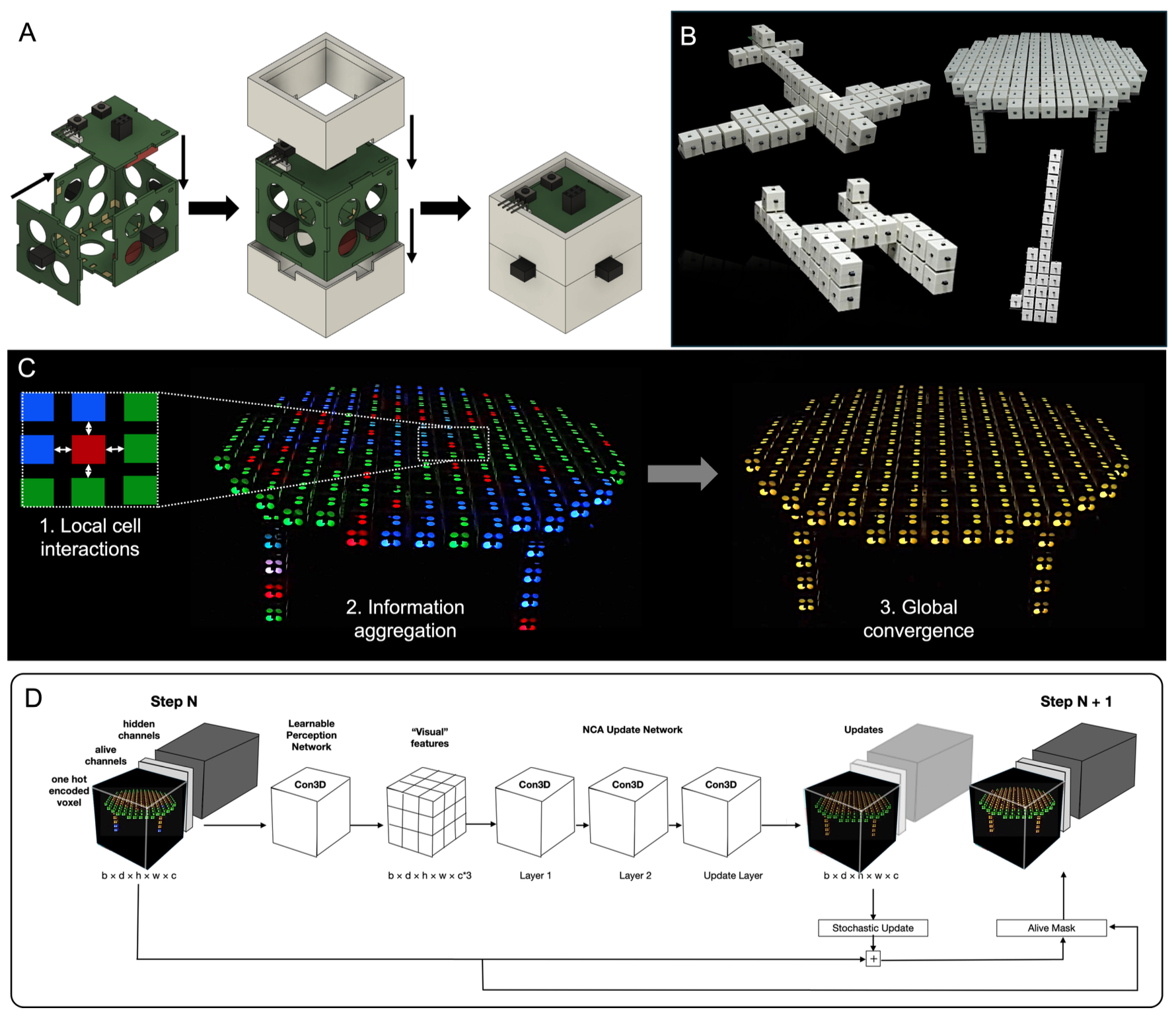
Each cellular brick is a cube made of six printed circuit boards, with electrical connectors on all six faces. Inside sits an ESP32-S2 microcontroller, an RGB light that displays the current category judgment, and the electronics needed for power and communication. The connectors handle mechanical connection, power delivery, and digital communication between adjacent modules all at once.
The same small neural network, its own internal memory, a current shape guess, and the states passed along from neighboring bricks.
A global map, spatial coordinates, or a central controller — and it can't see what distant modules are doing.
The biggest difference between real hardware and simulation is that messages get lost. The paper's fix is plain: before each run of the neural network, neighboring bricks resend their state five times over a three-second communication window; incomplete messages or ones missing a valid header get discarded. If a direction has no neighbor, or no valid message arrives in time, that input is recorded as zero. The physical system's robustness comes partly from this communication redundancy, not from the neural network alone.
How They Recognize the Whole Body From Neighbor Messages
The core algorithm of the system is called a Neural Cellular Automaton, or NCA. In a traditional cellular automaton, a person writes the rules in advance — for example, a cell decides what it becomes next based on the states of the cells around it. NCA is different: the local update rule is learned by a neural network through training, so researchers no longer have to manually list every possible case.
Each brick maintains a 28-dimensional internal state, including one alive flag, 20 hidden memory channels, and 7 shape-category scores. Each round, it reads the neighbor states in six directions, runs them through a 3D convolution and state-update network, revises its own internal memory and category judgment, and sends the new state to its neighbors. Every brick runs the exact same network — the only difference is the local information each one receives.
Starting point: Each brick only has a local view, so early answers can differ. Different colors represent scattered shape guesses.
Propagation: Each brick reads its neighbors' states, updates its own memory, and passes the new state along. Information from far away can only relay station by station.
Convergence: After dozens of rounds, the scattered judgments gradually become the same answer. The overall consensus isn't stored in a central node — it's generated by the interactions.
A single module never sees the whole shape, but distant information relays along the connections, round after round. One brick first forms a rough guess based on its close neighbors, and that guess becomes another brick's input in the next round. After dozens of iterations, the originally scattered local judgments converge into one shape category everyone agrees on. This is what swarm intelligence looks like in hardware: the overall answer isn't stored in any single central node — it grows out of continuous local interaction.
Close to Two Hundred Physical Bricks Really Did Recognize Their Own Shape
The team first trained the network in simulation on 487 3D shapes from ShapeNet, covering planes, chairs, cars, tables, houses, guitars, and boats, reaching an average classification accuracy of 98.97%. That average isn't even across categories: planes, chairs, tables, and boats all exceed 99%, while houses come in at only 85.04%. They then didn't write new rules for the hardware — they simply deployed the NCA trained in simulation directly onto the physical bricks.
That 98.97% is the result on the 487 training shapes, not a score on a held-out test set. And on the same simulated classification task, a simpler distributed graph-structure baseline (Voxel Graph Weisfeiler–Lehman, WL) reached 100%. NCA's advantage isn't a higher classification score — it's that each brick only needs to run a fixed number of local update rounds, which can be carried straight over to physical hardware and extended to damage localization and recovery.
The physical experiments built four structures: a 26-brick guitar, and progressively larger planes, boats, and a 197-brick round table. Each structure was tested three times, and in all 12 runs every brick eventually reached the correct consensus on the overall shape. The paper's standard procedure runs for 60 rounds, with the whole self-recognition process taking about three minutes.
Assembled Differently, or With a Few Bricks Broken — Can It Still Recognize Itself?
What really demonstrates swarm intelligence isn't a high score on a standard shape — it's the system holding onto its overall judgment even after the structure changes. The researchers randomly disabled 5%, 10%, or 15% of the physical bricks, stopping them from sending or receiving messages. Most shapes still performed well at a 5% failure rate; planes and boats stayed fairly stable even at 15%.
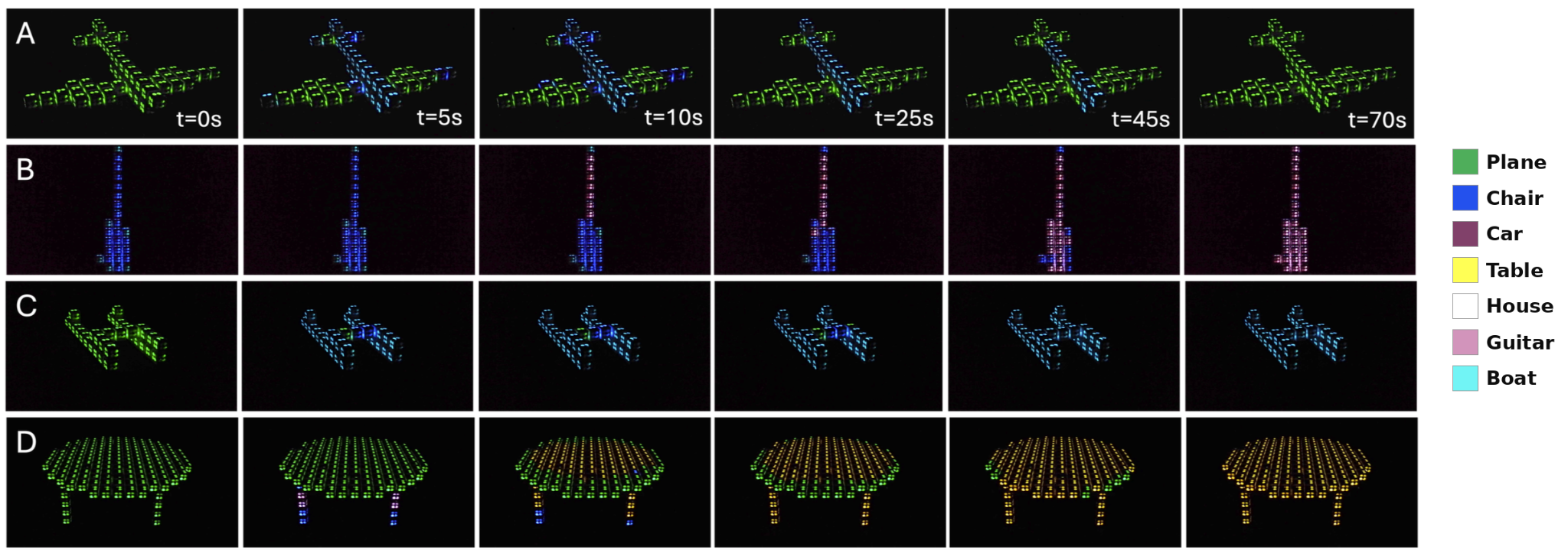
The effect of failure also exposes something about the shape of the object itself. A plane has multiple communication paths, so information can still route around even if some bricks go silent; a guitar's neck is a narrow channel, and one key brick failing can cut off both sides. Swarm intelligence eliminates a central point of failure, but it still depends on the information network formed by physical connections.
The team also tested variants never seen during training: a table with five legs at random positions and uneven lengths, a boat with its bridge shifted to one side, and shrunken versions of the plane and table. Most of these were correctly recognized — only the shrunken table was misclassified as a chair. That suggests the network learned some degree of abstract structural features, rather than simply memorizing the fixed coordinates of training samples.
Hidden Channels Developed Their Own Sense of Direction
The researchers then opened up the NCA's hidden channels to see exactly what internal signals the bricks use to tell a table from a chair. What they found were spatial patterns resembling "morphogens" in biological development: tables form a left-right gradient early on, along with a radial gradient spreading outward from the center; chairs form a more distinct front-back axis signal.
In the first few rounds, modules often mistake a chair for a table. The seat and the backrest each look like a flat or table-like piece on their own, but the backrest region gradually produces a directional hidden signal that propagates from back to front along the connections. As this signal spreads, more and more modules revise their judgment, until the whole group shifts from "table" to "chair." The researchers never told the network which gradient it should produce — this communication strategy emerged on its own during training.
From Recognizing the Body to Damage Detection and Regeneration
A system can only judge what's wrong once it knows what it is. So the team gave the NCA a second task: besides judging which shape category the whole belongs to, every unit also has to judge which of its six directions is missing a neighbor that should be there.
In the simulation experiments, each unit has to choose among seven states: no damage, or a defect on one of the six sides — positive or negative X, Y, or Z. The system's average accuracy for judging damage direction reached 94.8%, while still holding a 98.9% shape-classification accuracy. In other words, the same decentralized network can answer both "what are we" and "which of my sides is missing a piece" at once.
With a direction signal in hand, recovery can be written as a repeated growth process: existing units first predict the direction of the defect; once the prediction reaches local consensus, the system adds a new unit in that direction and judges again, repeating until no unit reports damage anymore. The study demonstrates two modes. The first lets the system judge the current shape on its own and recover — more autonomous, but severe damage can cause a chair to be reinterpreted as a table. The second is given the target shape in advance, so even with only a handful of seed units left, it can rebuild step by step toward that target.
The Same Rule Also Scales to More Than 18,000 Units
In simulation, the system scales from a 15³ grid up to 32³ and 64³, handling hollow shapes like a fish, a heart, and the Sakana logo, with the largest structure exceeding 18,000 cubes. With 128 hidden channels, classification accuracy across the three resolutions is 98%, 96%, and 96% respectively. Training ran on a single NVIDIA A10G GPU, with the 64³ repair model taking about 8 hours.
Next Up: Making the Structure Actually Move and Repair Itself
Today's cellular bricks already achieve distributed self-recognition and fault tolerance in physical hardware; damage-direction prediction and step-by-step regeneration are demonstrated in simulation. The physical bricks currently rely on external power and have no motors, magnetic docking, or ability to recruit new bricks from a resource pool. This boundary doesn't weaken the paper's point — if anything, it shows the research has completed the most critical prerequisite before physical regeneration: giving the structure a collective sense of its own shape first.
Following this path further, the team envisions smart building materials that can sense and report damage, modular robots that adjust their judgment in real time as connections change, and reconfigurable systems with magnetic connectors and tiny motion mechanisms that can actively pull in replacement modules from a shared pool. At that point, computation would no longer happen on a central computer outside the structure — it would become a property of the material itself.
Takeaway: Smart Cellular Bricks proves that close to two hundred 3D physical modules can form a shared judgment of the overall shape through neighbor communication alone, with no central map. But today they can "recognize the body" — they can't yet regrow themselves in the real world.
Sakana AI Built 3D Smart Cellular Bricks That Communicate and Self-Assemble Without a "Big" Brain in Charge, Showing "Biology-Like" Swarm Intelligence
No coordinates, no global map, no central control — every brick only exchanges messages with the neighbors it's directly connected to.
↓ Read it in one page · Physical experiments, simulation results, and future plans, kept separate
The team put the same small neural network into close to two hundred real cubes. A single brick doesn't know where it is, or what the whole has been assembled into.
✔ Whole structure: jointly judges whether it looks more like a plane, chair, car, table, house, guitar, or boat
"Recognizing itself" means a shape-category judgment, not reconstructing each brick's exact coordinates.
A five-legged table and a boat with an off-center bridge are still recognized.
but a shrunken table is misjudged as a chair
Planes and boats can route around failures; the guitar's neck is a communication bottleneck.
decentralization is still bound by structural topology
Close to two hundred bricks jointly recognize a shape, and keep working even when some modules go silent.
Fault tolerance
Rules transfer directly from simulation
Judging which side is missing, adding new units along the predicted direction, and scaling past 18,000 units.
Step-by-step recovery
Scaling to a 64³ grid
"this is a table"?
No camera looking down, no central computer handing out the answer.
only knows its neighbors
and recognize the whole shape together
- No spatial coordinates
- No global map
- No central controller
- Only reads 6-side neighbors
Distant info relays station by station along the connections, and scattered guesses gradually become one answer.
Real time: ~3 minutes
All 12 reached correct consensus
The largest structure is made of 197 bricks.
House only 85.04%
A simple WL baseline hits 100% on the same task.
it's local rules that run straight on hardware
might be missing a piece?
Average accuracy for damage-direction judgment is 94.8%; new units join along the predicted direction.
- No motors
- No magnetic docking
- Can't fill in on its own
not yet regrow itself for real