The Junior Developer Job Is Being Torched by AI: Programming Is Turning from a Job Title into a Skill Everyone Has
- US software developer employment for ages 22-25 has fallen 19% from its October 2022 peak, while employment for ages 41-49 grew 14% over the same period (Stanford Digital Economy Lab, based on ADP payroll data).
- Meanwhile, total US developer headcount grew 10% from May 2022 to May 2025 (from 1.53 million to 1.69 million) — the entry-level contraction is being masked by the much larger existing base.
- Broken down by specific job title: "computer programmers" fell 16% in a single year (versus an original forecast of just 6% decline per decade), while more judgment-heavy roles like data scientists and systems analysts grew 12% and 4.4% respectively.
- GitHub added 36 million new accounts last year (the platform's fastest growth ever); new iOS App Store software submissions rebounded 24% in 2025 after eight straight years of decline — a large share of these new builders don't identify as developers.
- The traditional apprenticeship chain — "juniors write code, seniors review it, juniors eventually become seniors" — is breaking down, and IBM and Salesforce have taken two opposite paths in response.
Same Developers, Two Different Fates
Data from Stanford Digital Economy Lab, based on ADP payroll records combined with the latest US Bureau of Labor Statistics occupational data, shows a historic contraction in employment for US software developers under 25 over the past three years — while over that same period, total US developer headcount has actually risen.
US software developer employment for ages 22-25 has dropped 19% in three years; over the same period, total US developer headcount is up 10%; GitHub added 36 million new accounts in the past year, the platform's fastest growth ever — equivalent to a new developer joining every single second. All three numbers are true at once, and this piece is about explaining how that's possible.
This chart is the single most important one on AI and programming jobs. It comes from Stanford Digital Economy Lab, using ADP payroll ledger data, breaking down US software developer employment by age, indexed to October 2022 (set to 100).
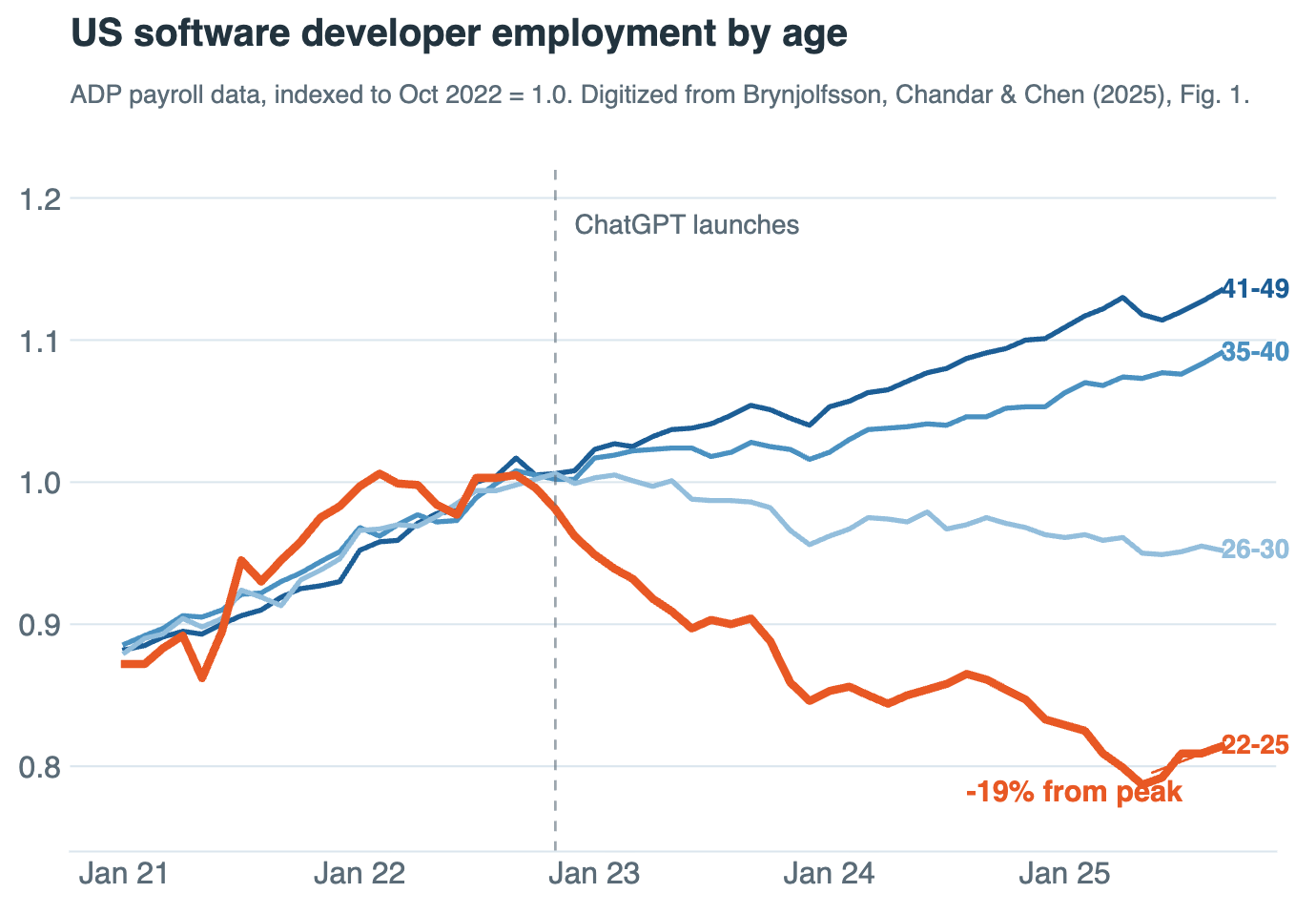
Developers aged 22-25 have fallen 19% from their peak in late 2022. Meanwhile, every single age bracket above 30 has grown over the same period — the 41-49 bracket is up 14%. This isn't some fluke at a handful of companies: even after the Stanford team controlled for firm-level shocks, young people in AI-high-exposure jobs still show a relative employment decline of 16%, and this decline is precisely concentrated in jobs where AI "automates" the work rather than "augments" it. Software development is simply the textbook example.
One more detail worth noting: the curve for young workers didn't fall off a cliff the moment ChatGPT launched. It had already peaked a few months before ChatGPT's release, then declined slowly through 2023, with the real acceleration coming in 2024 into early 2025 — exactly when coding assistants upgraded from "helping you finish the line you're typing" to "completing an entire ticket on its own." What really lit the fire wasn't ChatGPT — it was agentic coding.
It's no longer simple code autocomplete — AI can now break down a task on its own and execute several steps in a row, carrying an entire ticket through from start to finish. Put simply: it went from "helping you finish your sentence" to "helping you finish the job."
Why You Can't Blame This on the Economic Cycle
Several macro shifts unrelated to AI were indeed happening during this same period. To confirm this collapse is mainly AI's doing, we need to rule out these suspects one by one.
Why the Aggregate Numbers Look Fine
Zoom out to the whole economy, or even just "computer occupations," and you'll see a strange picture: every headline number is up.
From May 2024 to May 2025, total US employment grew 0.8%, while computer and math occupations grew 1.3% — faster than the overall economy. By the Bureau of Labor Statistics' count, the number of employed software developers rose from 1.53 million in May 2022 to 1.69 million in May 2025 — up 10% across the entire AI era. Rigorous studies in the US, Denmark, and by Anthropic itself have all failed to find a relationship between AI exposure and overall employment — the Danish study, based on government payroll ledgers, could rule out any effect larger than roughly 1%.
How can both things be true at once? Weight each age bracket by its share of the workforce, and the answer becomes clear.
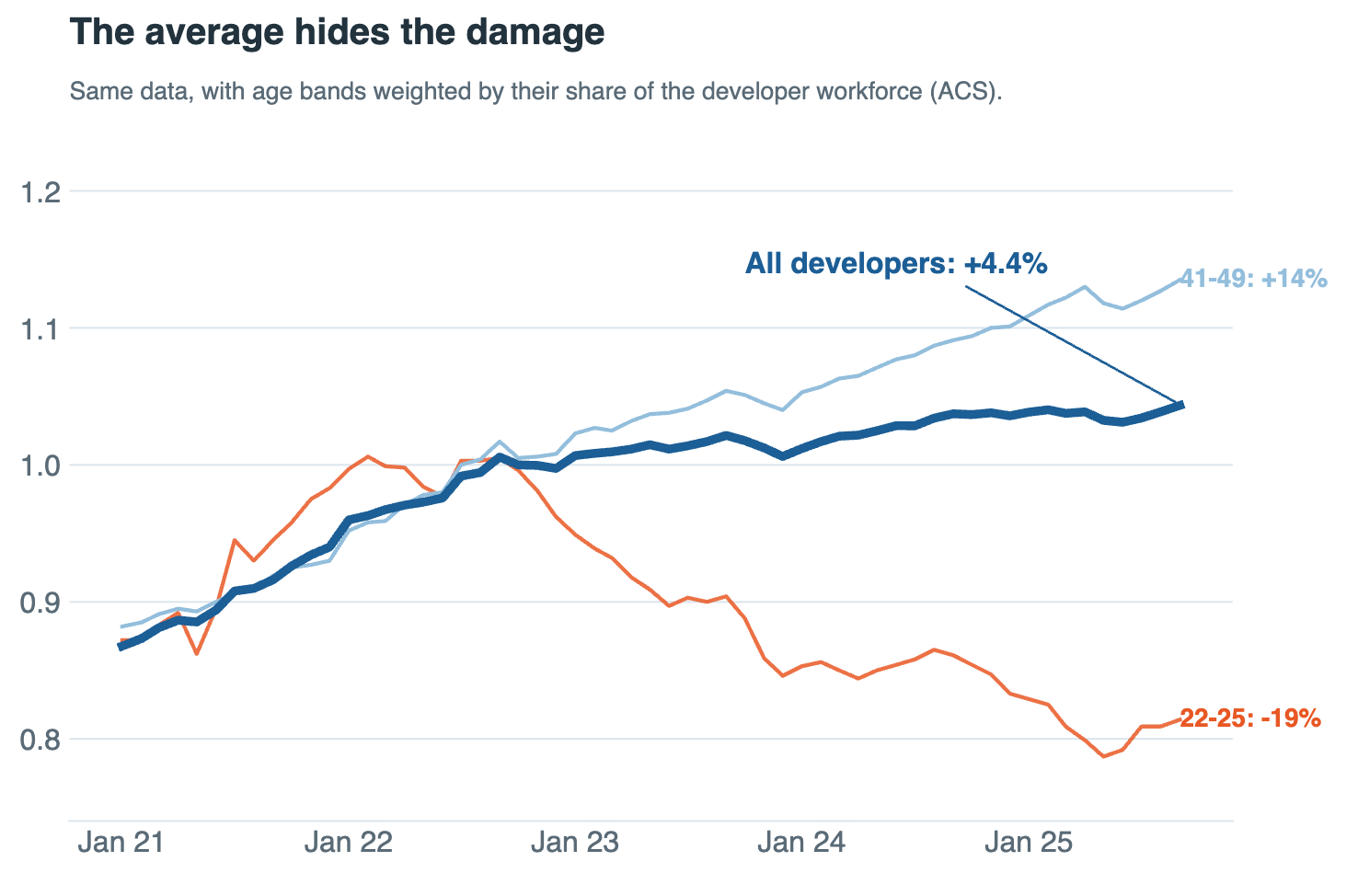
Once weighted, total developer employment is up 4.4% since October 2022. Young workers (grouped here by age rather than experience — a meaningful compromise in methodology) make up only about 8% of total developers, so a disaster for them barely moves the average at all. Even if you doubled their share in the calculation, the weighted total would still be positive.
This explains why every study that looks at the average concludes "AI hasn't hurt employment," while every study that looks at young workers specifically finds a "bloodbath" — they're looking at different parts of the same dataset.
Exactly What Kind of Coding Work Is AI Eating
Zoom in further to see which specific job titles are shrinking, and the picture gets even clearer. Same BLS data, May 2024 to May 2025.
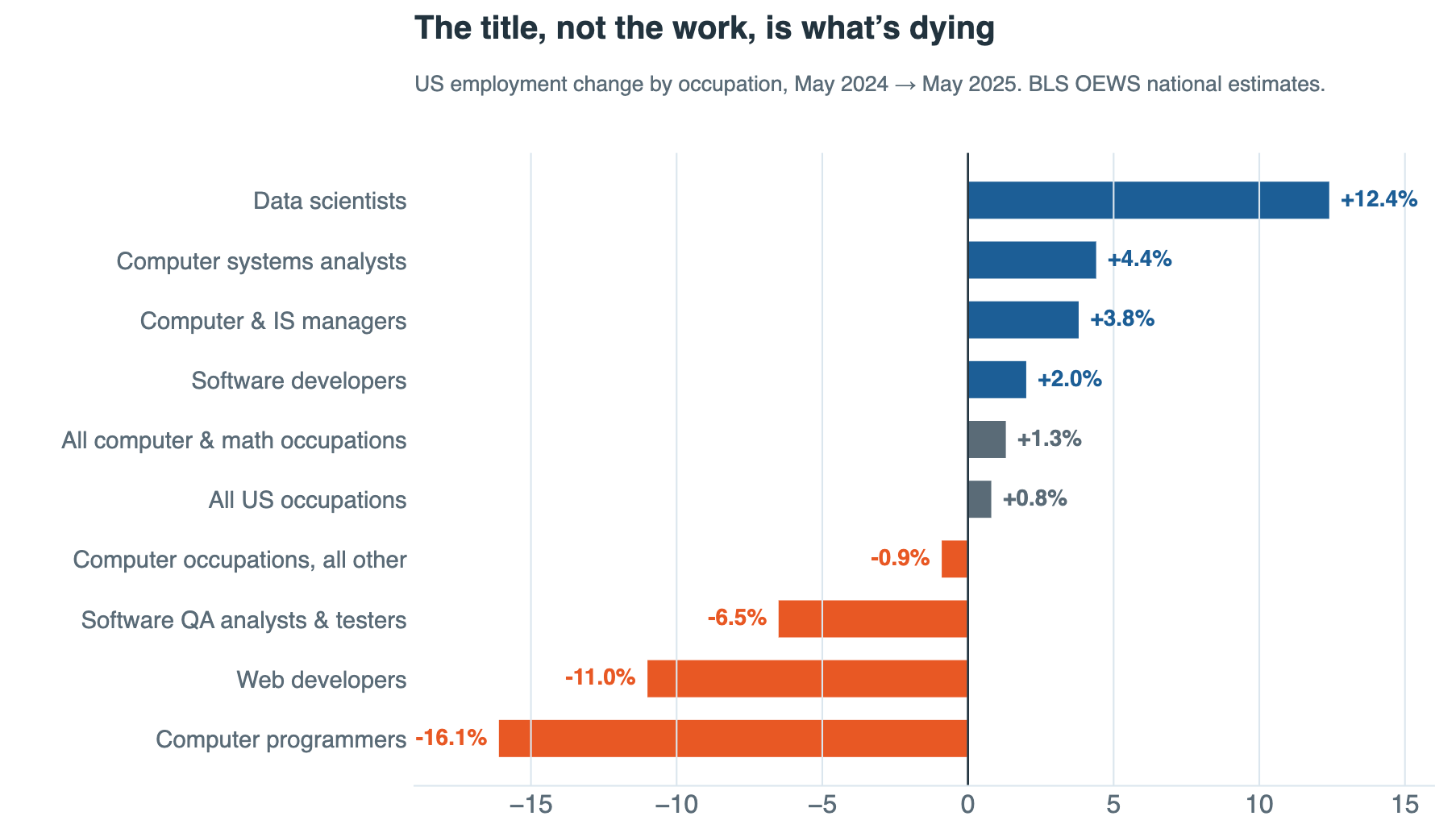
The "computer programmer" role — which the BLS defines as "someone who writes code to specifications set by others" — fell 16% in a single year. The BLS's own original forecast for this role was a decline of just 6% per decade. Web development, the author's own field, fell 11%; QA testing fell 6.5%. Meanwhile, data scientists grew 12%, systems analysts grew 4.4%, and the broader "software developer" category grew 2%.
The jobs disappearing produce "code written to someone else's spec." The jobs growing produce "judgment about what code should even be written." What AI is eating is one very specific kind of coding work.
The New Developers Really Did Show Up — They Just Don't Call Themselves Programmers
In 2025, the author wrote: AI is a new layer of abstraction, and like every abstraction layer before it, it will produce far more developers building far more software. He also wrote that this new wave should be called "software developers" too — inventing a different name would just create an artificial barrier. Looking back now, he thinks he was half right: a huge wave of new developers really did arrive — they just don't use that title.
This software boom is real, and measurable. GitHub added 36 million new accounts in its most recent Octoverse year — the platform's fastest growth rate ever, equivalent to a new developer every single second — along with 121 million new repositories, the most ever created in a single year, so much that its infrastructure was reportedly groaning at the seams. Of these new arrivals, 80% used Copilot within their first week. The largest developer influx in history is AI-native, and it happened at exactly the same moment paid entry-level jobs collapsed.
The author's favorite piece of evidence is the App Store, because publishing an iOS app carries real cost and real barriers: a $99 developer fee, a review process, and a working finished product. It measures software that's genuinely shipped, not tutorial exercises.
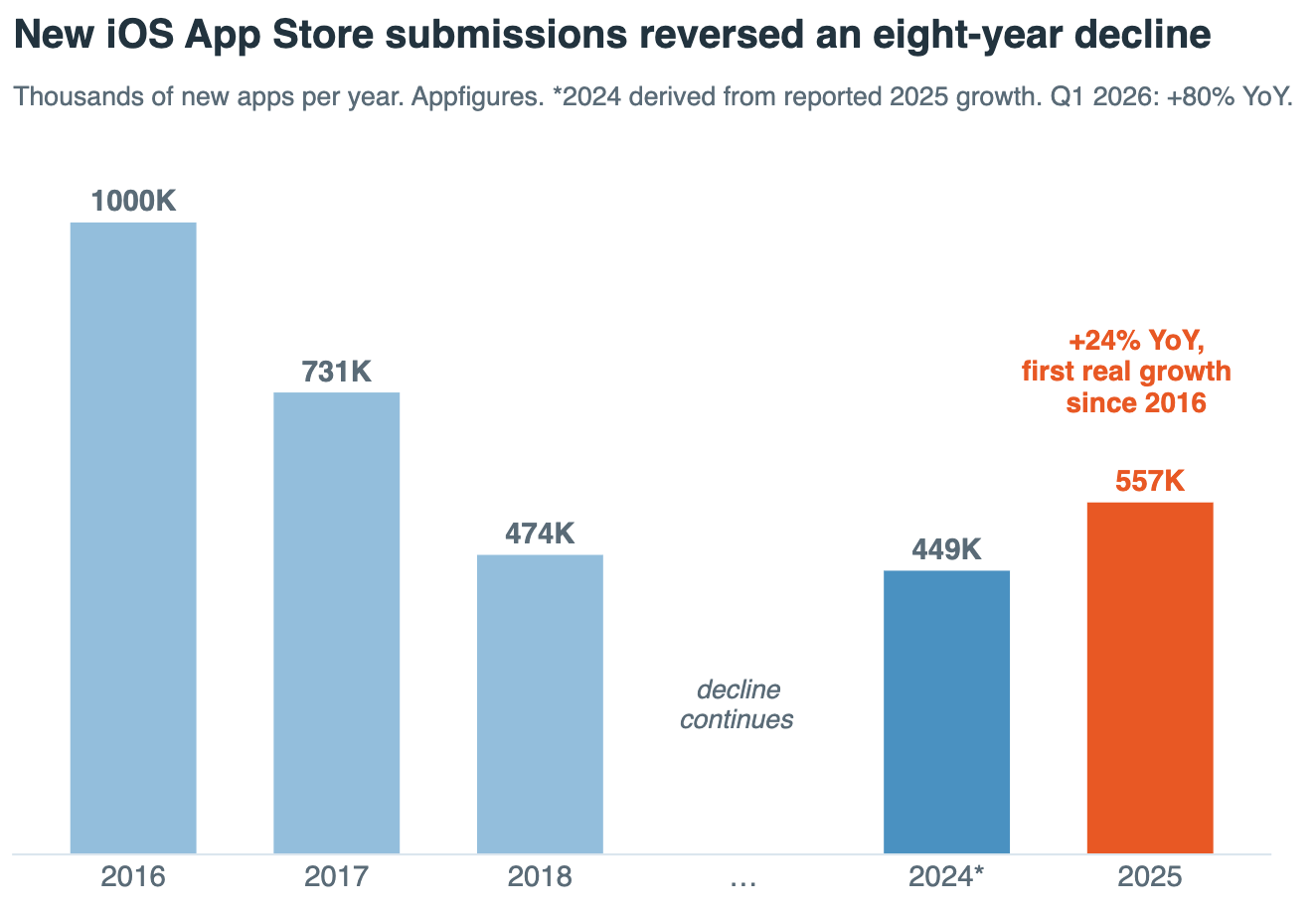
New App Store submissions peaked in 2016 and then declined for eight consecutive years. In 2025, they grew 24% — the first real growth since the peak — and by Q1 2026, iOS submissions were up another 80% year-over-year. The surge got so large that Apple's review times stretched from two days to several weeks. The category mix shifted too, toward productivity, tools, and lifestyle apps — exactly what you'd expect from "people building software for the first time to solve their own problems," rather than studios chasing game revenue.
Who are these people? According to Vercel, 63% of vibe-coding users are non-developers. Lovable says 60% of its users are "non-developers," and these users create over 100,000 new projects every day. Replit claims 50 million people have used its platform. These are marketers, founders, teachers, analysts, product managers — they're writing software, which, in the author's view, makes them developers. They just don't identify that way, and more importantly, that's not their job title — and job title is exactly what labor statistics count.
Marketers
with AI
as "Product Manager," "Teacher"
The long tail of new developers arrived right on schedule, and at real scale. But it showed up as "capability diffusing into every job title," not as a headcount bump within any single job title. A marketing manager who uses AI to build their own attribution dashboard still shows up in BLS data as a marketing manager.
What collapsed was the market for that credential. The activity itself is growing explosively.
The Broken Apprenticeship Chain
So, grading the author's 2025 prediction: right about the developers, wrong about the job title. That sounds like a happy ending — until you ask what comes next.
The career entry point for professional software engineers used to work like this: you get hired to write mediocre code, a senior engineer reviews your code, you slowly absorb judgment through repeated cycles of correction, and a decade later, you become that senior engineer. That chain is now broken. AI now writes the mediocre code, so nobody hires junior developers, so nobody is lining up to become the senior engineer who does the reviewing.
- Juniors hired to write mediocre code
- Seniors review and correct it
- Judgment absorbed through repetition
- Ten years later, they become senior
- AI writes the mediocre code directly
- So nobody hires juniors
- So nobody is in the pipeline
- No next generation of senior engineers
Meanwhile, millions of new builders are shipping software with nobody reviewing any of it. A Veracode study found that 45% of AI-generated code fails basic OWASP security tests (OWASP basic security tests are an industry-standard checklist for catching the most common, most easily exploited vulnerabilities). Another audit of vibe-coded apps found that 10% had serious row-level security flaws exposing user data (a row-level security flaw means database permissions are misconfigured, so users who should only see their own data can read other people's data instead). Apple, meanwhile, is buried under submissions it can't review fast enough. Software is being built, but the judgment layer hasn't kept pace — and the mechanism that used to cultivate that layer, apprenticeship within an employment relationship, has collapsed.
Two Futures: IBM Is Doubling Down, Salesforce Is Zeroing Out
Even on this scorched earth of junior developer jobs, a few promising new shoots are appearing. Facing the same broken chain, two major companies have taken completely opposite paths.
- Tripled entry-level hiring
- Rationale: juniors equipped with AI can now do work that used to require seniors
- Redesigned the junior role around "client engagement + requirements writing," not pure typing
- Hired zero engineers last fiscal year
These are the two candidate futures. Whichever one wins determines whether this industry still has senior engineers by 2036.
Has the Turning Point Already Begun?
A market that refuses to hire junior developers has one logical ending: the pain starts to be felt, and the market self-corrects. And maybe — just maybe — that's already starting to happen.
Indeed's job posting data actually bottomed out in May 2025, then rose for 13 consecutive months, up 10% year-over-year.
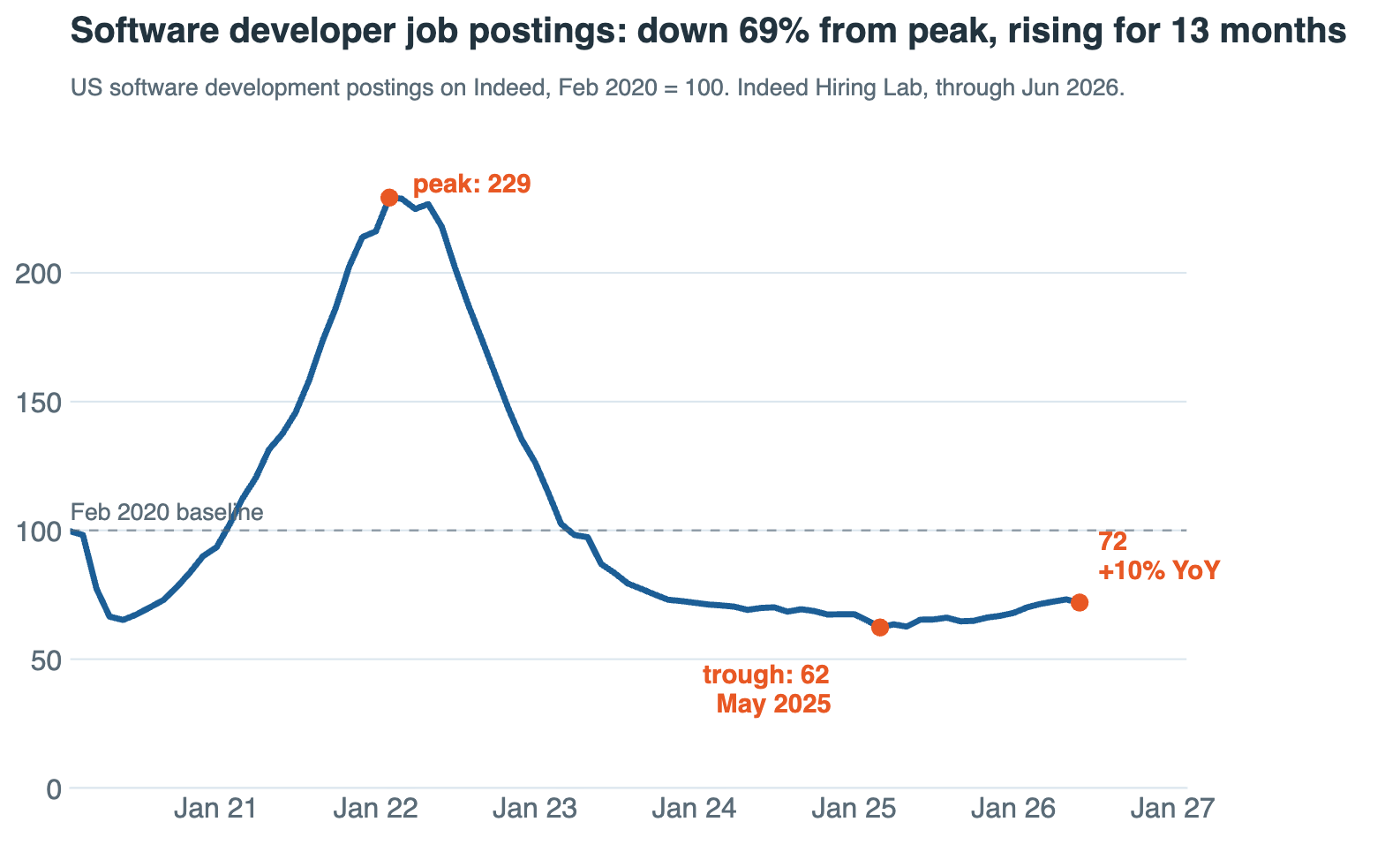
The author says that if Stanford's next update shows the 22-25 employment curve turning positive too, it could mean the market has found a new equilibrium. He suggests watching for more major employers launching programs like IBM's — and if none show up, someone will need to create them, or this entire software creation boom will eventually tip into a bust. His conclusion: what we're watching is programming stopping being a job title and becoming a skill instead — just like "typist" stopped being a job and became something everyone is simply expected to know how to do. For almost everyone, this transition is going reasonably smoothly — except for the people who were just about to step onto the old ladder, right as we set it on fire.
AI now writes the mediocre code, so nobody hires junior developers anymore, so nobody is lining up to become the senior engineer who does the reviewing.Laurie Voss · Seldo.com