The website of the future assembles itself on the spot for every visitor: Adobe demos pages generated live from intent
- Adobe chief scientist Carlos Sanchez demoed the "agentic site" at the AI Engineer World's Fair (AIEWF): a page assembled live by an AI based on a visitor's browsing behavior and search intent.
- Case one: on a site selling coffee machines, a visitor who had searched "camping" saw the copy, product ordering, and recommendations all reorganized around a "brewing coffee outdoors" theme. Case two: an open-ended query like "Europe AI conferences" generates a matching page directly.
- The system doesn't have the AI invent a page from nothing — it retrieves material from the company's existing content library and then assembles it. Sanchez says this is how they keep generation quality under control.
- The technical bar Adobe set for itself: page-generation latency under 1-2 seconds, current inference cost around 1-2 cents per page, expected to keep getting cheaper (all Adobe's own figures).
- This isn't live at scale on customers' production sites yet. Adobe is currently pitching the concept to customers and looking for partners willing to experiment. Sanchez himself says he isn't sure it will become the mainstream approach.
One website, shaped by who's looking at it
At the AI Engineer World's Fair (AIEWF) in San Francisco, Adobe chief scientist Carlos Sanchez demoed something the company is exploring: the "agentic site" — a web page that assembles itself live around each visitor's intent.
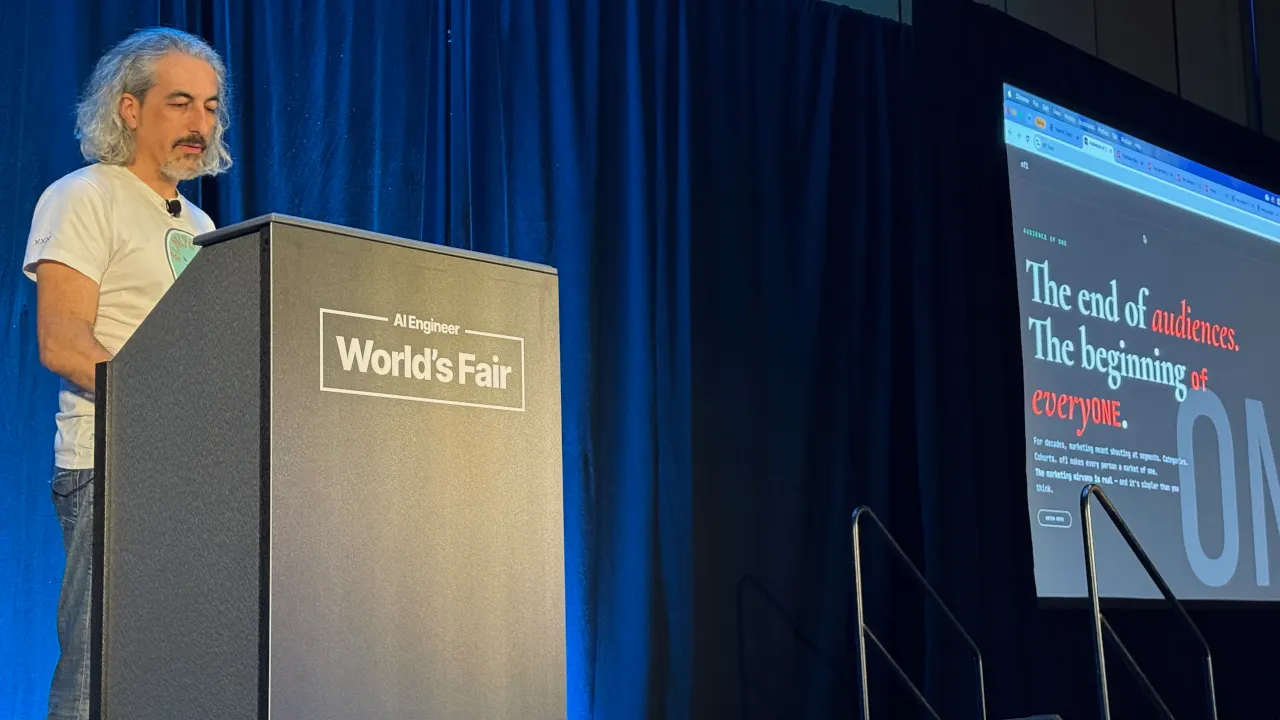
Think of a sales associate with a great memory and fast hands. Instead of handing you a few pre-printed brochures to choose from, they draft and print a version just for you, on the spot, based on what you just asked. Adobe calls this idea "audience of one" — the page differs per person, no longer slotting you into buckets like "women aged 25-34."
The same coffee-machine site, completely changed because you searched "camping"
In the demo, the system treats a visitor's browsing behavior and search terms as signals. On the same coffee-machine site, a regular visitor sees the standard homepage; a visitor who searched "camping" sees copy, product ordering, and recommendations all reorganized around the theme of "brewing coffee outdoors." The toggle below contrasts the two versions.
Same URL, same company — the tone of the copy, the products up front, and the recommendations below all shift to match the visitor's intent. The demo also has a second, more open-ended entry point: the visitor just types a query, and the page assembles itself around that sentence, live.
What we called "personalization" was really just picking from a menu
Sanchez says that after all his years running websites, "personalization" has always been an ideal — but in practice it basically meant one thing: choosing from a set of pre-defined options. A merchant recommends a product based on what you bought last time, or slots you into an audience segment and applies the matching version. That's it. Agentic sites swap out the very nature of this.
- Content is a fixed version written in advance
- Visitors sorted into a few preset segments
- One related product pushed from your last purchase
- Granularity stops at "segment," never "individual"
- The whole page is assembled live as you open it
- Serves only the one specific person in front of it
- Reorders copy, products, recs by current intent
- Granularity down to "audience of one"
How a page gets assembled on the spot
This is the core of the whole thing. The system first treats a visitor's browsing behavior and search terms as signals, sorts them into an intent category — exploring, researching, or ready to buy — then uses an AI to assemble a matching page from that intent. The key step sits in the middle: the AI doesn't invent content from nothing, it retrieves material from the company's existing content library and pieces it together.
Search terms
Explore / Research / Buy
content library
builds page
it to you
The company's existing on-site content is the "grounding corpus" for this system. Adobe's approach is to retrieve from that existing material and reassemble it, rather than have the AI fabricate an entire experience from scratch. Sanchez says this is done to keep generation quality under control. It's also why the system can hold hallucination risk down while keeping latency within 1-2 seconds and cost at a cent or two — because the job is "pick and assemble," not "write from scratch."
Intent classification is the pivot of this pipeline. The same person, in "just browsing" versus "ready to check out," gets a page whose center of gravity is completely different — the first spreads out the possibilities, the second heads straight for conversion. Three intents, three ways to assemble.
1-2 seconds, a cent or two: is this slow, is it expensive
For anyone doing AI engineering, the first wall live page generation hits is latency. Sanchez says Adobe evaluates models on more than accuracy — speed too: "We don't want a page to take more than a second or two to generate." He also gave a current cost estimate, and stressed the number only goes down.
"And our read is, it only gets cheaper," Sanchez says. "That's where it is today. Where it'll be in six months, who knows." With cost already down to a cent or two per page, "reshaping the page live for every visitor" is no longer something only the giants can afford.
Not actually live on customer sites yet
Adobe hasn't rolled this experience out at scale on customers' production sites. Sanchez says the company is currently pitching the concept to customers and looking for organizations willing to experiment. The first-choice setting is clear — e-commerce, because personalization ties directly to conversion rate. But he stresses the opportunity isn't limited to retail: "Any site that needs to lift conversion and has a whole range of user types or personas could use it."
The uncertainty is real too. Sanchez says plainly that he isn't sure agentic sites will become a widespread reality. He sums up building products in the AI era in one line: "With AI it's easy to build things, but hard to know what to build. We build it first, then go find the customers." Adobe isn't alone in this fog — site owners across the industry are right now weighing chat interfaces, structured content, generative UI, personal agents, and a pile of other new things, while also figuring out how to pull users back from third-party AI platforms to their own sites.
Web pages aren't just for people to look at anymore
Websites after 2026 have to serve more than human visitors. As personal agents get more capable, users may hand off a chunk of their buying and research entirely to an agent. And when that agent arrives at a site, the preferences it carries may be far richer than what the site could infer from cookies or recent browsing. Sanchez expects sites to evolve for both kinds of visitor at once.
But not every transaction gets the same degree of automation. A person might happily let an agent auto-reorder toilet paper — a low-stakes repeat purchase — but for a jacket, they'll probably still want to see the product themselves and make the final call. That means a site has to support varying degrees of "delegated authority," and can't treat "agentic commerce" as one uniform interaction mode. The spectrum below is the ground between those two ends.
Sanchez says it's still fuzzy whether sites will split into "two versions" — one for people, one for agents: "But clearly, you have to serve both sides."
The keys that open the door to agents
If a site has to serve both people and agents, it needs a set of interfaces that let agents get in and get things done. The original piece names three enabling technologies taking shape, each mapping to a different stretch of that spectrum and solving one problem.
Drops a site's interactive product experiences (configurators, visual product pickers) straight into the chat window the visitor is already using — no jump to the site. The human stays in the loop; the experience just moves into the conversation.
Lets a site actively package its own functions (order, look up, compare prices) as "tool interfaces" an agent can call directly, instead of the agent clicking buttons and filling forms like a person.
Lets the visitor's agent and the merchant's agent talk directly to close a deal, bypassing the human-facing web page entirely. This is the far right of the spectrum — the most automated end.
Sanchez says the end state might be a single site carrying both visual components and agent-callable tools, the two experiences coexisting — or a human-facing site paired with a set of agent-to-agent backend services. "This is still something everyone's working through," he says, "but one thing's for sure: there'll be an agent-facing direction." By his account, traditional websites probably won't disappear entirely, but their role will change: from a pile of fixed pages waiting for each visitor to browse, into a governed content-and-interaction system that assembles the right interface on demand. This is the direction Adobe is exploring.
Rather than a website being a set of fixed pages that every visitor navigates through, the "website" becomes a governed content-and-interaction system that assembles a suitable interface on demand. At least, that's the future Adobe is actively exploring. Carlos Sanchez / Richard MacManus, Latent.Space