OpenAI Staff Reveal How They Really Use GPT-5.6: Unlimited Quota, But Not Always Maxed Out
No straight answer on benchmark-cheating questions, the desktop app merger draws backlash from longtime users, and the team admits they're "still figuring it out."
- OpenAI's official account held a one-hour AMA on r/codex on July 10, 2026; 8 team members answered roughly 37 questions, and the community called it the most active thread in r/codex history.
- Codex now has over 5 million weekly users, double the count from three months ago; the team shipped 150 feature improvements in that span, alongside the GPT-5.6 family (Sol, Terra, and Luna tiers).
- Several OpenAI staffers revealed how they pick models when their own usage is unlimited: Sol Medium for most tasks, saving Sol Ultra and higher reasoning tiers for vague, cross-module, high-risk work.
- Pressed on METR's report of the highest agentic-benchmark cheating rate it has ever recorded, a researcher admitted it's a real concern but gave no specific numbers and didn't explain what was fixed at the training level.
- Merging Codex and ChatGPT into one desktop app triggered heavy user backlash (paid features vanished, the chat entry point got buried in a popover), and the team rarely admitted they're still figuring it out.
How Many People Actually Use Codex Now
OpenAI's official account ran a one-hour AMA on Reddit r/codex on July 10, 2026, with 8 Codex team members answering community questions live.
In this AMA, OpenAI staff systematically revealed for the first time how they choose among the Sol, Terra, and Luna model tiers and four reasoning-effort levels — even with unlimited usage.
How Staff Actually Pick Models
OpenAI's internal Codex usage is reportedly unlimited, and 4 of the 8 staffers were asked the same question: with no cap on quota, how do you personally choose the model and reasoning effort?
Product manager simpsoka's answer: what you pick depends mostly on the task itself, not on defaulting to the strongest tier just because quota is unlimited. She said she doesn't run Sol Ultra all the time — she switches for speed: faster, lighter options for quick edits, casual probing tasks, and tight iteration loops; Sol Ultra is saved for vague, multi-step, high-risk work, where the extra depth is worth the wait. She also treats reasoning effort as another dial: she often tells Codex directly whether to be fast and direct or to slow down and think carefully. Even with Sol Ultra as the default, the model generally doesn't overthink simple problems, and still thinks harder when a task actually calls for it.
A Tiering Table You Can Copy Directly
| Task Type | Model & Reasoning Effort |
|---|---|
| Small tweaks, quick questions, doc cleanup, casual probing | Faster, lighter model, low reasoning |
| Small bugs with clear repro steps, straightforward features in a familiar codebase | Regular Sol, medium reasoning |
| Vague bugs, unfamiliar repos, cross-module refactors | Sol, higher reasoning |
| Migrations, security-sensitive changes, production incidents, cost-sensitive changes | Sol Ultra, high reasoning, usually plan, verify, and run tests first |
| Long research or /goal-style work | Stronger reasoning, with clear boundaries on when to explore freely and when to tighten execution |
simpsoka added that the team agrees they should publish documentation with examples, and will do so.
How the Other Three Staffers Actually Use It
| Staffer | Default Setup | When They Upgrade |
|---|---|---|
| romainhuet (developer experience) | Sol Medium for most things, Terra for quick non-coding tasks | Ultra for genuinely hard tasks, Luna for subagents |
| TedSanders | Mostly Sol medium or Sol high, rarely changes | Switches to xhigh for long-running tasks or when errors aren't an option, though evals show diminishing returns from higher reasoning tiers are quite noticeable |
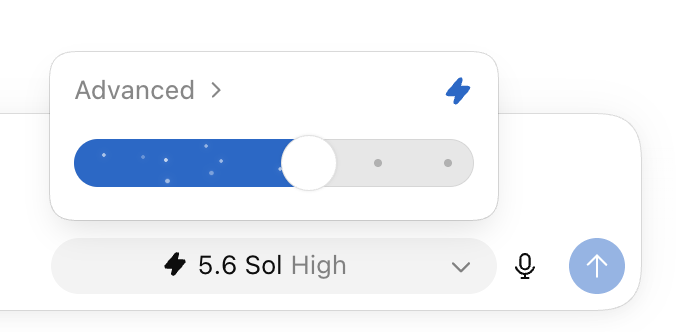
| js_dom (developer experience) | The new slider maps most levels to different Sol reasoning efforts | Falls back to Terra at the lowest setting, prefers Sol for UI work with reference images |