Cloudflare launches an automatic payment gateway: when AI crawls your web pages or APIs, it can now pay you automatically
- Cloudflare announced the "Monetization Gateway," letting customers charge for their web pages, data, API endpoints, and AI tool calls — pay-per-use, not a monthly subscription.
- How the payment works: when an AI wants to use your resource, it first gets a "payment required" prompt with a quote, automatically pays, then re-requests with a "proof of payment" credential — once verified, the request goes through. For example, an AI booking flights for you pays $0.01 to check flight-delay data, all done automatically, with no account registration needed upfront and no payment system for you to build.
- Settlement runs on stablecoins (like USDC); Cloudflare says it can achieve sub-second settlement. Verifying whether payment actually went through happens nearby, on Cloudflare's servers across 330+ cities worldwide, with no need to route around the world.
- You decide how to charge: set prices per endpoint, charge variable rates based on task complexity, or charge only unauthenticated visitors — configurable with a few clicks in the dashboard or a few lines of config code.
- This payment protocol isn't Cloudflare's alone — it's being built together with 25+ industry partners. The Monetization Gateway is currently in waitlist stage, not yet open to everyone.
What Cloudflare just announced
On July 1, 2026, Cloudflare announced the Monetization Gateway, a gateway that lets customers charge for any web page, dataset, API, or MCP tool call protected by Cloudflare. Payment runs through an open protocol called x402, settled in stablecoins (such as USDC).

Humans vs. AI crawlers — who's actually consuming your content
For 30 years, the web ran on a simple exchange: content for human attention, monetized through ads, subscriptions, and e-commerce. As AI agents become the web's primary visitors, that exchange is breaking down. Agents don't look at ads, and they won't sign up for a monthly subscription for every tool they want to use once — they read a page or data source once, take what they need, and leave.
By Cloudflare's own data, across the web, for every one human visitor a site gets back, AI crawlers scrape its content anywhere from a hundred to tens of thousands of times. The old attention-based model barely holds up against this kind of one-off, non-returning traffic — the unit of charging needs to shift from "a month" or "a seat" to "a request," "a token," "a result."
Why pay-per-use never worked before
The idea of pay-per-use billing has been around for a while, but it's always run into two real obstacles.
Traditional payment rails can't handle transactions of a few cents or less — the cost of collecting the payment exceeds the payment itself, and settlement isn't fast enough. Below a certain amount, it costs more to collect the money than the money is worth.
Companies wanting usage-based billing effectively have to turn themselves into half a payments company, building out an entire stack for usage tracking, billing, and reconciliation — a costly backend overhaul. Many companies opted for the simpler, often more profitable route of charging per seat instead.
Cloud services and APIs have long sold by the call or by the hour, but only to "known buyers": users register first, get an API key, then get billed by usage. Content mostly skipped payment altogether and ran on ads. There's never been a good rail for small charges to anonymous callers.
How payment gets completed inside a single HTTP request
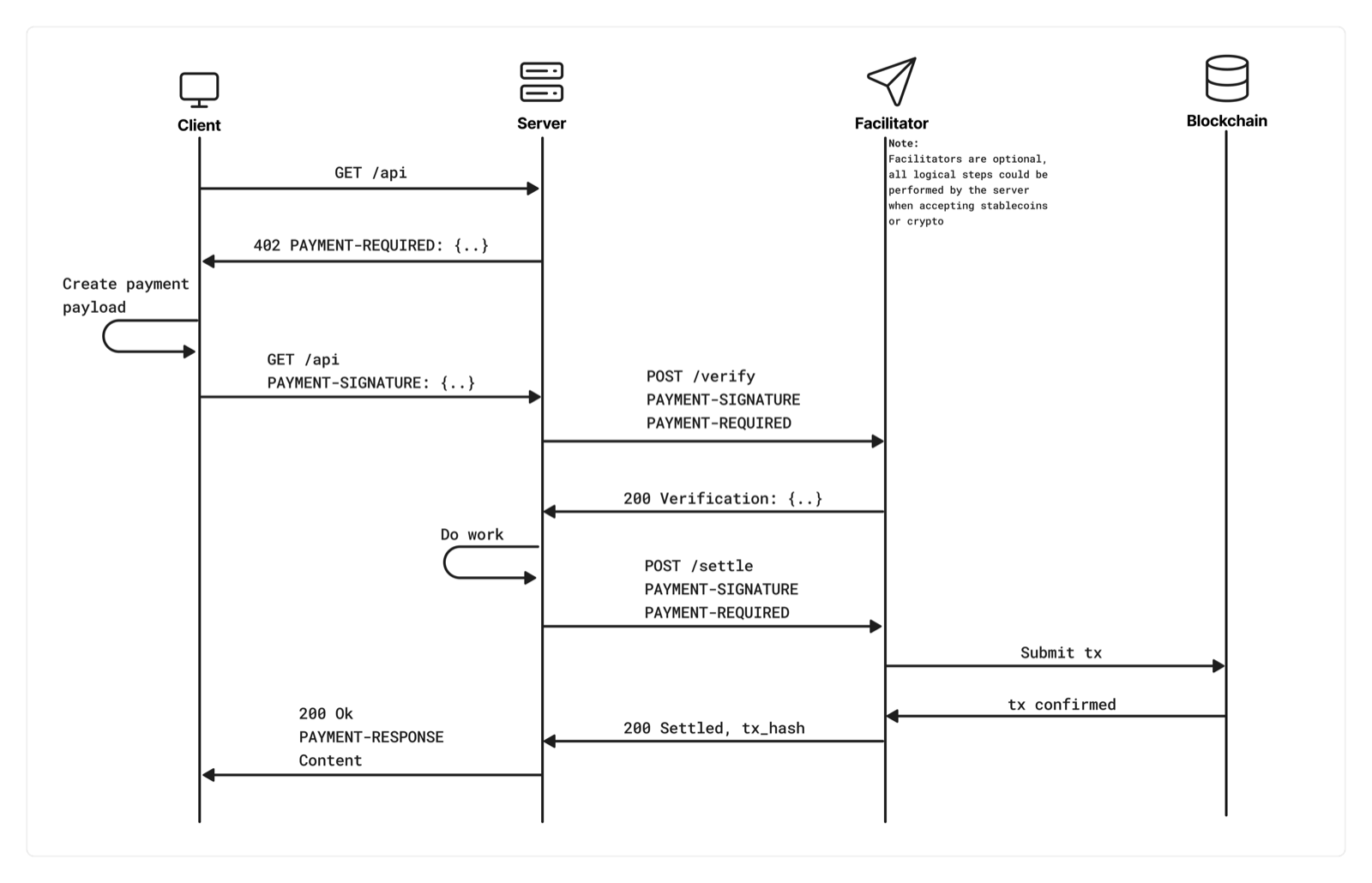
The core innovation that finally makes pay-per-use work is an open protocol called x402. It embeds payment directly into an ordinary web request, completing the whole thing within one HTTP request-response cycle.
x402 reuses an HTTP status code almost nobody uses — 402 (Payment Required) — which is where the protocol gets its name. The payment flow runs through ordinary HTTP request-response, without redirecting to a separate checkout page or calling a separate payments API.
Here's a concrete example: say there's a customer-service AI agent booking you a flight, and it needs to check "real-time flight delay" data — a site that charges $0.01 per lookup. It and the site complete both "fetching the data" and "paying for it" in a single ordinary web request:
See what these four steps look like at the HTTP level
① Agent sends request
GET /flight-delay?flight=CA981 HTTP/1.1

② Site requires payment, attaches quote
HTTP/1.1 402 Payment Required
{
  "price":  "0.01",
  "asset":  "USDC",
  "payTo":  "0x…(site's wallet address)"
}

③ Agent pays, resends with proof attached
GET /flight-delay?flight=CA981 HTTP/1.1
X-Payment: <PAYMENT_PROOF>

④ Facilitator verifies, returns data
HTTP/1.1 200 OK
{"flight": "CA981", "delay_minutes": 40}
Fields are illustrative — actual price/currency/payment-address formats follow the official spec.
A bit like a subway's contactless turnstile: tap once (a request carrying the proof) and it auto-deducts and lets you through — no pulling out your wallet, no queueing to buy a ticket, no jumping to a separate checkout window.
Two unfamiliar roles show up here — worth explaining each. First is the facilitator (payment verifier): the third party in the x402 flow that confirms "this payment actually went through." After the buyer pays, the facilitator checks whether the proof is valid; only once verified does the server release the resource. It never handles the money itself.
Similar to customs checking paperwork: it never touches the money, only verifies the documents are in order.
Second is peer-to-peer settlement: the money the buyer pays goes directly into the seller's own wallet, with no bank, platform account, or batch-clearing step in between — which is how it achieves near-real-time settlement. Cloudflare says the design targets sub-second settlement.
What charging rules can Monetization Gateway actually set
At the product level, Monetization Gateway provides a flexible rules interface for specifying exactly which traffic needs to pay. Rules are written similarly to other expression-based rules in Cloudflare — configurable via the dashboard, the API, or Terraform (a tool for managing configuration as code) — turning a paid endpoint into part of your infrastructure config. The official post gives three planned capability examples.
Require payment for requests to a given URL path. For example, charge $0.01 for every read (GET) or submit (POST) to /api/premium/*.
Charge variable rates based on task complexity. For example, price image generation by compute consumed, up to $2.
Intercept a 401 (Unauthorized) returned by the origin (your own server actually holding the data and running the service), and rewrite it as 402 (Payment Required), with a price and payment instructions attached.
What this gateway ultimately does is move billing and payment verification from the origin server to Cloudflare's edge.
The origin has to build its own account system, billing system, and payment integration, overhauling the backend to charge by usage — and absorb the load of high-concurrency payment traffic itself.
Billing and payment verification move to Cloudflare's edge (330+ cities), handled nearby — the handshake happens closest to the buyer, cutting latency and shielding the origin, which only needs to set prices and write rules.
Why stablecoins are doing the heavy lifting here
Charges here go as low as a few cents or even fractions of a cent — not worth collecting through traditional payment rails. Stablecoins fill that gap.
Stablecoins (such as Open USD, USDC) can move tiny amounts of money online with near-zero fees, settling in under a second — something traditional payment rails can't do today. x402 itself is payment-rail-agnostic, a natural fit for stablecoins, and comes with no chargebacks.
Worth clarifying one more thing: x402 is an open protocol, co-built by Cloudflare together with 25+ industry partners through the x402 Foundation (hosted under the Linux Foundation), with the earliest reference implementation on GitHub coming from Coinbase. It is not Cloudflare's private, proprietary protocol.
What developers and creators actually save — and gain
Bringing the mechanism and settlement details above back to one question: what do you actually get from using this. Per the original post, three main things.
- Service providers (websites, APIs, MCP services) don't need to build their own billing and payment-collection systems — they just write rules and set prices inside Cloudflare, with revenue landing directly in their wallet as stablecoin, tradeable or convertible to fiat at their discretion.
- Callers (including AI agents) don't need to register an account or get an API key upfront — the payment itself serves as the access credential, suited to use cases previously abandoned because the amount was too small for traditional rails to collect economically (say, a few cents per call).
- Creators and small API providers get a new charging channel — calls that almost nobody used to pay for can now be auto-charged; layered with Web Bot Auth (Cloudflare's identity-verification mechanism for confirming "is this visitor really the AI it claims to be"), it can verify caller identity at the same time it prices the call.
Can you actually use this right now
Worth flagging: Monetization Gateway is currently in waitlist opening stage, open for applications to existing Cloudflare customers.
The original post consistently describes features in future tense ("will give / will provide / will scale") — these capabilities are still being built and rolled out, not yet a fully shipped, mature product, and there's no public pricing page. Customers wanting to charge by usage for their web pages, datasets, APIs, or MCP tools can join the early access list.
If this rolls out widely, how would money flow across the internet
Setting aside the current stage and the near-term benefits, Cloudflare paints a bigger vision.
Agents are software acting autonomously on a user's behalf, and they're starting to carry their own wallets online, paying for datasets, API calls, tools, and compute without a human in the loop. Some resources are free, some require verifying "who you are" (identity) first, and many require both. Cloudflare positions itself as one of the few pieces of infrastructure that can complete both identity verification (potentially combined with Web Bot Auth) and payment verification within a single request, then pass it through to the origin — turning the request itself into a transaction.
Metering, payment exchange, and settlement all move away from your origin — what stays with you is what matters: your rules, your prices, your revenue. All you need to do is write a rule, and wallet-carrying agents will pay for whatever they use. Cloudflare Blog, "Announcing the Monetization Gateway"